

More news on this day
Ho Chi Minh City is moving ahead with an ambitious metro and rail blueprint that would connect its main transport hubs with the soon-to-open Long Thanh International Airport by 2030, as Vietnam courts investors from the United States and France for what officials describe as a transformative 13 billion dollar urban mobility program.
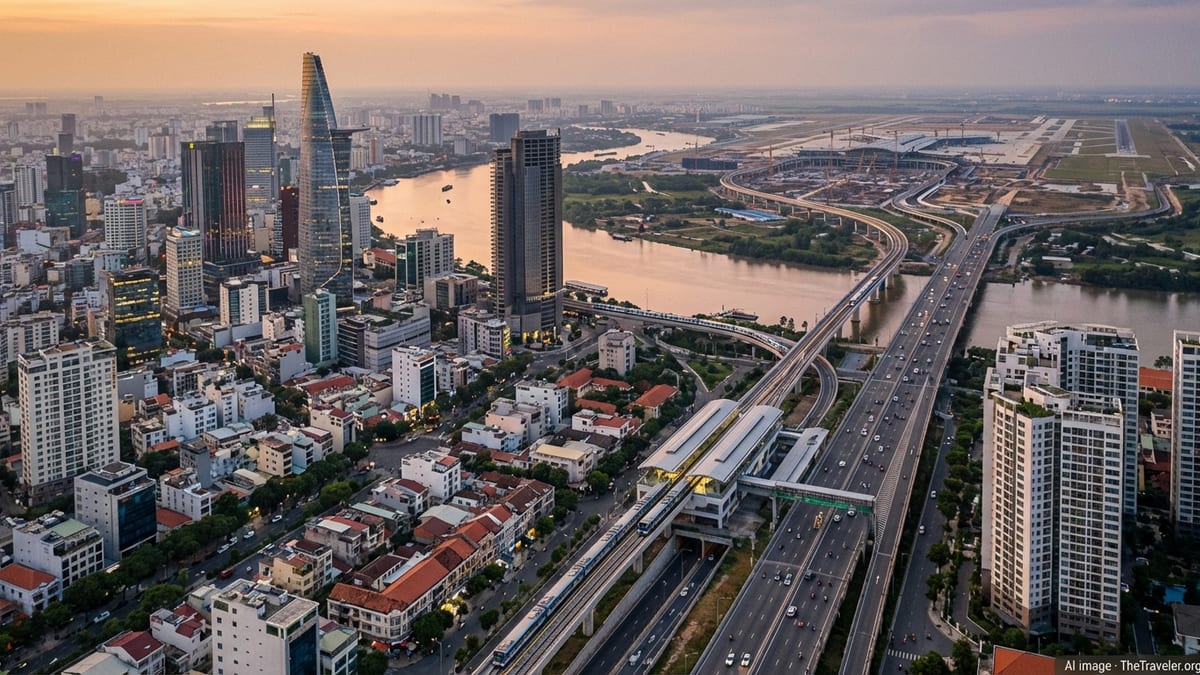
A New Global-Scale Airport Demands New Links
Long Thanh International Airport, located around 40 kilometers east of central Ho Chi Minh City in Dong Nai Province, is slated to take over most of southern Vietnam’s international traffic from mid-2026. National authorities have confirmed that the first commercial operations are scheduled to begin next year, after technical flights later in 2025, positioning Long Thanh as Vietnam’s primary gateway for long-haul routes across the Asia Pacific and to North America and Europe.
Plans call for Long Thanh to eventually handle tens of millions of passengers annually, relieving severe congestion at Tan Son Nhat International Airport, which currently manages both domestic and international flights far above its designed capacity. To unlock the new hub’s full potential, however, planners and transport experts have repeatedly warned that roads alone will not be sufficient, citing chronic bottlenecks on the Ho Chi Minh City–Long Thanh–Dau Giay Expressway even before the airport opens.
In response, central and city governments have elevated a coordinated rail and metro strategy to top priority, reclassifying the Thu Thiem–Long Thanh corridor as an urban rail line and handing more planning authority to Ho Chi Minh City and Dong Nai. The goal is a multimodal system that can move passengers quickly between the city’s core business districts, its existing aviation hub at Tan Son Nhat, and the new airport without forcing travelers back onto clogged highways.
Officials say this framework, with a target opening for the core rail link in 2030, has become a flagship opportunity for international partners including the United States and France, both eager to expand infrastructure cooperation with Vietnam.
The 13 Billion Dollar Metro Vision
At the heart of the emerging proposal is a package of urban rail projects anchored by Metro Line 2 and the Thu Thiem–Long Thanh rail link. City planners describe a spine that would run from Tan Son Nhat International Airport through dense inner districts to Ben Thanh, Ho Chi Minh City’s central metro interchange, before continuing east to Thu Thiem and on to Long Thanh International Airport.
The Ben Thanh–Tham Luong section of Metro Line 2, running roughly 12 kilometers northwest from the city center, has entered final preparation stages with a view to starting major construction in 2025. Key sections of the line are expected to be completed by the end of the decade, forming a critical connector between residential districts and the central business area. East of downtown, the Ben Thanh–Thu Thiem stretch, designed as an underground tunnel beneath the Saigon River, is planned to tie the historic core to the fast-growing Thu Thiem urban district.
From Thu Thiem, a separate but integrated light rail or metro line would continue along the Ho Chi Minh City–Long Thanh–Dau Giay Expressway and Ring Road 3 toward Dong Nai, then follow a corridor parallel to Provincial Road 25B into the airport precinct. Current planning documents describe a double-track line of around 40 to 48 kilometers, built to standard gauge and designed for speeds of up to 120 kilometers per hour, with commercial services targeted to begin in 2030.
Local media and policy analysis estimate that fully realizing this airport rail spine, together with associated metro branches, depots, power systems and station-area developments, could involve as much as 13 billion dollars in investment when land, technology, rolling stock and financing costs are all factored in. Vietnamese officials have signaled that public funds, domestic private capital and international partners will all be required to close the gap.
US and French Interest in Vietnam’s Urban Rail Boom
The scale and complexity of the Long Thanh corridor have drawn attention from overseas governments and investors, particularly in the United States and France, both of which have signaled interest in supporting Vietnam’s metro build-out through technology cooperation, export finance and private investment platforms. Washington has identified sustainable infrastructure as a pillar of its economic engagement in Southeast Asia, while French companies bring decades of experience in metro systems from Paris to Hanoi and Ho Chi Minh City itself.
In recent years, US agencies have expanded tools that can back privately led rail and airport connectivity projects, including long-term loans and risk guarantees aimed at mobilizing institutional capital into emerging market infrastructure. Analysts say a well-structured public private partnership for the Thu Thiem–Long Thanh line could be a candidate for such support if Vietnam can finalize a transparent regulatory framework and bankable project structure.
France, already a key partner in Ho Chi Minh City’s Metro Line 1 and in Hanoi’s urban rail development, is seen as another natural player. French engineering, rolling stock and signaling firms have actively pursued opportunities in Vietnam, and Paris has promoted green transport as a priority area in its broader relationship with Hanoi. Industry observers expect French contractors and financial institutions to be among those exploring roles in design, supply and possibly co-financing of the new lines.
Vietnamese officials have framed the metro program as part of a wider shift toward climate-resilient, low-carbon transport in one of Asia’s fastest-urbanizing regions. By aligning the Long Thanh rail plan with international climate finance and sustainable transport agendas, they hope to tap into a growing pool of green capital from development banks and institutional investors based in the United States, France and beyond.
From Congested Roads to Seamless Transfers
Today, the main route from central Ho Chi Minh City to the Long Thanh site is the Ho Chi Minh City–Long Thanh–Dau Giay Expressway, a highway that has become notorious for long queues of trucks, buses and private cars during peak hours. To ease the strain, authorities are pushing ahead with a multibillion-dollar expansion to eight or ten lanes, new bridge corridors and feeder roads across Dong Nai Province, much of which is scheduled to come on line around the time Long Thanh begins operations.
Even with this expanded road network, planners emphasize that a high-capacity rail link is essential for both passenger convenience and the airport’s long-term competitiveness. Once the metro and light rail elements are in place, travelers arriving at Tan Son Nhat for domestic flights would be able to transfer by metro to Ba Queo station, journey to the central Ben Thanh interchange, and continue via Thu Thiem onto a dedicated airport rail service to Long Thanh, all without stepping into street traffic.
Preliminary journey time estimates suggest that a nonstop or limited-stop service from central Ho Chi Minh City to Long Thanh could take as little as 20 to 25 minutes, compared with 40 minutes or more by expressway in uncongested conditions, and significantly longer in heavy traffic. For time-sensitive international connections and business travel, this difference could prove decisive in shifting passengers away from private vehicles and airport-bound ride-hailing services.
Beyond convenience, the metro network is central to a broader transit-oriented development strategy along the Thu Thiem–Long Thanh corridor. City planners envision dense, mixed-use clusters around major stations, combining housing, commercial space and public services that can absorb a growing urban population while limiting sprawl and car dependency. Success, they say, will depend on tight coordination among transport, planning and finance agencies as well as international technical partners.
Risks, Timelines and the 2030 Test
While the political will behind the Long Thanh rail corridor is clear, significant challenges remain. Land acquisition, a chronic bottleneck in large Vietnamese infrastructure projects, must be managed carefully to avoid delays and cost overruns. Officials also need to finalize the choice of technology, operating standards and institutional responsibilities between Ho Chi Minh City, Dong Nai Province and central ministries.
Financing structure is another open question. Analysts note that a 13 billion dollar metro and rail program, if confirmed, would be among the largest urban transport investments in Southeast Asia. To make it viable, Vietnam will likely need a blend of sovereign borrowing, public private partnerships, export finance from countries such as the United States and France, and potentially green bonds tied to climate and air quality benefits.
Authorities have begun to compress preparatory timelines by taking advantage of new legal mechanisms that allow faster approval for strategic rail projects. Key documents for the Thu Thiem–Long Thanh line are expected to be reviewed by national lawmakers in the coming years, clearing the way for groundbreaking in the second half of this decade. If construction can start by around 2026 and maintain momentum, the 2030 target for initial commercial services remains within reach, though experts caution that it will require disciplined project management.
For travelers, the stakes are straightforward. If the metro and airport rail links open on schedule, Ho Chi Minh City could offer one of Southeast Asia’s most integrated air-rail systems by the end of the decade, reshaping how residents and visitors move between city center, suburbs and international flights. If delays mount, Long Thanh may open as a modern airport reached primarily by crowded highways, leaving Vietnam to play catch-up as rivals in the region race ahead on high-capacity public transport.