

More news on this day
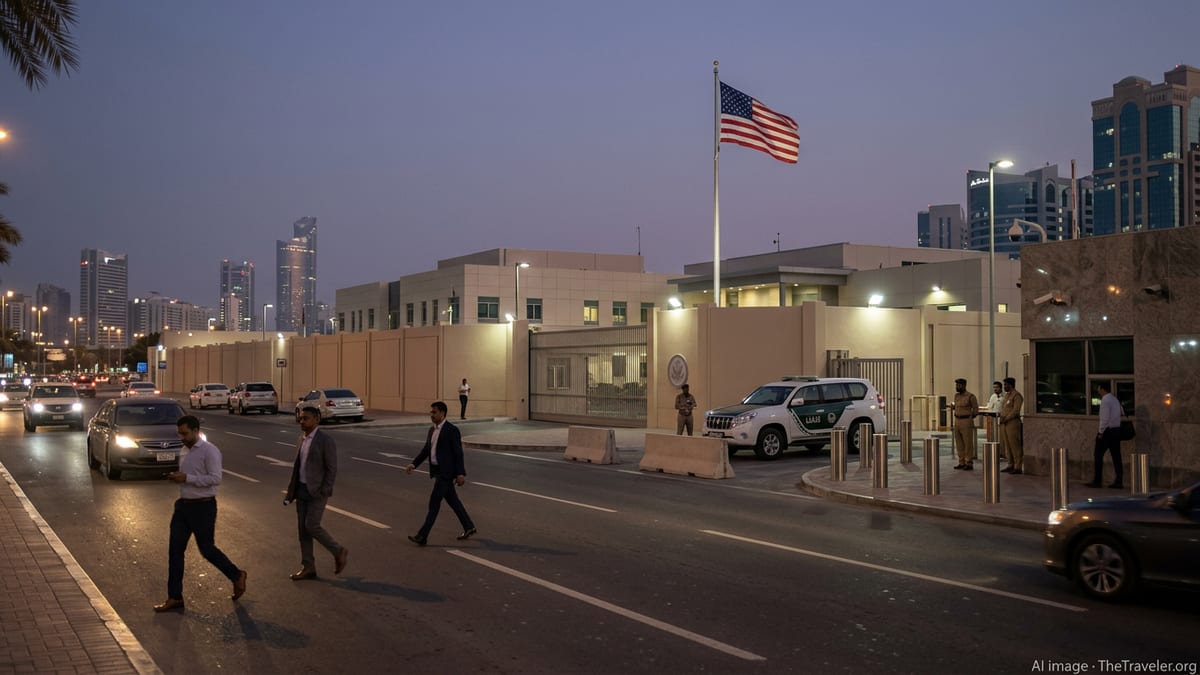
The United States Embassy in the United Arab Emirates has issued a heightened security alert for American citizens as intensifying conflict between Iran, the United States and Israel triggers missile and drone activity across the Gulf, flight disruptions and fresh questions about how safe it is to travel to and transit through one of the world’s busiest aviation hubs.
What the New U.S. Security Alert Actually Says
The latest alert, issued in early March and updated as recently as March 6, advises U.S. citizens in the UAE to be prepared for rapidly changing security conditions and to follow instructions from local authorities and the embassy. The notice comes as Washington has ordered the departure of non‑emergency U.S. government personnel from the country due to the increased threat of armed conflict and possible attacks on U.S. and allied interests.
The State Department has urged Americans to reconsider non‑essential travel to the UAE and to have contingency plans for sheltering in place or leaving on short notice. It is directing U.S. citizens across the region, including in the Emirates, to enroll in the Smart Traveler Enrollment Program so they can receive real‑time alerts on their phones and email.
For those already in the country, the embassy is encouraging travelers and residents to identify the nearest safe rooms or interior areas in homes and hotels, to keep copies of passports and important documents in both digital and physical form, and to maintain a supply of food, water and key medications in case movement is restricted after an attack.
In parallel, a worldwide caution issued by the State Department on February 28 underscores that Americans across the Middle East should be guided first and foremost by the specific messages coming from the nearest U.S. embassy or consulate, highlighting how fluid the situation has become.
Why the UAE Is on Alert Despite Business as Usual
The UAE has long promoted itself as a secure, reliably stable hub in a volatile region, but its geography places it close to the heart of the current confrontation. Following U.S. and Israeli strikes on Iran at the end of February, Iranian forces and allied militias have launched waves of drones and missiles across the Gulf, targeting bases, infrastructure and locations associated with Western interests.
Emirati air defenses have intercepted multiple drones and missiles headed toward the country in recent days, according to local statements, and authorities say they remain fully prepared to counter additional threats. While many projectiles have been shot down, videos shared on social media and in regional press show smoke plumes near ports and urban areas, underlining that even near‑misses can feel unnervingly close.
Officials in Abu Dhabi and Dubai insist that daily life continues largely as normal, with public services open and core tourism infrastructure functioning. At the same time, several major attractions, including popular leisure venues in Dubai, have closed temporarily as a precaution, and foreign embassies from multiple countries have activated crisis units or scaled back in‑person consular work.
The UAE government has publicly called for restraint and renewed diplomacy while stressing that it has not allowed its territory or airspace to be used for offensive operations against Iran. Nonetheless, the fact that it hosts key logistics, energy and transport assets keeps it firmly within the envelope of regional risk calculations.
Impact on Flights, Transit and Travel Plans
The most visible effect for travelers has been in the air. After initial barrages of drones and missiles, airspace closures and temporary suspensions of flights rippled across the Gulf, forcing Emirates, Etihad and other carriers to halt or reroute services for several hours at a time. Some airlines have offered flexible rebooking and cancellation options for passengers flying to and from the Middle East in March.
Dubai International Airport, normally one of the world’s busiest transit hubs, has managed to keep a large number of flights operating, but schedules have been volatile, with clusters of cancellations followed by surges in departures as windows of safe airspace reopen. Travelers connecting through Dubai or Abu Dhabi are being advised to build in extra time, stay in close contact with their airline and monitor airport announcements in case of sudden gate or timing changes.
For now, Emirati authorities emphasize that safety protocols at airports remain robust, with reinforced air‑defense postures and close coordination with international aviation regulators. However, security experts caution that further escalations in the Iran conflict could prompt broader, longer airspace restrictions, potentially affecting not just point‑to‑point trips to the UAE but also long‑haul itineraries between Europe, Asia and Africa that rely on Gulf stopovers.
Travel insurers are watching the situation closely, and some policies may classify elements of the conflict under war or force majeure exclusions. Travelers are being urged to read the fine print of any policy before departure and, where possible, to consider coverage that explicitly addresses disruption linked to political violence.
Practical Safety Guidance for Americans in the UAE
Security professionals and diplomatic sources say that for most people in the Emirates, the immediate risk remains low but not negligible. While the likelihood of being directly affected by a strike is still small, the embassy’s messaging reflects concern about secondary effects such as debris, traffic disruption, and localised panic if sirens sound or interceptions occur overhead.
Americans in the UAE are being encouraged to identify multiple routes between home, hotel and key locations, in case certain roads close without notice. They are also advised to avoid non‑essential visits to government buildings, foreign diplomatic compounds and large demonstrations, which could attract hostile attention during periods of heightened tension.
Inside hotels and residential towers, basic precautions include knowing where internal stairwells and emergency exits are located, staying away from exterior windows during any alerts, and following broadcast instructions from building management. Travelers should keep phones charged, turn on roaming if needed to receive alerts, and save local emergency numbers, including police and ambulance services.
The embassy additionally stresses the importance of maintaining a low profile. That means limiting visible displays of nationality, being discreet when discussing politics in public places and steering clear of photographing sensitive infrastructure such as ports, power stations and military facilities, which can draw scrutiny even in calmer times.
What This Means for Future Trips to Dubai and Abu Dhabi
For would‑be visitors looking ahead to spring and summer trips, the picture is mixed. On one hand, the UAE’s security architecture, from missile defenses to rapid‑response police units, has been significantly strengthened over the past decade, and authorities have demonstrated an ability to restore operations quickly after incidents. Many hotels report that current guests are choosing to stay and adapt their plans rather than leave immediately.
On the other hand, the strategic stakes of the Iran conflict and the direct involvement of U.S. forces mean that embassies are taking a more conservative line than during previous flare‑ups. The State Department has not yet imposed a full travel ban on the UAE, but the combination of worldwide caution notices, ordered departures of some U.S. staff and the new security alerts signals that conditions can change rapidly.
Travel analysts say demand for leisure trips to Dubai and Abu Dhabi is likely to soften in the short term, especially from North America, as airlines and tour operators weigh capacity cuts and some corporate travel managers temporarily pause non‑essential travel. At the same time, the UAE’s role as an aviation crossroads and business hub means a complete halt in travel is unlikely unless the conflict spreads substantially.
For now, the clearest message from U.S. and Emirati officials alike is that anyone planning to travel to or through the UAE should stay closely informed, build flexibility into their itineraries and be ready to change plans quickly if the security picture shifts again.