

More news on this day
Washington is racing to expand evacuation flights for Americans stranded across the Middle East, as the fast‑escalating U.S.-Israel conflict with Iran closes airspace, cripples commercial links, and triggers the largest U.S. civilian drawdown from the region in decades.
State Department Scrambles to Secure Aircraft
U.S. officials in Washington said on Tuesday that the State Department is working with the Pentagon and private carriers to secure a mix of military and charter aircraft to move citizens out of the most volatile hotspots. A senior public affairs official said the department is in direct contact with roughly 3,000 Americans who have asked for help or information on how to depart, a figure that is expected to rise as communications improve and security conditions deteriorate.
The push comes after days of criticism from lawmakers and stranded travelers who say they were told to leave immediately but given few practical options as airlines canceled routes and several governments closed their skies. Officials acknowledge that, so far, most Americans have been forced to piece together their own escape routes via scarce commercial seats or overland journeys to still-functioning hubs.
In internal planning, evacuation flights are being prioritized for citizens in countries facing active missile and drone attacks or significant damage to critical infrastructure. Limited capacity, however, means that early flights are likely to focus on medical cases, families with young children, and those who lack the financial means to purchase commercial tickets.
Diplomatic sources in Washington describe the operation as the most complex noncombatant evacuation effort since the Iraq war, involving multiple air forces, civil aviation regulators, and regional partners trying to keep corridors open long enough for flights to land and depart safely.
Airspace Closures Choke Off Commercial Options
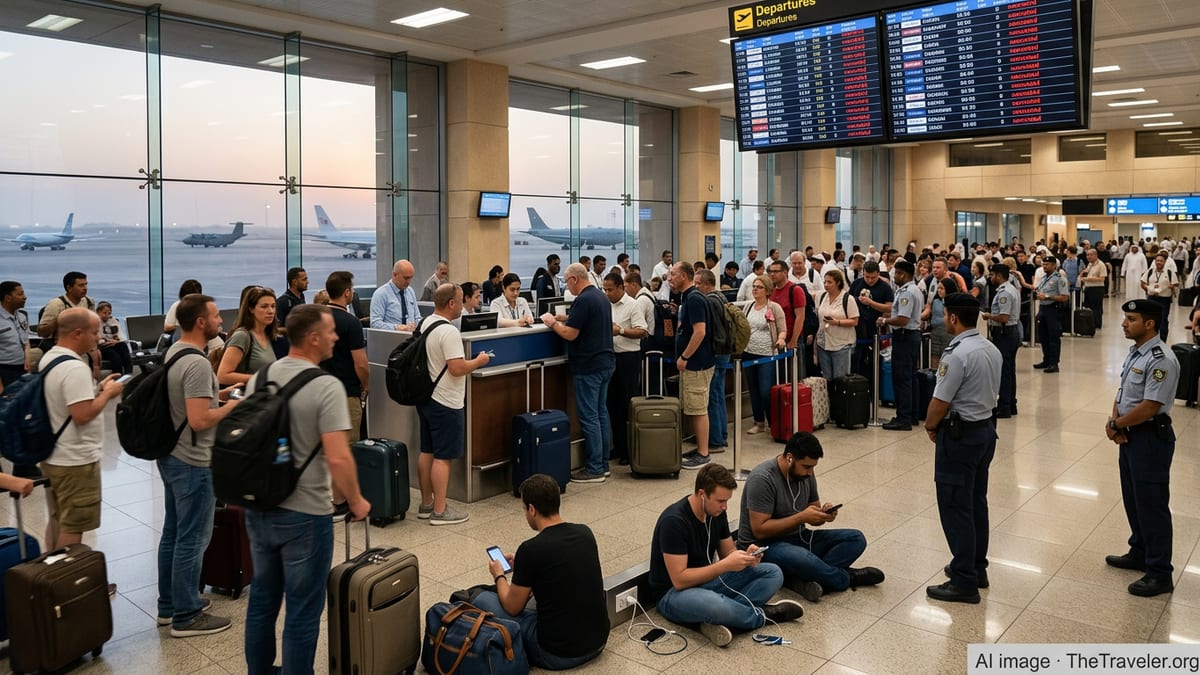
The deteriorating security picture has quickly translated into a severe aviation crunch. Since the joint U.S.-Israeli strikes on Iran began over the weekend, thousands of flights to and from the region have been canceled, leaving airport terminals crowded with travelers facing indefinite delays and rapidly changing information screens.
At least eight countries, including Kuwait, Bahrain, Qatar, and Israel, have temporarily closed some or all of their airspace, according to flight tracking data. Even in states that remain open, carriers have trimmed schedules, rerouted around suspected conflict zones, and shifted crews out of the region, sharply reducing available seats for those trying to leave.
The bottlenecks have pushed some Americans to head for alternative gateways, such as airports in Egypt and the United Arab Emirates, where a limited number of repatriation and regular commercial flights are still departing. Travel agents in Washington and New York report a surge in last-minute bookings and one-way fares posting at several times their usual price as demand far outstrips supply.
U.S. officials concede that evacuation flights alone cannot meet the immediate need and are urging citizens still able to travel safely to continue pursuing any viable commercial route, even if it involves circuitous itineraries through third countries in Europe, Africa, or South Asia.
Americans Caught Between Warnings and Limited Help
The scramble for seats comes after the State Department issued an unusually sweeping advisory on Monday telling U.S. citizens to depart immediately from more than a dozen Middle Eastern countries and territories, including Iran, Iraq, Israel, the Palestinian territories, Saudi Arabia, the United Arab Emirates, and Yemen. Officials cited “serious safety risks” linked to missile and drone attacks, unrest near diplomatic compounds, and the potential for further military escalation.
For many on the ground, the warning landed at a moment when flights were already disappearing. In several capitals, U.S. embassies have reduced staff or temporarily closed to the public following direct or attempted strikes nearby, limiting in-person consular services. In some locations, messages from posts have emphasized that missions are not currently able to organize local evacuations or provide transportation to airports or border crossings.
The gap between the urgent call to leave and the lack of immediate, visible government assistance has fueled anger from members of Congress, who accuse the administration of failing to anticipate how quickly civilian travel would collapse. Lawmakers from both parties are pressing the State Department to publish clear timetables and criteria for evacuation flights, and to ensure that costs do not become a barrier for families seeking safety.
Behind the scenes, consular staff in Washington and at remaining open posts are fielding a flood of registration forms, phone calls, and messages through the Smart Traveler Enrollment Program and newly created digital channels. Officials say these lists will be central to assigning seats once evacuation aircraft begin operating from designated hubs.
Regional Hubs and Overland Escape Routes
With direct flights halted in some of the most affected countries, attention in Washington has shifted to building a network of regional exit points where evacuation flights can safely land. Diplomatic and aviation negotiations are underway with governments in North Africa, the eastern Mediterranean, and the Gulf to secure time-limited landing rights, ramp space, and security support.
Americans in higher-risk areas are being encouraged, where conditions permit, to move overland toward these prospective hubs, often by private car, chartered buses, or local carriers still operating shorter domestic legs. U.S. officials stress that any such movement is voluntary and must be based on a realistic assessment of local security, roadblocks, and curfews, conditions that can change from hour to hour.
Travelers who do manage to reach safer airports face additional screening and longer check-in times as authorities heighten security around terminals and restrict access roads. Humanitarian organizations working in the region warn that families with elderly relatives, young children, or disabilities may find these journeys particularly challenging and could require priority access to any government-organized flights.
Hotel operators and tourism boards in secondary hubs report a sudden influx of transit passengers, many of them Americans and other foreign nationals who expected short layovers but are now bracing for multi-day stays while they wait for flight slots to open. Local tourism industries, already strained by cancellations, are simultaneously providing an improvised safety net of lodging and ground transport.
Travel Disruption Reverberates Through Tourism and Business
The disruption is hitting the region’s tourism and aviation sectors just as they were entering a traditionally busy spring season. Popular destinations in the Gulf and along the eastern Mediterranean have seen package tours suspended, cruise itineraries reshaped, and major conferences postponed as corporate travel managers enact blanket bans on nonessential trips.
In Washington, travel analysts say that the sudden drop in Middle East capacity is beginning to ripple through global networks, with aircraft and crews being repositioned to other regions and long-haul itineraries involving transits through Gulf hubs being rebooked or canceled. U.S. carriers with codeshare agreements in the region are working to reroute customers via Europe or Asia, but warn that options will remain limited as long as airspace closures persist.
The uncertainty is also complicating decisions for Americans who had been planning leisure or business trips to nearby destinations not covered by the latest advisories. Travel risk consultants are advising clients to build in flexible tickets, consider alternative routings that avoid conflict-adjacent air corridors, and closely monitor evolving guidance from the State Department and airlines.
For now, Washington’s message is unequivocal: Americans currently in the affected countries should leave as soon as they can, enroll with consular authorities, and be prepared for short-notice travel if and when evacuation flights become available. As regional conflict continues to widen, officials concede that the window for safe departure may narrow quickly, even as they work to expand the very lifelines on which thousands of travelers now depend.