

More news on this day
Flight attendants at United Airlines, Delta Air Lines, American Airlines, and Southwest Airlines are driving a fresh wave of pay demands after years of lagging wage growth, raising the prospect of a structural shake-up in labor costs, ticket pricing, and service models across the U.S. airline industry.
Get the latest news straight to your inbox!
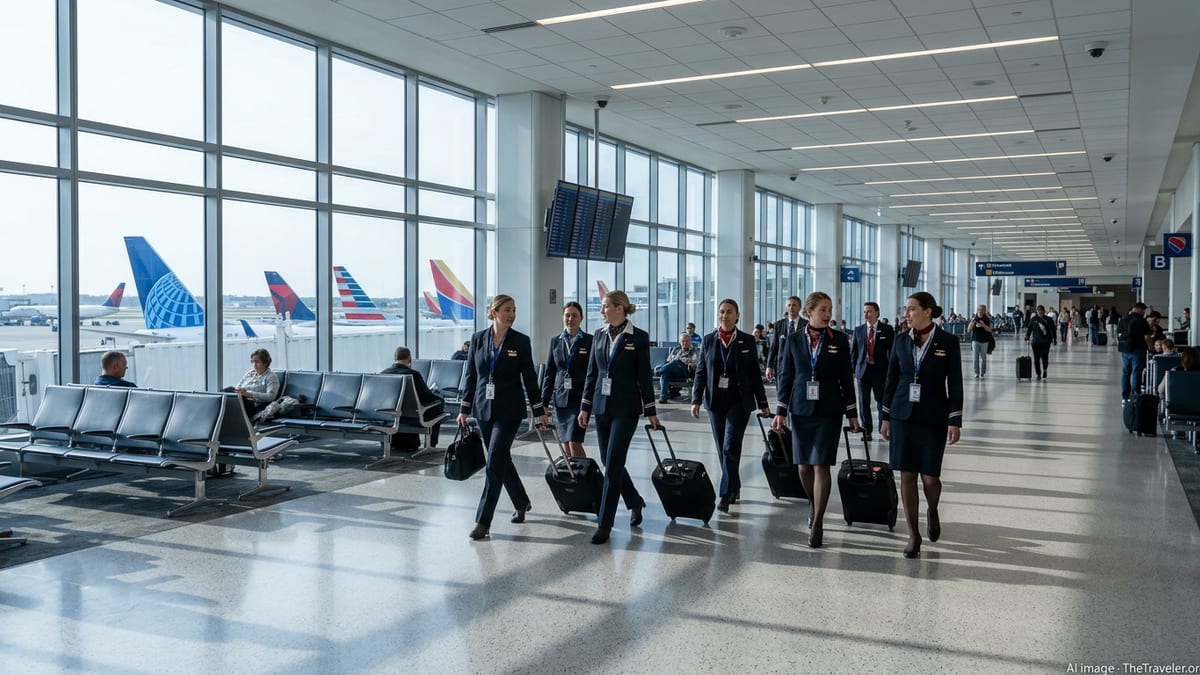
Five Years of Mounting Frustration in the Cabin
Across the major U.S. carriers, publicly available information shows that cabin crew pay has not kept pace with inflation, passenger volumes, or record revenues, even as flight attendants shoulder longer duty days and increasingly complex onboard responsibilities. Industry data and union communications indicate that for many workgroups, the last meaningful raises date back roughly five years, coinciding with the start of the pandemic and a prolonged period of emergency cost-cutting.
Reports on recent negotiations describe a recurring theme: while airlines rapidly restored profits, crew pay scales and work rules often remained stuck in pre-pandemic frameworks. Flight attendants point to higher living costs in base cities such as New York, Chicago, Dallas, and Los Angeles, and argue that stagnating wages effectively translate into substantial pay cuts in real terms.
The sharpening labor push is unfolding just as air travel demand remains strong and carriers rely heavily on flight attendants to manage packed cabins, safety briefings, ground delays, and frequent schedule disruptions. Against that backdrop, the latest bargaining rounds are viewed by worker groups as a long-delayed reset rather than a routine cost-of-living adjustment.
This convergence of pent-up wage pressure, robust travel demand, and shifting labor expectations has set the stage for a potential realignment of how the largest U.S. airlines compensate their front-line cabin crews, with implications that go far beyond any single carrier.
United Airlines Edges Toward a New Pay Benchmark
United Airlines has become a focal point in the current phase of negotiations. The carrier and the Association of Flight Attendants reached a high-profile tentative agreement in 2025 that included substantial cumulative pay increases, retroactive compensation for years without raises, and new forms of pay such as boarding-time compensation, according to union summaries and company statements. However, United’s flight attendants voted the agreement down by a wide margin, signaling that rank-and-file expectations have moved higher than earlier bargaining frameworks anticipated.
Public summaries of that tentative deal indicated that the package could have delivered total pay increases approaching the mid-40 percent range over five years, combined with lump-sum payments to cover prior years without general wage hikes. Even so, the rejection underscored how deeply the five-year wage freeze period has shaped worker sentiment. Many flight attendants expressed concern that inflation and housing costs in major hub cities would erode the value of those gains before the contract expired.
Subsequent updates from union communications and industry coverage suggest that United has returned to the table with revised proposals, aiming to offer what executives describe as top-of-industry pay at every seniority level if a new deal is ratified. The outcome could establish a powerful new benchmark for hourly pay, boarding compensation, and quality-of-life provisions that other carriers may be pressured to match.
For travelers, United’s bargaining path is being watched closely. A relatively smooth ratification could stabilize operations and cabin staffing, while prolonged talks or renewed conflict risk fueling uncertainty during peak travel seasons if patience among crews wears thin.
American Airlines Sets a High Bar With a New Contract
American Airlines has already locked in a sweeping new agreement with its flight attendants that many analysts describe as one of the richest in the industry to date. According to published coverage and union materials, the Association of Professional Flight Attendants ratified a five-year contract in late 2024 that delivered immediate wage increases of up to around 20 percent for some crew members, along with sizable retroactive pay tied to the lengthy bargaining period.
The deal adds billions of dollars in value over its term, with total wage increases projected in the mid-30 percent range and incremental annual raises structured through the life of the agreement. Importantly, the contract also introduced boarding pay for a unionized U.S. cabin crew, a feature that had previously been largely absent from American’s pay model and is now emerging as a central demand at other carriers.
Analysts note that by resolving its contract and lifting pay significantly, American has reduced the immediate risk of disruptive labor showdowns with its flight attendants. At the same time, the agreement has raised competitive pressure on other large U.S. airlines to respond with comparable offers if they hope to retain experienced cabin crew and attract new hires in a tight labor market.
For American’s customers, the near-term impact is more subtle. The airline has signaled that it intends to absorb higher labor costs through a mix of productivity improvements and revenue strategies. Over time, however, sustained increases in fixed costs could contribute to firmer base fares, particularly on routes where low-cost competition is limited.
Delta and Southwest Navigate Parallel Pay Pressures
Delta Air Lines occupies a distinct position in the current negotiations landscape. Delta’s flight attendants are not covered by a union contract, but they have been the focus of ongoing unionization campaigns and have benefited from a series of company-initiated pay actions. Publicly available corporate announcements show that Delta implemented multiple across-the-board raises for employees in recent years, including a roughly 4 percent increase in 2025 following a record profit-sharing payout.
Advocates for Delta flight attendants argue that while these raises are meaningful, they still trail the structured, long-term gains secured through union contracts at competitors such as American. Campaign materials from organizing groups highlight unresolved issues including night-pay policies, sick leave protections, and the absence of formal bargaining rights. As unionized flight attendants elsewhere secure higher rates and new forms of compensation, pressure is likely to intensify on Delta to keep voluntary pay adjustments in line with emerging industry standards.
Southwest Airlines, by contrast, operates within a long-established union framework for its cabin crew. In 2024, flight attendants represented by Transport Workers Union Local 556 ratified a new contract that greatly increased hourly pay and included a sharp up-front raise exceeding 20 percent, followed by several years of additional annual increases, according to union documents. Those improvements pushed Southwest’s rates to the top tier of U.S. airline cabin crew compensation and were marketed internally as surpassing Delta’s pay at comparable seniority levels.
Southwest’s agreement illustrates how a single breakthrough contract can raise the floor for the entire sector. As Southwest and American move ahead with richer deals already in place, Delta and United face growing expectations from their own flight attendants, who see peers at other airlines gaining both sustained wage growth and enhanced protections after years of constrained pay.
What Higher Flight Attendant Pay Could Mean for Travelers
The push for sizable pay raises across the big four U.S. carriers carries broad implications for travelers and the wider travel economy. Labor costs are among the largest expenses for airlines, and multi-year agreements with cumulative wage increases in the double digits can add billions of dollars to operating budgets. Industry observers note that while airlines may absorb some of these costs through efficiency gains and aircraft upgrades, a portion is likely to eventually filter into fare structures.
However, higher pay is also closely tied to service reliability and safety outcomes. Competitive compensation can help airlines reduce turnover in the cabin, retain experienced flight attendants, and make the profession more sustainable over the long term. That, in turn, can support smoother boarding processes, better handling of irregular operations, and improved passenger experiences on full flights.
There are also knock-on effects for regional airlines and international competitors. Once major U.S. carriers lift their pay scales, smaller operators and low-cost carriers may need to follow suit to avoid losing crew to better-paying rivals, particularly at busy coastal and hub airports. The result could be a sector-wide recalibration of cabin crew economics, influencing everything from route networks to the frequency of certain marginal services.
For now, the outcome remains in flux. American and Southwest have secured ambitious deals, Delta continues to rely on company-led raises amid rising organizing activity, and United is working to craft a contract that satisfies flight attendants after a high-profile rejection. Together, these parallel developments point toward a new era in which U.S. flight attendants, after roughly five years of constrained wage growth, are asserting greater leverage over how the financial gains of the post-pandemic travel rebound are shared.