

More news on this day
A succession of intense winter storms, partial government shutdown effects and a fragile aviation infrastructure have combined to unleash fresh chaos across US skies this season, driving mass flight cancellations and periodic airport shutdowns that travelers may continue to feel well into spring.
Get the latest news straight to your inbox!
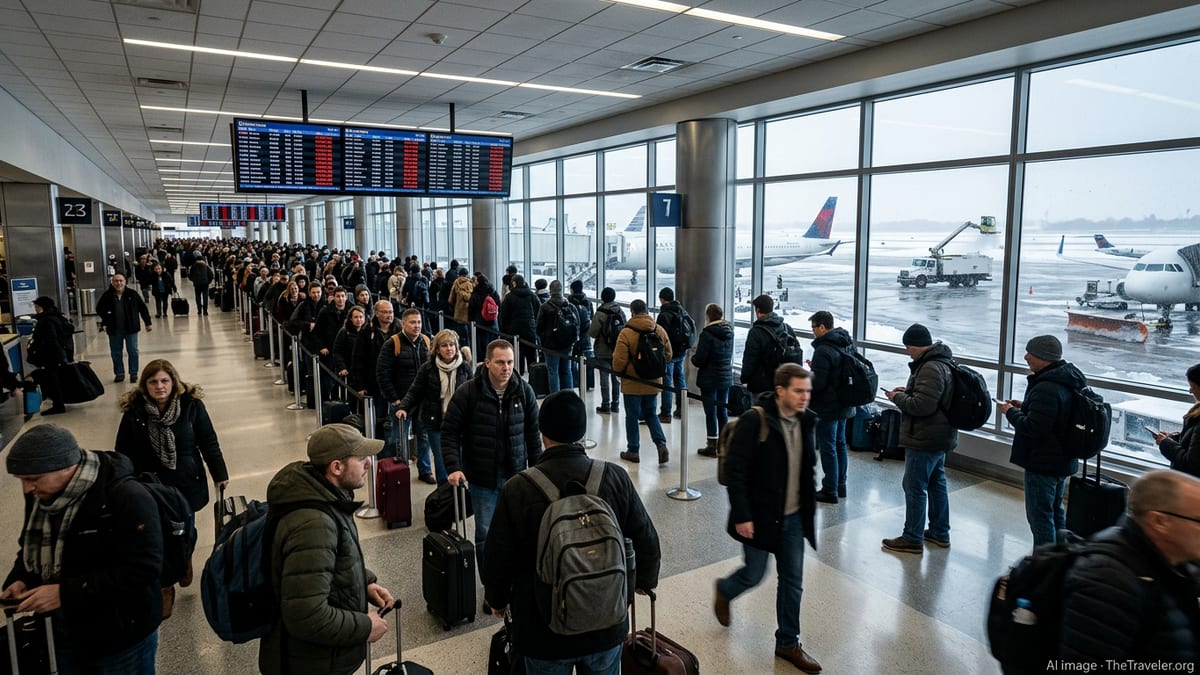
Winter Storms Turn Airports Into No-Go Zones
From late January through mid-March 2026, a series of powerful winter systems has repeatedly disrupted air travel across the United States, transforming key hubs into temporary no-go zones. A major storm in late January triggered what several outlets described as the worst single day of US flight cancellations since the early pandemic years, with more than 11,000 flights grounded and roughly 17,000 delayed as snow and ice swept from the Southern Plains to the Northeast.
In the Northeast, airports serving New York, Boston, Philadelphia and Washington have faced rolling shutdowns of runways and taxiways as crews struggled to keep pace with heavy snow, blizzard conditions and freezing rain. Coverage from national and specialist travel outlets indicates that airports such as John F. Kennedy, LaGuardia, Newark Liberty and Ronald Reagan Washington National at times saw most or all departures halted, as ground stops and runway closures cascaded through airline networks.
More recently, a North American storm complex moving from the Midwest toward New England between March 13 and March 17 has added another wave of disruption, including additional cancellations at Boston Logan and other regional airports. Publicly available airline data and flight-tracking services show that, even when formal airport closures are brief, the knock-on effects can persist for days as aircraft and crews remain out of position.
The operational picture has been complicated further by a February blizzard that prompted emergency declarations from Maryland to Maine, with reports of thousands of cancellations clustered over a single weekend. In New York City and across Long Island, snowfall totals rivaled some of the most severe storms of the last decade, forcing carriers to suspend operations entirely at times as visibility fell and snow removal struggled to keep pace.
Ground Stops, Partial Closures and a Fragile System
While full terminal shutdowns remain relatively rare, targeted airport closures and air traffic ground stops have become a defining feature of the current disruption. Industry analyses describe repeated ground stops at major hubs such as Chicago O’Hare and Hartsfield-Jackson Atlanta International Airport during intense weather events in early March, temporarily halting all arrivals and departures as thunderstorms, snow and low ceilings made operations unsafe.
On the West Coast and in the Southwest, a separate winter system earlier this month led to partial closures at airports in Las Vegas, Orange County and San Diego, where high winds, visibility drops and runway conditions prompted suspensions of certain operations. In several cases, only specific runways or time windows were closed, yet those targeted measures still translated into hundreds of cancellations as airlines reworked schedules in real time.
Operational updates from carriers and airport bulletins suggest that, beyond the weather itself, infrastructure bottlenecks play a significant role in amplifying disruption. De-icing capacity, snow-removal equipment and limited gate availability can quickly become chokepoints when several waves of flights try to depart after a storm. Once aircraft begin stacking up on the ground, crew duty-time limits start to bite, causing additional cancellations even after skies clear.
These dynamics help explain why a relatively short ground stop can ripple outward into widespread delays and cancellations. When a major hub pauses operations, aircraft that would normally flow through that node are delayed or stranded, affecting flights across the country. The result is a system that appears highly sensitive to any shock, with travelers in sunny destinations experiencing cancellations triggered by conditions thousands of miles away.
Government Shutdown Effects and Staffing Strains
Compounding the weather chaos, the ongoing partial shutdown of parts of the federal government has introduced new uncertainty around screening and security. Recent coverage from national news organizations notes that Transportation Security Administration checkpoints at some major airports have seen longer lines and periodic staffing strains as the funding impasse drags on, particularly during peak travel periods.
At the same time, the broader aviation workforce remains under pressure. Airlines have rebuilt schedules aggressively in response to strong demand, but pilot and cabin-crew availability still reflects the aftershocks of pandemic-era buyouts and training backlogs. Reports from airline operations and industry analysts indicate that crews are timing out more frequently during weather disruptions, when long stretches on the ground or extended duty days push them beyond regulated limits.
Air traffic control staffing has also drawn renewed scrutiny. Trade groups and aviation analysts have repeatedly warned that key facilities are operating with limited buffers, meaning that even minor staffing shortfalls can force traffic-flow restrictions. When this coincides with winter storms, controllers may be required to reduce arrival and departure rates further, intensifying delays and raising the likelihood that airlines will proactively cancel flights.
The interaction between these factors means that a storm today can have a larger effect than a similar system a decade ago. With leaner staffing, higher baseline demand and more tightly packed schedules, there is less slack in the network to absorb shocks. Travelers, in turn, are more likely to see flights scrubbed entirely rather than simply delayed.
Why Your Next Flight Could Be Canceled
For passengers holding tickets in the coming days and weeks, the question is not just where storms are forecast, but how vulnerable their particular route is to cascading disruption. Flights that rely on busy hubs already strained by recent weather may be especially exposed if another strong system sweeps across the country or if the current pattern of heavy snow and severe thunderstorms lingers into late March.
Even in regions expecting clearer skies, residual congestion can still upend plans. Aircraft displaced by earlier storms may be slow to return to their usual rotations, and crew rosters can take multiple days to normalize. Analysts tracking airline performance note that schedules may look fully restored on paper while operational buffers remain thin, making carriers more likely to cancel marginal flights preemptively rather than risk long delays and customer service challenges.
Infrastructure work and safety incidents over the past year have also highlighted how quickly targeted airport closures can emerge with little public warning. Runway construction, emergency inspections or localized power outages can lead to partial shutdowns at individual airports, adding another layer of uncertainty during a season already defined by weather extremes.
All of this suggests that travelers should expect a more volatile environment than traditional seasonal averages might imply. Published data on delays and cancellations in January and February already point to disruption levels that rival some of the most challenging winters of the last decade, and the current mid-March storm complex indicates that the pattern has yet to fully ease.
How Travelers Can Navigate a Volatile Air Network
Although the current wave of cancellations and temporary airport closures is driven by factors largely outside passengers’ control, travel specialists emphasize that planning and flexibility can still reduce the risk of being stranded. Booking nonstop flights rather than connections where possible, favoring early-morning departures and allowing generous connection times are among the strategies often cited by consumer advocates when the network is under stress.
Publicly accessible airline and airport dashboards now provide near real-time information on delays, ground stops and weather advisories, giving travelers a clearer picture of where pressure is building. Monitoring those tools closely in the 24 hours before departure can offer early warning signs that a route is at risk, allowing time to request rebooking or adjust ground plans.
Some carriers are also issuing weather waivers that permit customers to change flights without penalty when major storms are forecast, particularly at hubs that have already endured repeated shutdowns this season. While those waivers cannot eliminate cancellations, they can open up options to reroute through less affected airports or shift travel to a different day before schedules fill with displaced passengers.
With the heart of the winter disruption period now overlapping with spring break and major sporting events, demand for seats remains intense even as the system strains under weather and staffing pressures. For now, the most realistic expectation for US air travel is continued turbulence, both in the air and on departure boards, as airlines, airports and federal agencies attempt to steer through one of the most challenging early-year travel environments in recent memory.