

More news on this day
Air travelers across the United States faced another bruising day of disruption as 114 flight cancellations and around 3,440 delays rippled across 27 major airports, snarling schedules from New York and Los Angeles to Miami, Atlanta, Orlando and Seattle and hitting Delta Air Lines, American Airlines and Southwest Airlines particularly hard, according to flight-tracking tallies and industry reports.
Get the latest news straight to your inbox!
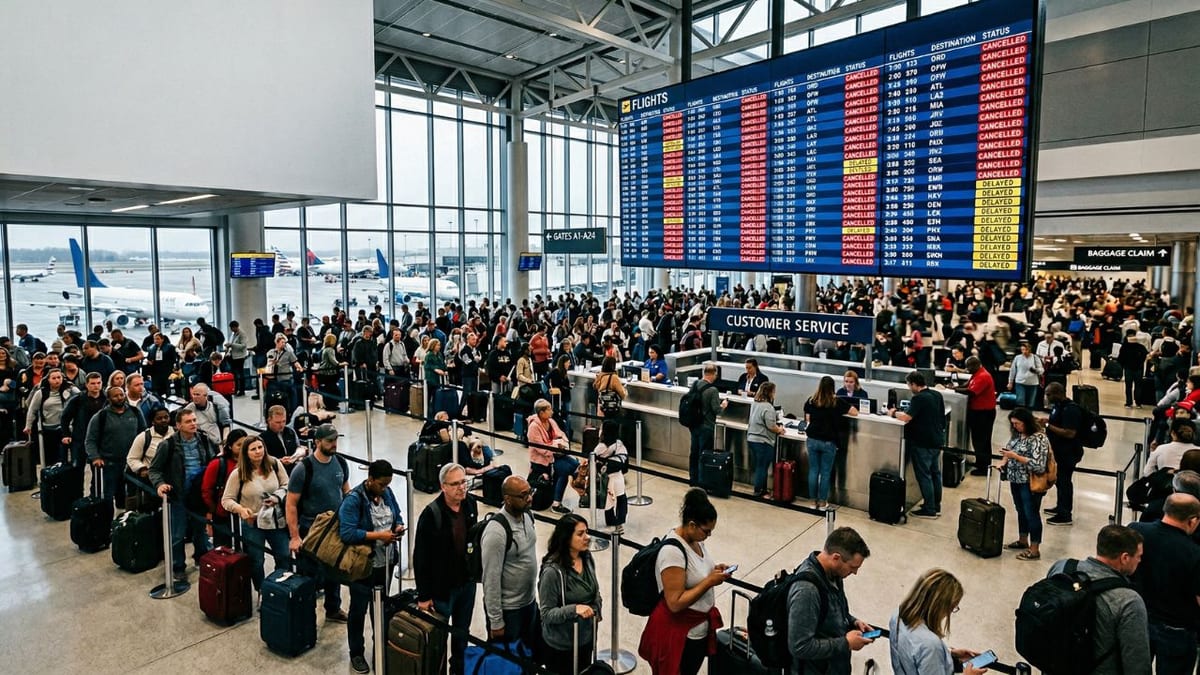
Nationwide Gridlock Across Key US Hubs
Publicly available data from flight-tracking platforms and industry coverage indicates that the latest wave of disruptions is concentrated at the country’s busiest hubs, where even modest schedule changes can cascade into nationwide gridlock. New York area airports, Los Angeles International, Miami International, Hartsfield Jackson Atlanta, Orlando International and Seattle Tacoma all reported elevated levels of delayed and canceled services, affecting both domestic and limited international routes.
Reports show that these hubs collectively handled the bulk of the 3,440 delays, with departure banks in the early morning and late afternoon bearing the greatest strain. Extended turnaround times, aircraft repositioning issues and crowded airspace pushed many flights well beyond their scheduled departure slots, forcing rolling knock-on delays for connecting services throughout the day.
Airlines adjusted schedules in real time, trimming a relatively small number of departures compared with the much larger volume of delays. Aviation analysts note that while 114 cancellations are significant, the scale of the disruption is being driven primarily by prolonged delays on flights that did eventually operate, creating operational and customer service challenges across the network.
Delta, American and Southwest Under Pressure
According to recent operational snapshots and published coverage, Delta Air Lines, American Airlines and Southwest Airlines rank among the most affected carriers in the latest episode of turbulence for the US aviation system. Delta and American, which both operate dense hub-and-spoke networks through major airports such as Atlanta, New York, Miami and Dallas Fort Worth, saw disruptions compound as late arrivals limited aircraft and crew availability for subsequent departures.
Southwest, whose point to point model depends on tight aircraft turns across numerous mid sized and large airports, also experienced a high volume of delayed departures. When early segments slip, aircraft and crews arrive late into subsequent cities, leaving limited room to recover as the day progresses. Industry observers point out that this structure can magnify the impact of even localized weather or air traffic issues at a few key stations.
Operational updates and airline status boards show that many affected flights were delayed between 45 minutes and three hours, with some exceeding that window in congested evening periods. While the overall cancellation count remained lower than in severe storm or full system failure scenarios, the breadth of the delays placed intense pressure on customer service channels as travelers sought rebooking options, hotel stays and revised connections.
Complex Mix of Weather, Congestion and Staffing Issues
Recent weeks have already been challenging for US aviation, with late winter and early spring storms, a protracted federal government shutdown affecting security screening, and air traffic control staffing constraints all contributing to heightened disruption. Coverage from multiple outlets in March and early April highlighted days with thousands of delays and hundreds or more cancellations nationwide, underscoring how sensitive the system has become to any additional strain.
On the latest day of disruption, early reports point to a familiar mix of contributing factors. Residual weather impacts in parts of the Midwest and Northeast, along with thunderstorms affecting Florida and the Southeast, limited arrival and departure rates at several major hubs. At the same time, ongoing congestion management measures at busy airports and tight staffing at selected facilities reduced the flexibility to absorb schedule changes without triggering ground delays and airborne holding patterns.
Aviation data reviewed by travel analysts suggests that the US system is operating close to capacity during peak travel periods, particularly around the spring break and Easter holiday window. In such conditions, even modest reductions in usable runway capacity, security throughput or crew availability can quickly snowball into widespread delays, as there are few spare aircraft and time buffers available to restore normal operations.
Passengers Face Long Lines, Misconnections and Overnight Stays
For travelers on the ground, the statistics translated into long check in and security queues, crowded gate areas and a rush for scarce rebooking options. Passenger accounts shared via social media and consumer platforms describe missed connections at major hubs, extended tarmac waits while crews and ground handlers worked through backlogs, and searches for last minute hotel rooms as evening cancellations piled up.
With 27 major airports reporting significant disruption, many travelers found that alternative routings were also heavily booked or delayed, limiting the usefulness of simple rebookings. For those connecting through the largest hubs, a delayed first leg often meant an unworkable connection for the second, pushing itineraries back by many hours or into the following day.
Consumer advocacy groups and travel commentators continue to highlight that US passenger protections for delays are limited compared with some other regions. Airlines may offer meal vouchers, hotel accommodation or rebooking assistance in certain circumstances, but in many weather related or air traffic driven disruptions, compensation is not guaranteed, leaving passengers to shoulder added costs and logistical complexity.
What the Latest Crisis Signals for Spring and Summer Travel
The latest surge of cancellations and delays adds to a growing body of evidence that US aviation is entering the peak spring and summer season with little margin for error. Government data and independent research over recent years show that a small number of large hubs generate a disproportionate share of delay minutes, and that disruptions at airports such as Atlanta, Chicago O’Hare, Los Angeles, New York’s main gateways, Orlando and Boston can quickly ripple throughout the national network.
Industry observers note that airlines have scheduled aggressively to capture strong leisure and visiting friends and relatives demand in March and April, even as staffing and infrastructure constraints remain unresolved in key parts of the system. Flight-tracking and weather reports suggest that an active storm pattern, combined with ongoing security and air traffic control challenges, could continue to generate volatile travel days with elevated disruption risk.
For travelers planning trips in the coming weeks, publicly available guidance from travel experts emphasizes building extra time into connections, monitoring flight status through airline apps and airport display systems, and considering earlier departures when possible to reduce exposure to late day operational snarls. The current wave of 114 cancellations and 3,440 delays across 27 airports serves as another reminder that, for now, even routine travel days in the United States can quickly turn unpredictable.