

More news on this day
Thousands of passengers across the United States faced abrupt itinerary changes and long queues on March 11 and March 12 as United Airlines, American Airlines, Delta Air Lines, Qatar Airways and Lufthansa canceled close to 200 flights, snarling operations at major hubs including Chicago, Atlanta, Dallas, Los Angeles, Miami, New York, Denver and Phoenix.
Get the latest news straight to your inbox!
Major US Hubs Struggle With Wave of Cancellations
The latest disruption built through Monday evening and into Tuesday morning, when realtime aviation data began to show clusters of cancellations across the country’s busiest hubs. Chicago O’Hare, Atlanta Hartsfield-Jackson, Dallas Fort Worth, Denver and Phoenix all reported mounting scrubs on key morning departures, amplifying delays that had already been rippling through the system.
While overall US cancellations remained below the worst weather days of the winter, the concentration among a handful of global carriers intensified the impact. United, American and Delta collectively accounted for the majority of domestic cancellations into and out of Chicago, Atlanta, Dallas, Denver and Phoenix, while Qatar Airways and Lufthansa cut select long haul departures that feed those same hubs, sending knock-on effects across connecting networks.
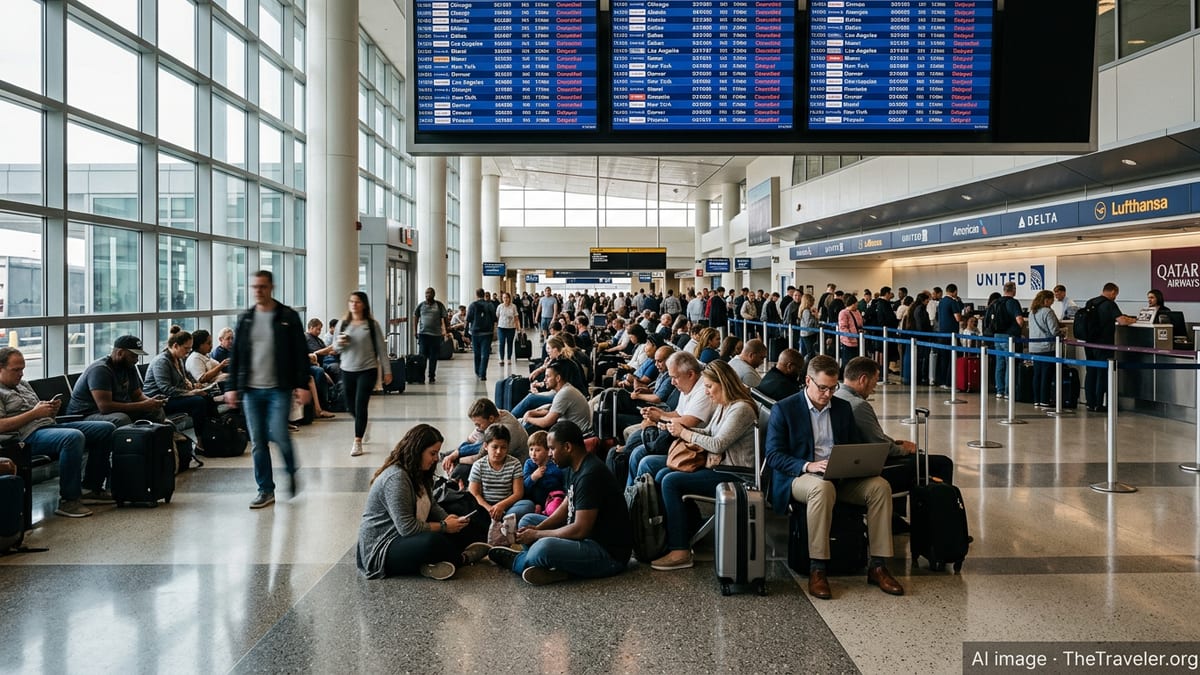
By midday, travelers arriving at departure halls in Chicago, Atlanta and Dallas were greeted with departure boards speckled with red, as morning cancellations triggered further schedule reshuffles. Overnight aircraft and crew had failed to reach their scheduled positions, forcing airlines into rolling adjustments that continued through the first half of Tuesday.
Smaller regional airports feeding these hubs also experienced disruption as regional partners repositioned aircraft or consolidated lightly booked flights, leaving some travelers with last minute bus transfers or forced overnights in gateway cities.
International Routes Hit as Qatar Airways and Lufthansa Cut Services
The disruption was not limited to domestic traffic. Selected international routes operated by Qatar Airways and Lufthansa into major US gateways were among those cancelled or rescheduled, adding a long haul dimension to the chaos. At Los Angeles International Airport and New York’s JFK, passengers bound for Doha and key European hubs awoke to find overnight cancellations or significant re timings on their itineraries.
In Miami and New York, where transatlantic and Middle East services are concentrated, passengers on Qatar Airways and Lufthansa reported rebookings via alternative European or Gulf hubs, or being shifted one or two days later on the same route. For long haul travelers with onward connections to Asia, Africa or the Middle East, these shifts translated into missed cruises, tours and business meetings, with some forced to reroute entirely around the disruptions.
Because Qatar Airways and Lufthansa rely heavily on US partner feed from United and other domestic carriers, the wave of US cancellations further complicated rebooking. Passengers who managed to secure seats on later long haul flights often found their domestic connections from cities like Denver or Phoenix under review, leaving them in limbo at check in counters while agents searched for viable alternatives.
Travel agents in New York and Los Angeles said they spent much of Tuesday morning re-planning itineraries for clients with complex routings that included Chicago, Atlanta or Dallas as domestic waypoints into international departures, particularly where minimum connection times had suddenly become unworkable.
Weather, Airspace Tensions and Operational Strains Converge
The cancellations came against a backdrop of multiple pressures on global aviation. Pockets of unsettled late winter weather and low ceilings in parts of the Midwest and Southeast triggered air traffic control programs that slowed arrivals into Chicago and Atlanta, in turn forcing airlines to trim schedules and combine flights where possible.
At the same time, ongoing airspace restrictions and instability affecting routes over parts of the Middle East have required airlines such as Qatar Airways and Lufthansa to reroute or thin out certain services. Longer routings increase fuel burn and crew duty times, leaving carriers with less flexibility to absorb additional disruption when US weather or congestion flares up.
Operationally, US carriers are still working with tight staffing margins after a heavy winter of storms and an elevated baseline of delays. Industry analysts noted that when major hubs like Chicago, Dallas or Denver experience even moderate weather or traffic management initiatives, the lack of slack in the system means airlines now move more quickly to cancel flights outright rather than risk cascading delays late into the evening.
For travelers, that shift can be a mixed blessing. While a firm cancellation announced early allows time to rebook or adjust plans, the clustering of nearly 200 cancellations across overlapping hubs on the same day significantly reduced the pool of alternative same day options.
Passengers Face Long Lines, Limited Seats and Patchwork Solutions
In terminals from Los Angeles to Miami, the human impact of the disruption was immediately visible. Families bound for spring vacations waited in snaking customer service lines, while business travelers hunched over laptops on terminal floors searching airline apps for any available seats later in the week. Many passengers reported conflicting information between airline notifications, airport departure boards and agents at the gate.
With key morning departures scrubbed, remaining flights to cities such as Chicago, New York, Atlanta and Dallas quickly filled, often leaving only high fare economy or premium cabin seats for last minute rebookings. Some travelers opted to fly to secondary airports within driving distance of their original destination, such as rerouting from Chicago to Milwaukee or from Miami to Orlando, then completing the last leg by car.
Hotel shuttles around Denver, Dallas and Phoenix reported a surge in late night and early morning pickups as stranded passengers accepted airline vouchers or paid out of pocket for unexpected overnight stays. Ride hailing drivers near Los Angeles and Miami airports similarly described a sharp uptick in long distance rides as travelers chose to abandon air connections entirely for regional journeys.
Social media posts from passengers on United, American, Delta, Qatar Airways and Lufthansa highlighted a patchwork of responses, from automatic rebooking messages that arrived before travelers reached the airport, to others who discovered cancellations only when they scanned departure screens at check in.
What Travelers Can Do If Their Flight Is Affected
With schedules still fluid across multiple carriers, travel advisers recommended that passengers with flights touching Chicago, Atlanta, Dallas, Los Angeles, Miami, New York, Denver or Phoenix in the coming days monitor their reservations closely and be prepared to act fast if irregular operations continue.
Most major airlines are offering at least limited flexibility for customers impacted by cancellations, including complimentary rebooking within a defined date window, and in some cases the option to adjust to alternative airports in the same region. Travelers are being urged to use airline apps and websites as first line tools to secure new itineraries, then speak to agents to fine tune connections or special service requests.
Experts also suggest considering early morning departures, which tend to be less affected by knock on delays, and avoiding tight connections through the most congested hubs when booking new tickets during volatile periods. For those with essential long haul travel via carriers such as Qatar Airways and Lufthansa, allowing extra buffer time between domestic and international legs can reduce the risk of misconnecting if another round of US cancellations arises.
While airlines expect operations to gradually stabilize, Tuesday’s wave of nearly 200 cancellations underlines how quickly global travel plans can unravel when multiple stresses converge on a handful of critical US hubs.