

More news on this day
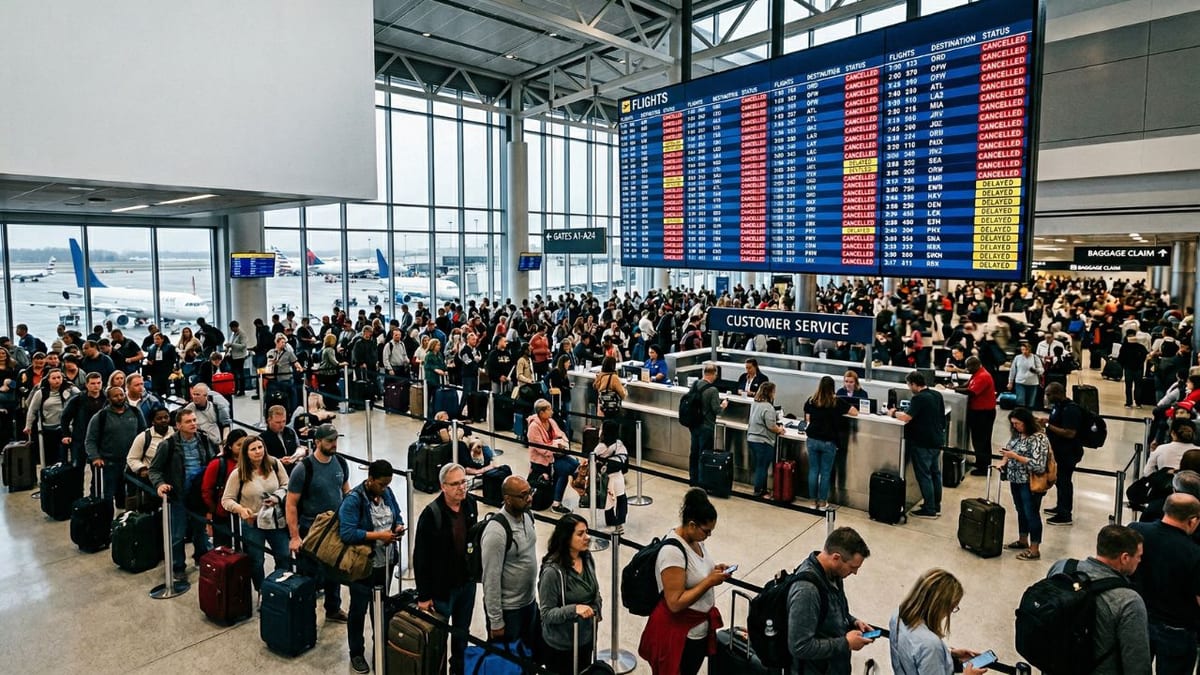
A new wave of aviation disruption is rippling across the United States, with publicly available tracking data showing at least 114 flight cancellations and 3,440 delays affecting 27 major airports and stranding passengers from New York and Los Angeles to Miami, Atlanta, Orlando and Seattle.
Get the latest news straight to your inbox!
Nationwide Disruptions Hit Major Hubs From Coast to Coast
The latest day of turmoil follows a pattern of mounting operational strain across the U.S. network, where large hubs have repeatedly found themselves at the center of cascading delays. Recent tallies published by travel-industry outlets describe thousands of delayed and cancelled flights concentrated at airports such as Atlanta, New York, Orlando, Boston, Chicago, Los Angeles, Seattle, Houston and Newark, with ripple effects felt at dozens of smaller facilities.
Reports indicate that the most recent count of 114 cancellations and 3,440 delays is part of a wider March 2026 surge in disruption that has already upended tens of thousands of flights across the Americas. Travel coverage drawing on aviation analytics shows that these numbers layer on top of earlier waves of storms, congestion and staffing challenges that have repeatedly pushed the U.S. system to its limits this year.
At major coastal gateways including New York, Los Angeles, Miami and Seattle, the cumulative impact has been visible in long security lines, backed-up gate areas and rolling departure pushes that extend well into the evening bank of flights. Interior hubs such as Atlanta and Orlando, which handle heavy connecting traffic for both domestic and international routes, have emerged as critical pressure points when weather or staffing constraints reduce capacity, forcing schedules to compress and delays to compound.
Travel data providers highlight that, while the absolute number of cancellations remains far below some historic meltdown events, the scale of same-day delays now regularly impacts several thousand flights nationwide, turning relatively contained operational issues into full-day disruptions for passengers trying to connect across the network.
Delta, American and Southwest Among Carriers Most Exposed
Publicly available airline performance snapshots show that the country’s largest carriers, including Delta Air Lines, American Airlines and Southwest Airlines, continue to bear a disproportionate share of the disruption, simply because of their size and concentration in the busiest hubs. Recent coverage of U.S. operations has documented days when Delta recorded the highest number of cancellations, while American logged the most delays, underscoring how quickly performance metrics deteriorate when even a few major hubs are squeezed.
Delta’s exposure is particularly acute at Atlanta and New York, where the airline operates dense schedules that depend on tight connections and finely tuned aircraft rotations. When thunderstorms, ground delay programs or crew availability issues reduce hourly arrival and departure rates, those finely balanced patterns can unravel in a matter of hours, forcing schedule resequencing and, in some cases, preemptive cancellations to avoid overnight mispositioning of aircraft and crews.
American faces similar vulnerabilities at its core hubs, including Miami and major Midwestern and East Coast airports, where delays can quickly spill into transcontinental and Latin America networks. Meanwhile, Southwest, with its high-frequency point-to-point model, has limited slack in its schedule; disruptions in a few large stations such as Denver, Chicago, Orlando or Houston can propagate quickly through its system, complicating recovery efforts.
Analysts note that while each airline has invested in resilience measures, such as additional spare aircraft and improved crew scheduling tools, the combination of strong demand, high load factors and tightly packed schedules means that there is little margin when several regions are hit by adverse conditions on the same day.
Weather, Staffing and Congested Airspace Drive Compounding Delays
Recent reporting on U.S. aviation performance points to a familiar trio of triggers behind the latest disruptions: fast-moving weather systems, staffing constraints and already congested airspace at the country’s most important hubs. Thunderstorms and heavy rain across key corridors have repeatedly prompted air traffic control programs that slow arrival and departure rates, forcing airlines to hold flights on the ground and adjust routings to keep aircraft out of overloaded sectors.
On several days this year, publicly available data has shown ground delays imposed at airports such as Newark, Orlando and Washington, with knock-on effects felt at connecting hubs across the country. Earlier coverage documented occasions when thousands of flights were delayed and more than a thousand cancelled in a single day as storms intersected with peak travel periods, a combination that left airlines with few options to absorb additional disruption.
Staffing remains another sensitive factor. While the Federal Aviation Administration has reported progress in rebuilding its controller workforce, published analyses indicate that some facilities continue to face tight staffing windows, particularly during overnight transitions and peak travel waves. When combined with weather, these constraints limit flexibility to reroute traffic around storms or congestion, increasing the likelihood that minor issues become multi-hour delays.
Aviation researchers and industry reports also highlight that, compared with pre-pandemic norms, many carriers are running more complex schedules using similar or slightly reduced fleets, leaving less room to recover from irregular operations. This structural tightness means days with moderate weather and operational challenges can now produce disruption levels that previously would have required more extreme conditions.
Passengers Face Missed Connections and Extended Rebooking Times
For travelers, the operational statistics translate into a familiar set of frustrations on the ground. The combination of 114 cancellations and 3,440 delays across 27 airports means that even passengers whose flights ultimately operate often arrive hours behind schedule, miss onward connections, or find themselves rebooked on overnight or next-day services when final legs are sold out.
Accounts compiled in media and travel-industry coverage describe terminal scenes ranging from long lines at customer service counters to crowded seating areas where passengers wait for rolling departure estimates that shift in 15 or 30 minute increments. In large connecting hubs such as Atlanta, Orlando and major New York airports, these delays reverberate throughout the day, affecting flights far removed from the original weather cell or staffing constraint.
Travel advisors and consumer advocates cited in recent coverage continue to recommend that passengers build more buffer time into itineraries, particularly when connecting through delay-prone hubs or traveling during seasons associated with storms or severe weather. Morning departures are often highlighted as less vulnerable to knock-on delays, since aircraft and crews are more likely to start the day in position before the network begins to absorb new operational shocks.
At the same time, travelers are increasingly urged to rely on real-time airline apps and airport departure boards, as schedules printed days or weeks in advance cannot account for the sort of rolling tactical adjustments that have become common during high-disruption periods.
Signs of a System Under Persistent Strain
Industry data and government statistics released over the past year suggest that the latest wave of cancellations and delays is part of a broader pattern of strain within the U.S. aviation system rather than a singular, isolated event. Federal overviews of air traffic in 2024 show substantial volumes of operations at the country’s 30 largest airports, while travel-analytics firms report that a significant share of passengers experienced some form of disruption during peak months.
Research into long-term delay trends indicates that post-pandemic travel has become more sensitive to relatively small perturbations, as staffing, aircraft availability and airspace capacity all operate closer to their limits. The experiences of March 2026, with multiple days of widespread delays at major hubs across North and Central America, reinforce conclusions that even modest storms or localized staffing issues can cascade into days of irregular operations.
Policy discussions around air travel reliability have increasingly focused on the balance between maximizing capacity and safeguarding operational resilience. While airlines and regulators point to investments in technology, hiring and infrastructure, the persistent appearance of days with thousands of delays suggests that the system remains vulnerable when several stress factors align.
For now, aviation analysts expect that passengers planning to transit New York, Los Angeles, Miami, Atlanta, Orlando, Seattle and other major airports will continue to face an elevated risk of disruption during busy travel periods, particularly as spring and summer weather patterns intensify and demand remains strong across domestic and international networks.