

More news on this day
Thousands of travelers across the United States are facing long lines, missed connections, and crowded terminals today as 78 flights are canceled and at least 547 delayed nationwide, with major disruptions concentrated in Georgia, Florida, Texas, and several other key travel states. Big carriers including Delta Air Lines, Air Canada, and American Airlines are reporting mounting operational strain as they work to recover schedules, rebook stranded passengers, and manage the latest wave of weather and staffing-related turbulence hitting the already stretched US aviation system.
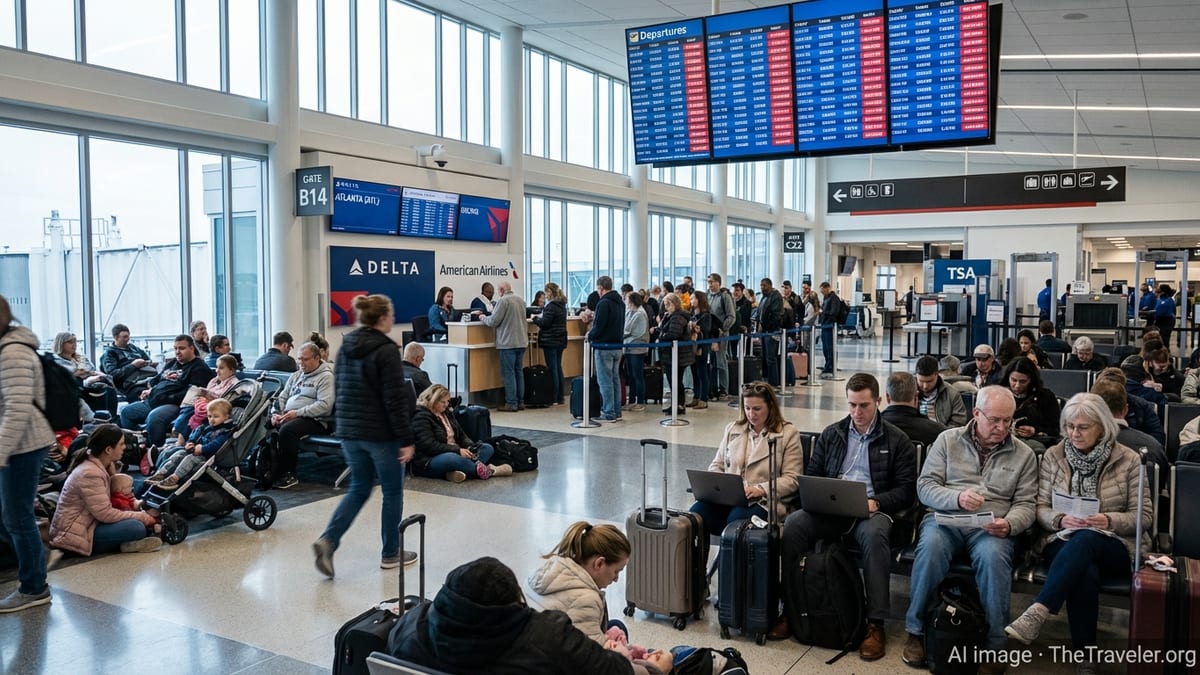
Where Today’s Flight Disruptions Are Hitting the Hardest
Operational data from airline and airport tracking services shows that while the overall number of cancellations remains below the worst seen during major winter storms, today’s 78 cancellations and 547 delays are heavily concentrated at a handful of busy hubs. Georgia, Florida, and Texas are among the most affected states, with Atlanta, Orlando, Miami, Dallas–Fort Worth, and Houston reporting persistent disruption windows as the day progresses.
In Georgia, Hartsfield–Jackson Atlanta International Airport, the world’s busiest passenger hub and a critical base for Delta Air Lines, continues to see pressure as morning and mid-day departures stack up with delays. Similar patterns are visible in Florida, where Orlando and Miami are facing ripple effects from earlier weather systems and congested airspace, complicating turnarounds for both domestic and international flights. In Texas, Dallas–Fort Worth and Houston are once again shouldering a disproportionate share of disrupted traffic, particularly on routes feeding the Midwest and East Coast.
Secondary markets are also feeling the impact. Airports in states such as New Jersey, California, and Minnesota are reporting pockets of significant delays where traffic flows intersect with the hardest-hit Southern hubs. Even where cancellations remain relatively limited, rolling delays are lengthening travel times, forcing tight connections to be rebooked and leaving thousands of passengers effectively stranded for hours at origin or connection points.
What Is Driving Today’s Wave of Cancellations and Delays
Today’s disruptions come against the backdrop of an already fragile US aviation network, still recovering from a punishing winter season and earlier large-scale interruptions linked to Winter Storm Fern, which triggered thousands of cancellations across more than 30 states in late January. The cumulative effect has left airlines juggling crew positioning, aircraft availability, and congested maintenance schedules, so even moderate weather or air-traffic constraints can quickly ripple across multiple hubs.
Weather remains a central factor. Lingering storm systems across parts of the Southeast and Mid-Atlantic, combined with residual snow and de-icing delays farther north, are forcing airlines and air-traffic controllers to slow departure and arrival rates. Thunderstorms and low visibility in portions of Florida and the Gulf states are adding further complexity, often requiring holding patterns, diversions, or ground stops that then cascade into missed and delayed connections nationwide.
Operational bottlenecks are compounding the weather issues. Chronic staffing tightness in key roles such as air-traffic control and ground operations means there is less flexibility to absorb sudden surges in traffic or recover quickly after a disruption. Recent federal warnings about potential longer lines and processing delays at security and border checkpoints have also proved well-founded at some major airports, where passengers report extended waits at TSA and customs, especially during peak international arrival banks.
How Delta, Air Canada, and American Airlines Are Coping
Among the carriers dealing with today’s turbulence, Delta Air Lines, Air Canada, and American Airlines are under particular scrutiny due to the size of their US networks and their prominence at key affected hubs. Delta, with its massive operation in Atlanta and significant presence in Minneapolis, Detroit, and New York, has been juggling a mix of weather constraints and residual scheduling complexity tied to earlier storms and a series of recent operational crises that left thousands of its customers stranded across several continents.
Air Canada is feeling the strain on cross-border and transcontinental routes, especially those linking Canadian hubs such as Toronto and Montreal with major US gateways in the Northeast and Sun Belt. Capacity reductions and schedule adjustments made earlier this year, as Canadian carriers retrenched from some US routes, have left fewer options when irregular operations hit. As a result, individual cancellations or missed connections can take longer to resolve, with some travelers being rebooked a full day or more later.
American Airlines, still dealing with the aftereffects of record disruptions during Winter Storm Fern and recent challenges at its Dallas–Fort Worth hub, is again facing elevated delays on key domestic corridors. The carrier has been attempting to stabilize operations with more conservative schedules, targeted incentive pay for crew to cover open trips, and more cautious flight planning in weather-sensitive regions. Even so, today’s figures show that American’s network remains vulnerable when multiple hubs experience pressure at once.
Major Airports Under Strain and What Passengers Are Seeing on the Ground
At airport level, the impact for travelers is being felt in familiar ways: long customer service lines, jammed gate areas, and limited seating or food options in crowded concourses. In Atlanta and Dallas–Fort Worth, morning disruptions quickly translated into rolling gate changes and clusters of delayed departures stretching into the afternoon, creating confusion among passengers already on tight itineraries or traveling with families.
In Florida, leisure-heavy airports such as Orlando and Miami are seeing a large share of affected passengers heading to or from cruise ports and popular vacation destinations. Delayed arrivals are forcing some travelers to scramble to adjust hotel and ground-transportation bookings, while missed connections are particularly painful for those with fixed departure times for cruises or tours. Airlines are prioritizing rebooking but, with cabins relatively full, many stranded passengers are being offered limited same-day alternatives.
Further north and west, airports in states such as New Jersey, Illinois, Colorado, and Washington are grappling with knock-on effects rather than direct weather hits. Chicago, Denver, Newark, and Seattle are all important connecting nodes; once aircraft and crews arrive late from the South or East, the delay pattern propagates onward. In some cases, a single hold or ground stop at a Southern airport in the early morning can translate into multiple missed evening connections in the Mountain West and Pacific Northwest.
Why This Follows a Pattern of Repeated Disruption
Today’s numbers come on the heels of several recent days in which US travelers have endured high volumes of cancellations and delays, highlighting a pattern rather than an isolated incident. Only yesterday, data compiled from tracking services indicated more than 180 cancellations and over 6,600 delays across the country, with major carriers like United, American, Delta, and Southwest all reporting significant schedule disruptions.
Earlier in the week, a combination of severe winter weather and the ongoing partial federal government shutdown had already led to more than 7,000 delays on a single day, according to airline and airport reporting. Those events followed a brutal January storm cycle, when Winter Storm Fern forced airlines to cancel or postpone more than 10,000 flights over several days and pushed some carriers, notably American, into their most severe weather-related operational crises since the pandemic.
The repeated shocks have exposed how little spare capacity remains in the modern US airline system. With aircraft fleets running near full utilization and demand for both leisure and business travel staying strong, airlines have limited room to build in buffers. That means each new storm, system outage, or staffing squeeze is more likely to tip the network into cascading disruption, rather than being absorbed quietly at the margins.
What Stranded Travelers Can Do Right Now
For passengers caught up in today’s turmoil, the most important step is to stay proactive. Travelers are being urged to check flight status frequently through airline apps or airport displays, as departure times and gate assignments are shifting rapidly. Even if a flight is currently listed as on time, knock-on effects from earlier delays can change that within minutes, especially on routes tied to Atlanta, Orlando, Miami, Dallas–Fort Worth, or Houston.
Experts recommend that stranded travelers immediately get into multiple rebooking queues when a flight is canceled or badly delayed: join the line at the gate or service desk, use the airline’s mobile app or website, and, where available, contact the carrier via call centers or messaging channels. Same-day options can disappear quickly in peak travel periods, so being among the first to request alternatives is critical. For those with international connections, asking about rerouting through different hubs may open up options that are not automatically suggested by booking systems.
Passengers should also keep careful records of their disruption, including delay length, reason codes provided by the airline, and any out-of-pocket expenses for meals or lodging. While US regulations around compensation are less comprehensive than in some other regions, airlines generally provide meal vouchers or hotel accommodations in the case of long delays or overnight misconnects when the cause is within the carrier’s control. Even when weather is cited, some carriers offer goodwill gestures or frequent-flyer mileage credits to maintain customer loyalty.
How to Plan Upcoming Trips as Disruptions Continue
Today’s events are a warning signal for travelers with flights scheduled in the coming days and weeks, particularly those connecting through the most affected hubs or flying on carriers already stretched by recent storms. Industry analysts suggest building in larger time buffers for connections, especially when flying through Atlanta, Dallas–Fort Worth, Chicago, Denver, or major Florida airports that frequently sit at the center of weather systems.
When possible, choosing earlier departures can also improve odds of on-time arrival, as morning flights are less exposed to accumulated delays from earlier in the day. Nonstop flights, even at a higher fare, may be worth the premium during periods of repeated disruption, reducing exposure to missed connections and multi-leg rebooking headaches. Travelers with flexible schedules might also consider avoiding peak travel days around weekends or major events, when loads are heaviest and spare seats most limited.
Finally, observers note that today’s turbulence is part of a wider realignment in North American aviation, as some carriers trim or restructure US routes while others concentrate more capacity in high-demand leisure corridors. For passengers, that means fewer alternative routings when things go wrong and a greater need to track not just the weather, but the broader operational health of their chosen airlines and airports.