

More news on this day
Thousands of U.S. air travelers confronted another bruising day of late departures and crowded terminals on March 31 as more than 2,800 flights were delayed nationwide while a 45‑day Department of Homeland Security shutdown continued to squeeze Transportation Security Administration staffing and disrupt airline schedules.
Get the latest news straight to your inbox!
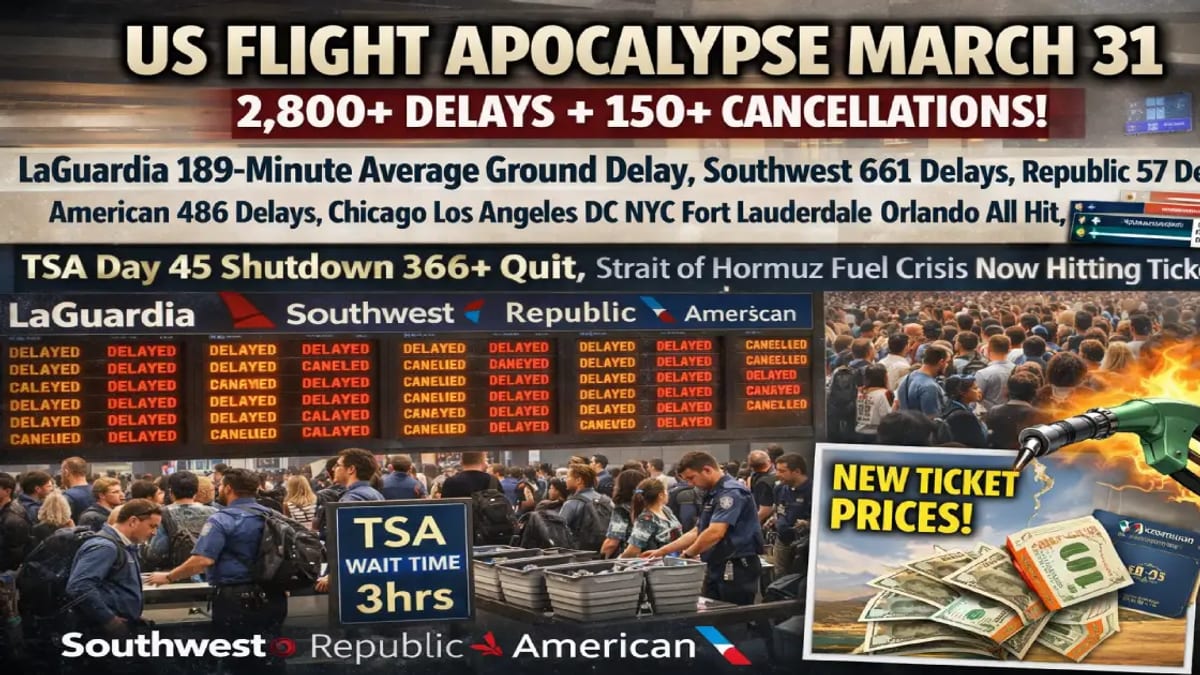
Image by Travel Tourister
Nationwide Gridlock as Delays Top 2,800 Flights
Domestic and international routes across the United States experienced significant disruption on Tuesday, with industry trackers reporting well over 2,800 delays by late afternoon. Hub airports from Atlanta and Chicago to Los Angeles and New York reported rolling hold‑ups as security bottlenecks and tight aircraft rotations cascaded through the system.
Published coverage from aviation data providers indicates that the latest wave of delays followed familiar patterns seen throughout March: early‑morning congestion at security checkpoints spilled into missed pushback times, which in turn forced crews and aircraft out of position for the rest of the day. Even routes that remained technically “on time” frequently departed after lengthy waits at the gate or on the taxiway.
Reports from travel industry outlets note that several major carriers adjusted schedules in recent weeks, trimming some frequencies and padding block times in an effort to absorb security‑related slowdowns. Despite these moves, the cumulative effect of repeated daily disruptions has left many airports operating with little margin to recover when problems arise.
International services were not immune. Coverage focused on transatlantic and transborder flights into major U.S. gateways, which faced knock‑on delays as arriving aircraft waited for gates or crew clearances. Passengers originating in Europe, Canada and the Caribbean frequently encountered additional waits upon arrival as they joined long lines at customs and security recheck points.
TSA Pay Relief Arrives, but Shutdown Pressures Persist
The latest surge in disruptions came just days after the White House authorized emergency pay for TSA employees, a move widely described in national media as an attempt to ease the mounting strain at airport checkpoints without formally resolving the underlying budget impasse. Publicly available information shows that workers began receiving back pay at the start of this week, even as the broader Department of Homeland Security shutdown entered its seventh week.
According to reporting from major wire services, the partial shutdown began on February 14 after Congress failed to agree on long‑term funding for DHS. TSA officers were designated as essential and required to keep working, but went weeks without full pay. As financial pressures mounted, callouts rose, hundreds of officers resigned, and checkpoints at high‑volume hubs periodically closed or consolidated, driving wait times sharply higher.
Analyses by travel and business outlets suggest that the emergency pay directive has started to ease the most severe bottlenecks at some airports, particularly during off‑peak hours. However, TSA leadership has publicly warned that staffing shortfalls, burnout and attrition will continue to affect operations for weeks or months, even if Congress ultimately reaches a funding deal.
Industry groups representing airlines, airports and travel companies have urged lawmakers to provide stable, dedicated funding for aviation security, arguing that repeated shutdowns and eleventh‑hour fixes create a cycle of disruption that undermines traveler confidence and raises costs for carriers.
Regional Disparities: Some Hubs Buck the Trend
Despite headline‑grabbing scenes of snaking queues at many large airports, the impact of the shutdown has not been uniform. Local coverage in several markets highlights outliers where security operations have remained relatively smooth, even as the national system strains under the pressure.
In Minneapolis–Saint Paul, for example, regional outlets report that TSA wait times have generally stayed under 30 minutes, with some checkpoints processing passengers in under five minutes during certain periods. Airport officials there point to stable staffing levels and proactive queue management as key factors in avoiding the worst of the national slowdown.
Similar pockets of relative calm have been noted at some mid‑sized and secondary airports, where traffic volumes are lower and staffing rosters have been less affected by callouts and resignations. Travelers routed through these facilities often report a stark contrast with the conditions at major hubs, even on the same itinerary.
However, analysts caution that the broader network remains vulnerable. When one or two key nodes experience severe backups, aircraft and crew schedules ripple outward, eventually affecting airports that may have no local security issues of their own. This interdependence means that even communities with short TSA lines can still see delayed or canceled flights when disruptions hit elsewhere.
Spring Travel Season Collides with Structural Strain
The latest day of widespread delays comes at a sensitive moment for the travel industry, with the spring break and Easter period pushing passenger volumes close to peak summer levels. Surveys cited in travel trade coverage suggest that nearly half of U.S. travelers plan to fly at least once in 2026, raising concerns that prolonged instability could dampen demand later in the year.
Recent academic and government analyses of delay patterns in the U.S. aviation network indicate that security‑related slowdowns increasingly function as a primary driver of systemwide congestion, especially at high‑volume connecting hubs. While weather and air traffic control constraints remain major factors, the current shutdown has drawn renewed attention to checkpoint throughput as a critical weak link.
Economic assessments prepared for the travel sector during earlier shutdowns estimated multibillion‑dollar losses tied to trip cancellations, missed connections and reduced discretionary travel. Industry economists warn that the current disruption, layered on top of last year’s record‑long full government shutdown and this year’s earlier brief funding lapse, could erode the momentum of a still‑recovering sector.
Travel advisors and consumer advocates, writing in public guidance materials, are increasingly steering clients toward strategies that assume ongoing unpredictability, including longer arrival lead times, nonstop flights when possible, and flexible booking options that allow for same‑day changes without heavy penalties.
What Travelers Are Experiencing and How Airlines Are Responding
For passengers, the most immediate impact of the shutdown‑driven turbulence is felt in the terminal. Media coverage from across the country continues to document travelers arriving two to three hours before departure only to find security queues spilling into parking garages and ticketing halls at some of the busiest hubs.
Some airlines have responded by issuing broad travel waivers on select days or routes, allowing customers to rebook without change fees when disruption exceeds certain thresholds. Carriers are also reshuffling aircraft assignments, prioritizing long‑haul and high‑yield routes while trimming lightly booked short‑haul frequencies where operational slack is available.
Airport managers, described in local reporting, are experimenting with stopgap measures such as temporary stanchion layouts, overflow queuing areas and coordinated messaging across terminal screens and public address systems to direct passengers toward less crowded checkpoints. At some locations, Immigration and Customs Enforcement personnel have been redeployed to assist with basic security functions in an attempt to keep lines moving.
Travel experts quoted in consumer columns emphasize that conditions can vary widely not only from airport to airport, but even from one terminal or checkpoint to another within the same facility. They recommend that passengers monitor airline apps and airport social channels closely on the day of travel, build in extra time, and prepare for last‑minute gate or schedule changes as the shutdown’s effects continue to reverberate through the U.S. air system.