

More news on this day
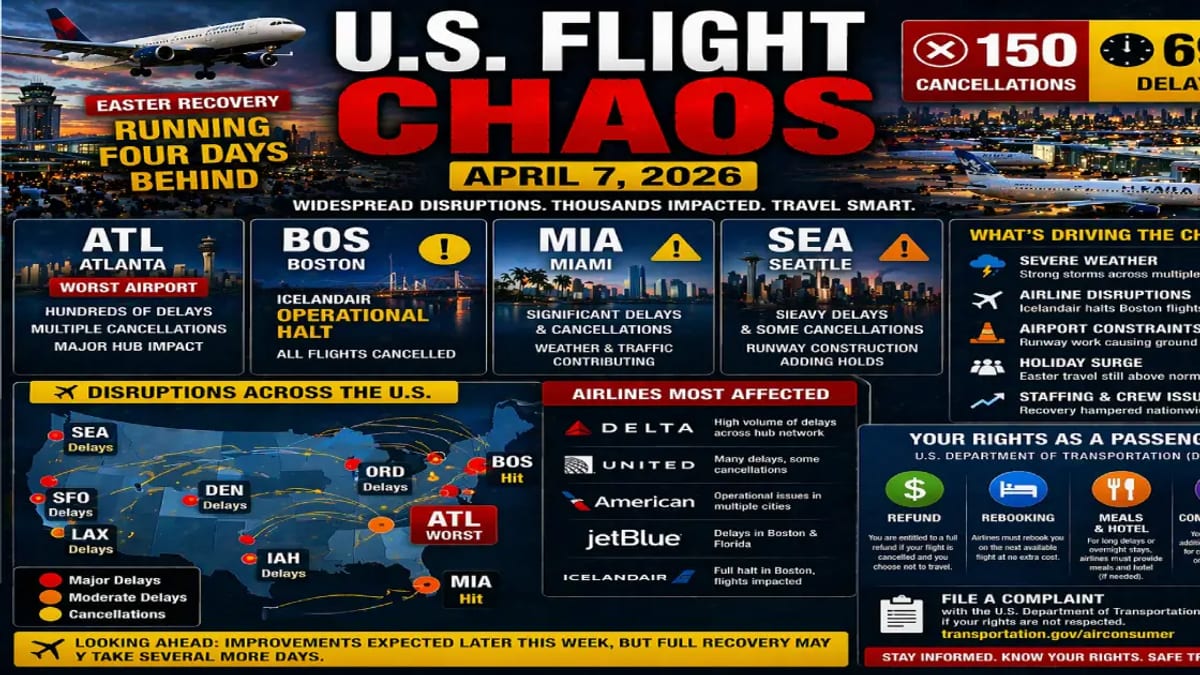
Major US airports faced another turbulent travel day on April 7 as more than 840 flight disruptions rippled across the country, snarling schedules at key hubs from Atlanta and Chicago to New York and Los Angeles.
Get the latest news straight to your inbox!
Disruptions Mount Across the US Network
Operational data compiled from airline trackers and industry reports indicates that at least 844 flights were disrupted across the United States on April 7, including a mix of cancellations and significant delays. The impact was concentrated at the country’s largest hubs, where congestion quickly spilled into connecting routes and regional networks.
Travel and aviation outlets tracking real-time operations reported that hundreds of services were running behind schedule, with additional cancellations announced throughout the day as aircraft and crew fell out of position. One industry snapshot pointed to more than 200 cancellations and more than 4,000 delays affecting US departures and arrivals overall, underscoring how a single day of strain can cascade into widespread disruption.
Passengers at key connecting airports such as Atlanta, Chicago, Dallas Fort Worth, New York area airports, Los Angeles, Houston, Orlando, Boston and Seattle experienced rolling delays as airlines worked to reset schedules. Publicly available flight boards showed clusters of late departures in peak afternoon and evening waves, particularly on high-frequency domestic routes.
Although the total number of disruptions fluctuated over the course of the day, the 844-plus figure highlights how even without a full nationwide ground stop, the US system can experience disruption levels that resemble a low-grade operational crisis.
Major Hubs Bear the Brunt
The heaviest disruption on April 7 was concentrated at the country’s largest and busiest airports, which function as central nodes in domestic and international networks. Reports from aviation trackers and travel media show that Atlanta, the world’s busiest passenger hub, saw elevated delays as early bank departures slipped and later waves struggled to recover.
In the Northeast, New York’s major gateways, including John F. Kennedy, LaGuardia and Newark, reported clusters of late and canceled flights. These airports serve as both international gateways and dense domestic connectors, meaning any disruption can quickly affect itineraries across the United States and beyond. Chicago’s O’Hare and Midway likewise recorded a significant share of delayed departures, with knock-on effects reported at smaller Midwest airports that depend on hub connections.
On the West Coast, Los Angeles and Seattle saw schedule pressures build during the afternoon and evening, according to published coverage and live tracking data. Delays on transcontinental flights compounded congestion, as late inbound aircraft forced subsequent departures to push back their schedules, squeezing operations during already busy spring travel periods.
Sunbelt hubs such as Dallas Fort Worth, Houston and Orlando also featured prominently in disruption tallies. These airports have been central to the broader rise in US delay statistics in recent seasons, and April 7 provided another example of how weather, volume and staffing constraints can combine to slow their high-throughput operations.
Underlying Pressures: Staffing, Weather and Global Strain
The April 7 disruption wave unfolded against a backdrop of continuing structural pressures on the US aviation system. Recent industry analyses and trade coverage highlight persistent shortages of air traffic controllers at some of the nation’s busiest facilities, including those managing the airspace around Atlanta, Chicago, New York, Southern California and Dallas. These staffing gaps limit the ability of controllers to handle peak volumes, prompting flow-control measures that translate into ground delays at airports around the country.
While localized weather did not trigger a single high-profile storm shutdown on April 7, scattered thunderstorms and low ceilings in several regions added friction to operations already running close to capacity. Airlines increasingly operate tight networks with limited spare aircraft and crew, so even modest weather-related slowdowns can push schedules beyond their breaking point, producing the kind of cascading delays seen in the latest tallies.
Global aviation turmoil has also narrowed airlines’ margins for error. Coverage of the current aviation crisis affecting North American and Caribbean routes notes tens of thousands of delays and cancellations across March and early April, including at major US gateways. Limited spare capacity following earlier route cuts, fleet groundings and adjustments to long-haul traffic flows means carriers have less flexibility to absorb fresh disruption days like April 7 without visible impact to passengers.
Industry observers point out that, taken together, these factors have turned the US National Airspace System into a highly complex, high-utilization network where relatively common operational challenges can quickly generate outsized disruption statistics.
Passengers Face Long Lines and Tough Choices
For travelers, the April 7 disruption numbers translated into tangible inconvenience: missed connections, overnight rebookings and long waits in terminal queues. Travel and consumer reports describe passengers encountering snaking lines at check-in and customer service counters at several major hubs as they sought alternative routings or compensation.
In Atlanta, which only recently emerged from earlier shutdown-related congestion, wait times fluctuated sharply over the day. While some checkpoint metrics fell back to manageable levels by mid-morning, accounts from recent days highlight how quickly lines have been stretching during peak waves when earlier disruptions ripple into subsequent departures.
Consumer advocates continue to urge travelers to rely on airline mobile apps and text alerts to rebook themselves when possible, noting that self-service channels often move faster than in-person queues on high-disruption days. Published guidance from travel experts also recommends building longer connection windows, especially when routing through known congestion points such as New York, Chicago, Atlanta, Dallas Fort Worth and key Florida airports.
Travel insurance providers and comparison platforms have reported a steady rise in claims linked to delays and missed connections in recent seasons, reflecting a broader pattern in which days like April 7 are no longer outliers but part of a recurring cycle of operational stress.
What April 7 Signals for the Spring Travel Season
Analysts tracking long-term performance metrics note that spring has traditionally offered a brief respite between winter storms and peak summer traffic, but recent data suggests that disruption rates remain elevated even in shoulder months. Research into US flight punctuality shows that nearly one in five flights can be affected by delays during some spring periods, a figure that aligns with the broad scale of April’s early disruption counts.
The 844-plus disruptions recorded on April 7 appear significant, yet they are also indicative of a system that has been grappling with recurrent stress since the pandemic recovery phase. Large-scale IT failures, weather extremes and staffing constraints have all produced highly disrupted days in recent years, and the latest chaos underscores how quickly those patterns can resurface when conditions align.
For airlines, the challenge in the coming weeks will be to stabilize schedules ahead of the busier late spring and summer peaks. That effort is likely to involve continued fine-tuning of flight frequencies, more conservative scheduling buffers at vulnerable hubs and a renewed focus on crew availability to avoid last-minute cancellations.
For passengers looking beyond April 7, the day’s disruption totals serve as a reminder to treat schedules as fluid rather than fixed. Building flexibility into itineraries, monitoring flight status closely and preparing contingency plans are increasingly becoming standard practice for navigating a US air travel system where days of widespread upheaval are becoming more frequent.