

More news on this day
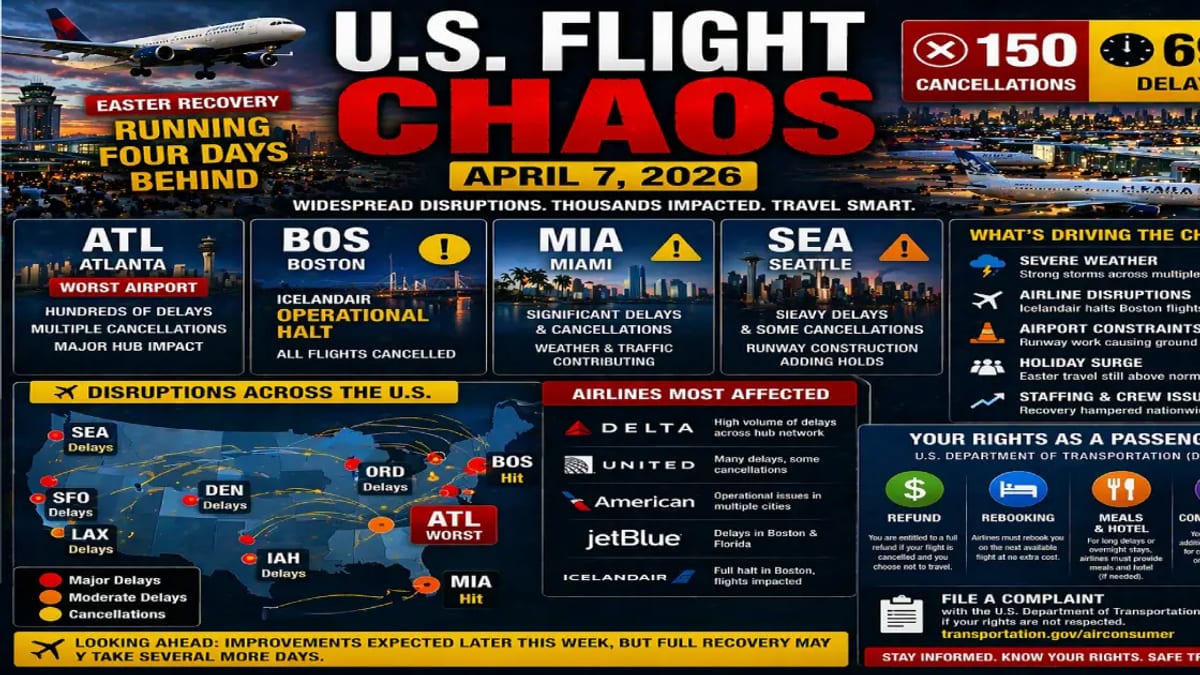
More than 844 flight disruptions across the United States on April 7 left passengers facing long lines, missed connections and overnight waits at major hubs, as storms in key regions collided with already stretched airline and air traffic control operations during one of the busiest post‑Easter travel weeks.
Get the latest news straight to your inbox!
Major Hubs Absorb Another Day of Turbulent Operations
Publicly available tracking data and industry coverage indicate that April 7 added another heavy day of disruption to an already difficult early April for US aviation, with well over 844 combined cancellations and significant delays recorded nationwide. Large connecting hubs such as Atlanta, Chicago, Dallas, New York, Los Angeles and Houston again featured prominently in disruption summaries, reflecting how tightly scheduled networks can seize up when just a few airports encounter constraints.
Reports from flight status platforms show that national delays on April 7 remained in the thousands, while cancellations numbered in the hundreds, echoing patterns seen on April 6, when more than 4,700 delays and over 300 cancellations were logged across US airports. Carriers with large hub operations, including the three biggest US network airlines and several regional partners, absorbed much of the impact as delays on inbound flights eroded connection windows and forced rebookings onto already full services.
Industry analysis suggests that the strain did not stem from a single system failure but from a convergence of factors, including lingering storms, airspace flow programs and resource constraints at some facilities. The result for travelers was similar regardless of root cause: rolling departure pushes, extended waits for gate space and crowded customer service desks at key connection points.
Miami and Southeast Hubs Hit Hard by Storms
The Southeast emerged as one of the hardest hit regions on April 7, as a band of heavy rain and thunderstorms swept across parts of Florida and neighboring states. At Miami International Airport, local and national outlets reported a morning ground stop for arriving flights tied to thunderstorm activity, followed by ongoing departure delays averaging around half an hour as conditions slowly improved.
Coverage focused on South Florida indicates that Miami logged more than 200 total disruptions for the day, including scores of late departures and arrivals and a notable cluster of cancellations. Nearby Fort Lauderdale also experienced knock-on delays, as airlines adjusted schedules and repositioned aircraft and crews around evolving storm cells and air traffic control restrictions.
Further north, major Southeast hubs such as Atlanta and Charlotte recorded dozens of cancellations and several hundred delays combined, according to travel-industry monitoring. These airports serve as primary connection points for domestic and international traffic across the region, so any capacity reduction quickly propagated through secondary airports from the Gulf Coast to the Carolinas, creating a patchwork of late-running flights and missed onward connections.
Nationwide Ripple Effects from One Day of Disruption
Although the most visible issues on April 7 were concentrated in the Southeast, the impact extended widely across the US network. Tracking data cited in travel coverage show that disruptions at big hubs often translated into rolling delays and equipment swaps at mid-sized airports, as aircraft scheduled for rapid turnarounds arrived late and crews bumped up against duty-time limits.
Reports indicate that large coastal gateways, including New York area airports, Boston and Los Angeles, appeared repeatedly in delay tallies as the day progressed, reflecting both their dependence on connecting traffic and their sensitivity to upstream disruptions. Even where local weather remained relatively benign, spacing requirements in congested airspace and bottlenecks at overtaxed ground operations contributed to departure queues and holding patterns.
For passengers, this meant that a storm cell in South Florida or a brief traffic management initiative at a single hub could translate into missed connections hours later in another region. With flights during the post‑Easter period running at high load factors, same‑day rebooking options were limited, and travelers often had to accept lengthy layovers, reroutes through secondary hubs or departures pushed into the following day.
Spring Travel Surge Collides With Structural Constraints
The April 7 turmoil unfolded against a backdrop of robust spring demand and lingering structural challenges in the US aviation system. Forecasts cited by national news outlets anticipate US airlines carrying well over 2.5 million passengers per day on average through March and April, leaving schedules with little slack when weather, airspace restrictions or technical issues arise.
While airlines have increased staffing and added aircraft compared with the immediate post‑pandemic years, analysts note that crew scheduling remains complex, and maintenance requirements and aircraft routing constraints can quickly limit flexibility on difficult days. At the same time, ongoing air traffic control staffing pressures at certain facilities and new operational constraints at some airports, such as runway construction and updated arrival rules, reduce the margin for absorbing irregular operations.
Recent coverage of San Francisco International Airport, for example, highlights how reduced arrival rates tied to runway work and federal safety rules are expected to push up average delays there through much of 2026. When such structural limits coincide with transient disruptions like the April 7 storms, the result can be widespread network instability that outlasts the initial trigger.
Travelers Confront Growing Need for Contingency Planning
For passengers caught in the April 7 disruptions, the experience underscored how even routine travel days can quickly unravel during peak periods. Images and reports from airports around the country described crowded concourses, long lines at customer service desks and extended waits for baggage as airlines worked through the backlog created by cancellations and late arrivals.
Consumer advocates and travel analysts responding to this latest wave of disruption emphasize the importance of advance planning, particularly when connecting through historically delay‑prone hubs or flying at the tail end of major holiday periods. Recommendations commonly include booking earlier departures where possible, allowing generous connection times and monitoring flight status through both airline apps and independent tracking services from the night before travel.
Publicly available guidance also encourages travelers to familiarize themselves with airline policies on weather‑related versus controllable disruptions, as these distinctions influence eligibility for meal vouchers, hotel support or refunds when irregular operations stretch into overnight stays. As the April 7 episode showed, a single day that generates more than 844 disruptions can have knock‑on effects for subsequent departures, making flexible itineraries and contingency plans increasingly valuable parts of US air travel.