

More news on this day
Thousands of air travelers across the United States found themselves stuck at airports or facing long, uncertain waits as major carriers including Delta, SkyWest, American, Southwest and United racked up 96 flight cancellations and 3,064 delays across key hubs such as Atlanta, Chicago, Los Angeles, New York, Miami, San Francisco and Phoenix.
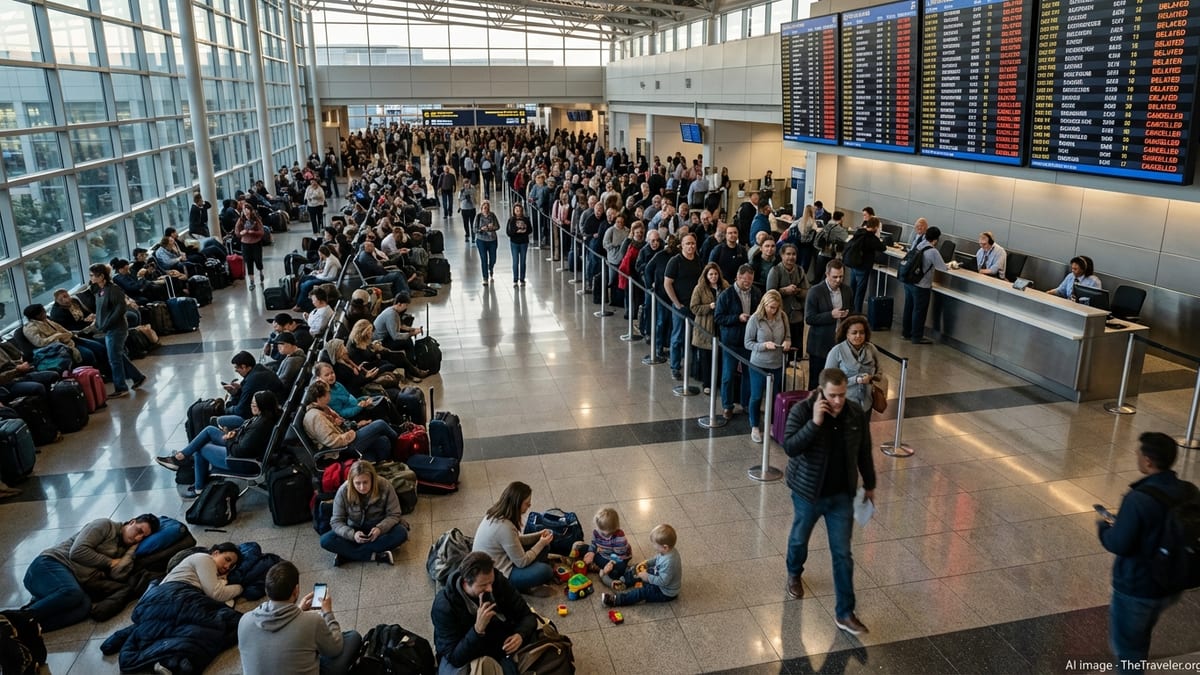
Disruptions Ripple Across the Nation’s Busiest Hubs
The latest bout of air travel disruption hit some of the country’s busiest gateways, stranding passengers at crowded concourses from Hartsfield Jackson Atlanta International to Chicago O’Hare, Los Angeles International and New York area airports. Operations also deteriorated at major sunbelt and West Coast hubs, including Miami, San Francisco and Phoenix, compounding the nationwide ripple effect.
While the headline figures of 96 cancellations and 3,064 delays may appear modest compared with the most severe meltdowns of recent years, aviation analysts say the pattern is familiar. A relatively small number of outright cancellations, combined with a very high volume of rolling delays, can leave passengers effectively “isolated” for hours or even days as missed connections and curfews cascade through the system.
Travelers reported long lines at customer service desks, difficulty rebooking online and scarce hotel availability around major hubs. Those caught in the disruption included business travelers returning from meetings, families on school-break trips, and international passengers attempting to connect to domestic flights onward from coastal gateways.
Because many affected airports serve as critical connection points for regional and small-city flights, the impact spread far beyond the large metros listed on the disruption tallies. Delays in Atlanta or Chicago quickly translated into missed last flights of the night for travelers bound for smaller communities across the Southeast, Midwest and Mountain West.
Weather, Congestion and Crew Shortages Converge
Industry data from flight-tracking services and airline operations centers pointed first to weather as a key trigger. Fast-moving storm systems, snow and low clouds over portions of the Midwest, Rockies and Northeast forced the Federal Aviation Administration to implement a series of ground stops and flow-control measures, limiting the number of takeoffs and landings at already busy airports.
Once those restrictions were in place, congestion built rapidly. Packed schedules at peak morning and evening banks left little slack for airlines to absorb even short runway closures. Aircraft queued on taxiways, departure slots backed up and inbound flights were held at origin airports, creating the first wave of delays felt by passengers in cities hundreds or even thousands of miles away from any severe weather.
At the same time, carriers continued to grapple with tight staffing in some crew bases, particularly among regional affiliates that operate shorter routes for the largest brands. When storms push aircraft and crews out of position, those staffing constraints become more visible, as airlines struggle to find reserve pilots and flight attendants who can legally and safely take over delayed flights once original crews “time out” under federal duty rules.
In this latest disruption, several airlines acknowledged that recovering schedules took longer than anticipated because available crews and aircraft were not where they needed to be once weather began to improve. That mismatch between resources and demand has become a recurring challenge during peak travel periods, particularly around weekends and holidays.
Major Carriers Shoulder the Brunt
Delta, SkyWest, American, Southwest and United accounted for the bulk of the cancellations and delays, reflecting their dominant roles at the affected hubs. Delta and its partners handle a large share of traffic in Atlanta and at several mid-continent hubs, while SkyWest operates regional flights feeding multiple major brands across the West and Midwest.
Southwest, with its point to point network and large operations in Phoenix, Chicago Midway, Denver and Southern California, is particularly exposed when storms move across multiple regions in quick succession. Even when the actual number of cancelled Southwest flights remains relatively low, late-arriving aircraft can quickly disrupt its tight turn times and dense schedules throughout the day.
American and United, for their part, remain highly concentrated at major connecting hubs such as Chicago O’Hare, Miami and Newark. Any operational slowdown at those airports can strand connecting passengers, particularly those arriving from international or long haul domestic routes whose options for same day rebooking are limited.
While each carrier pointed to weather and airspace constraints as primary causes, consumer advocates argue that thin staffing buffers and ambitious schedules leave airlines with too little resilience when conditions deteriorate. They note that the same names tend to appear at the top of delay tables whenever heavy storms or system outages strike.
Scenes of Frustration at Gate Areas and Ticket Counters
Inside terminals, the human impact of the statistics was visible in gate areas filled with passengers camped out on the floor and in corners, staring at departure boards that refreshed with new estimated times every half hour. Airport loudspeakers repeated apologies and boarding-time revisions as agents tried to juggle rolling delays, standby lists and crew reassignments.
Families described scrambling to find food, portable chargers and quiet spots for children as delays stretched late into the night. Business travelers, some with international meetings scheduled for the next morning, weighed whether to stay in line for rebooking or abandon their trips altogether. Others shared pictures of long lines snaking around terminal concourses as airline staff worked to reissue boarding passes and arrange hotel vouchers.
Some passengers reported that airline apps and websites were slow or repeatedly crashed under heavy demand, forcing them to rely on airport kiosks and staffed counters. Those digital bottlenecks echoed issues seen during earlier large scale disruptions, when technology systems strained under simultaneous rebooking requests and schedule changes pushed from airline operations centers.
Volunteer airport ambassadors and local concessions operators attempted to ease tensions by directing travelers to quieter seating areas, handing out water and extending operating hours where possible. Still, for many passengers, the prevailing mood was a mix of resignation and fatigue, with some resorting to overnight stays on terminal benches when hotel rooms sold out nearby.
Smaller Cities and Regional Flyers Hit Hard
Although major media attention focused on massive hubs like Atlanta, Los Angeles and New York, the disruption proved particularly painful for travelers starting or ending their journeys in smaller markets. Flights to secondary and tertiary cities often operate just once or twice a day, leaving limited backup options when a connection is missed at a hub.
Regional carriers such as SkyWest, which feed multiple large airlines from smaller communities, play an outsized role in these situations. When large numbers of mainline flights are delayed, regional departures are frequently pushed back or cancelled to free up scarce gates and runway slots for larger aircraft. That triage can leave travelers in places like smaller Midwest or Mountain West cities marooned for 24 hours or more.
For business travelers, that can translate into missed client meetings, lost work days and added costs as they scramble to book last minute hotel rooms or rental cars in alternative cities. For leisure travelers, especially those on tight vacation schedules or with nonrefundable reservations, a single missed night can significantly diminish the value of their trip.
Airport managers in mid-size markets say they are working closely with airlines and the FAA to improve communication when large-scale disruptions unfold, but acknowledge that their options are limited when aircraft and flight crews are simply not available. Many encourage passengers to sign up for direct alerts from both airports and airlines for the most up to date local information.
Regulators and Lawmakers Renew Pressure on Airlines
The latest wave of delays comes as the Department of Transportation and members of Congress continue to scrutinize how airlines handle widespread operational failures. After past meltdowns, particularly involving large carriers overwhelmed by winter storms and technology outages, regulators have pressed airlines to strengthen contingency plans and improve compensation policies for stranded passengers.
Officials have emphasized that while weather itself is beyond airline control, how carriers plan for seasonal storms, invest in backup systems and treat customers when things go wrong are very much under their purview. Recent enforcement actions and public warnings signal a willingness to levy significant penalties when investigators determine that carriers failed to meet promised standards.
Advocacy groups argue that more transparent and enforceable rules are still needed, especially on issues such as automatic refunds for long delays, guaranteed meal and hotel vouchers when disruptions are within airline control, and prompt rebooking on rival carriers when an airline has no viable alternative. They say the recurring scenes of stranded passengers demonstrate that voluntary commitments have not gone far enough.
Airlines counter that they have already made substantial investments in irregular operations playbooks, upgraded crew scheduling tools and improved customer communication via apps and text alerts. They caution that overly rigid rules could backfire by forcing them to pare schedules and raise fares to account for higher regulatory risk and operating costs.
Passengers Weigh Options and Seek Workarounds
For travelers caught in the latest disruption, practical choices were often limited. Some opted to accept multi stop reroutes that added hours of flying and airport time to their journeys, taking any available seat that would move them closer to their final destination. Others abandoned flights altogether in favor of rental cars, buses or trains when alternative ground transportation was available.
Seasoned frequent flyers advised fellow passengers to check nearby airports for open seats, even if that meant a drive of several hours once they landed. They also encouraged travelers to monitor flights to and from other hubs where weather conditions were more favorable, since agents can sometimes rebook stranded passengers via alternative routes if seats are open.
Travel insurance providers reported an uptick in calls from customers seeking clarity on coverage for hotel nights, meals and missed connections caused by delays rather than outright cancellations. Policies vary widely, and many travelers only discover the limitations of their coverage when they are already stuck at the airport.
Consumer advocates again urged passengers to document all expenses, keep screenshots of delay notifications and retain boarding passes, which can be useful when filing claims with airlines, credit card issuers or insurers after the fact. They also reminded travelers that, even when weather is listed as the primary cause, airlines may still offer goodwill vouchers, frequent flyer miles or other partial compensation if customers persist in following up.
Looking Ahead to a Packed Travel Calendar
The disruption unfolds against a backdrop of robust demand for air travel, with airlines reporting strong bookings for upcoming holiday periods, spring breaks and major events across the United States. That appetite for travel, combined with tight pilot and aircraft supply, leaves little margin for error when storms, IT glitches or air traffic control constraints hit.
Industry planners say they are working to fine tune schedules, add spare aircraft where possible and coordinate more closely with the FAA to anticipate bottlenecks at critical times of day. Some carriers have trimmed marginal routes or off-peak frequencies to create more operational breathing room at the busiest hubs.
Still, aviation experts caution that passengers should expect continued volatility, particularly during stormy seasons and around high-demand weekends. They recommend that travelers build in extra time, favor morning departures where practical and consider nonstop flights when possible, since each added connection introduces another potential failure point in the system.
For the thousands of travelers isolated and delayed during the latest wave of cancellations and schedule disruptions, those lessons are arriving the hard way. As airlines, regulators and airports debate long term fixes, passengers remain on the front lines, navigating a system that can swing from smooth to chaotic with a single shift in the weather or a handful of grounded aircraft.