

More news on this day
Thousands of passengers across the United States are facing lengthy waits, missed connections, and overnight stays in airports as a fresh wave of flight disruptions ripples through major carriers and hub cities, with dozens of cancellations and more than 3,000 delays reported in recent days.
Get the latest news straight to your inbox!
Major Airlines Struggle With Another Day of Disruption
Publicly available tracking data and recent industry coverage indicate that Spirit Airlines, American Airlines, Southwest Airlines, United Airlines, JetBlue and several other carriers are again contending with widespread scheduling problems across the United States. While outright cancellations have remained comparatively limited, numbering in the dozens, delays have surged into the low thousands as aircraft and crews fall out of position and congestion builds at key hubs.
Reports from national and specialist travel outlets show that, over multiple days in early April, U.S. airports collectively recorded several thousand delayed departures and arrivals alongside roughly 60 to 70 canceled flights on some of the most heavily affected days. These figures translate into thousands of disrupted journeys, as even a single delayed aircraft can impact onward legs and connections deep into an airline’s network.
Operational statistics published this week highlight how the burden has been shared across carriers. American, Southwest, United, Spirit and JetBlue have all featured prominently in delay tables, alongside Delta and Alaska on certain days. Some analyses of March and early April performance point to a noticeable softening in on time arrivals for several low cost and network airlines, reflecting a system under persistent strain.
The pattern resembles earlier disruption episodes seen during busy holiday periods, when relatively modest numbers of cancellations can mask a much larger pool of delayed flights, missed connections and last minute rebookings for travelers relying on tight transfer windows.
Pressure Points at Atlanta, Houston, Chicago and Orlando
Recent tracking of individual hubs suggests that the disruption has been especially visible at Atlanta, Houston and Chicago, three airports that sit at the heart of large domestic and international networks. Data reviewed by travel outlets for April 7 and the surrounding days show Atlanta’s Hartsfield Jackson International Airport dealing with dozens of cancellations and several hundred delays, with knock on effects for routes linking Georgia to major cities across the South and Midwest.
Chicago O’Hare and Houston George Bush Intercontinental have reported similar patterns, with high volumes of delayed services overshadowing a smaller number of outright cancellations. Reports indicate that at O’Hare, weather and airspace constraints in recent days have triggered arrival holds and departure restrictions, spreading delays onward to cities such as New York, Orlando and San Francisco as aircraft rotate through their daily schedules.
Orlando, a key leisure gateway for both domestic and international visitors, has also emerged as a recurring trouble spot. Coverage of the latest operational statistics describes waves of late running departures to and from Orlando as thunderstorms and congestion along the East Coast force airlines to slow the pace of arrivals. For families traveling at the tail end of the spring break and Easter period, even moderate schedule changes have translated into missed park reservations, shortened vacations and extra hotel nights.
Because many of these hubs function as connection points, disruption in any one of them can quickly spread nationwide. A delay in Atlanta or Chicago early in the day can cascade into late evening departures from smaller cities that depend on those hubs for onward links, leaving passengers stranded far from the original source of the problem.
Northeast Corridors and West Coast Bottlenecks
In the Northeast, New York area airports and Philadelphia have seen their own waves of disruption tied to the same national pattern. New York’s major fields have repeatedly appeared near the top of daily rankings for delayed flights, according to compilations by aviation analytics services and consumer rights groups. Newark, LaGuardia and John F. Kennedy have all reported days with well over one hundred affected services, impacting both short haul domestic routes and longer haul flights to the West Coast and Europe.
Philadelphia has also experienced elevated levels of delay as traffic flows in and out of the Mid Atlantic, with airline scheduling decisions in New York and Washington feeding into the city’s own arrival and departure banks. Corridor congestion in this region is particularly sensitive to weather and air traffic control capacity, so even short lived thunderstorms or low clouds can reduce throughput and force airlines to trim or slow operations.
On the West Coast, San Francisco International Airport continues to operate under runway capacity limits linked to ongoing infrastructure works and revised landing procedures. Industry reporting describes how these constraints, combined with bouts of coastal weather, have left the airport handling fewer movements per hour than in previous years, raising the risk of rolling delays on busy days. When storm systems pass through Northern California, departure queues lengthen and inbound aircraft may be held in the air, worsening punctuality metrics for multiple airlines at once.
As flights connecting San Francisco to Chicago, Houston, New York and Atlanta run behind schedule, the effects loop back into the broader national network, complicating efforts by airlines to restore normal operations elsewhere in the country.
Why Delays Far Outnumber Cancellations
Analysts note that, despite passenger perceptions of chaos, the total number of canceled flights on many of these recent days has remained relatively low compared with historical mass disruption events. Reports from travel industry publications emphasize that airlines often prefer to operate behind schedule rather than cancel outright, especially when aircraft and crew are already in place and demand is strong.
This approach keeps more seats in the air, but it also means that delays can build steadily throughout the day. A morning departure from Houston or Orlando that leaves one hour late may cause its next leg to depart two hours behind schedule from Chicago or New York, with the final outbound flight of the evening ending up significantly delayed. Passengers booked on those later services may experience the longest waits, even though the original issue occurred many hours and hundreds of miles away.
In addition, publicly available on time performance summaries for March suggest that some carriers are operating closer to the limits of their scheduling resilience. When average arrival punctuality slips, it can indicate that there is less buffer built into the timetable to absorb routine slowdowns caused by congestion, ground handling challenges or short bursts of poor weather. Under such conditions, a relatively small disturbance may be enough to push a large portion of the daily schedule beyond the 15 minute threshold that counts as a delay.
Consumer advocates point out that these dynamics make it difficult for travelers to predict which flights will be most affected. Two departures from the same airport on the same airline can face very different risk profiles depending on where those aircraft have flown earlier in the day and how heavily they depend on congested hubs such as Atlanta, Chicago, Houston, New York or San Francisco.
What Travelers Are Experiencing on the Ground
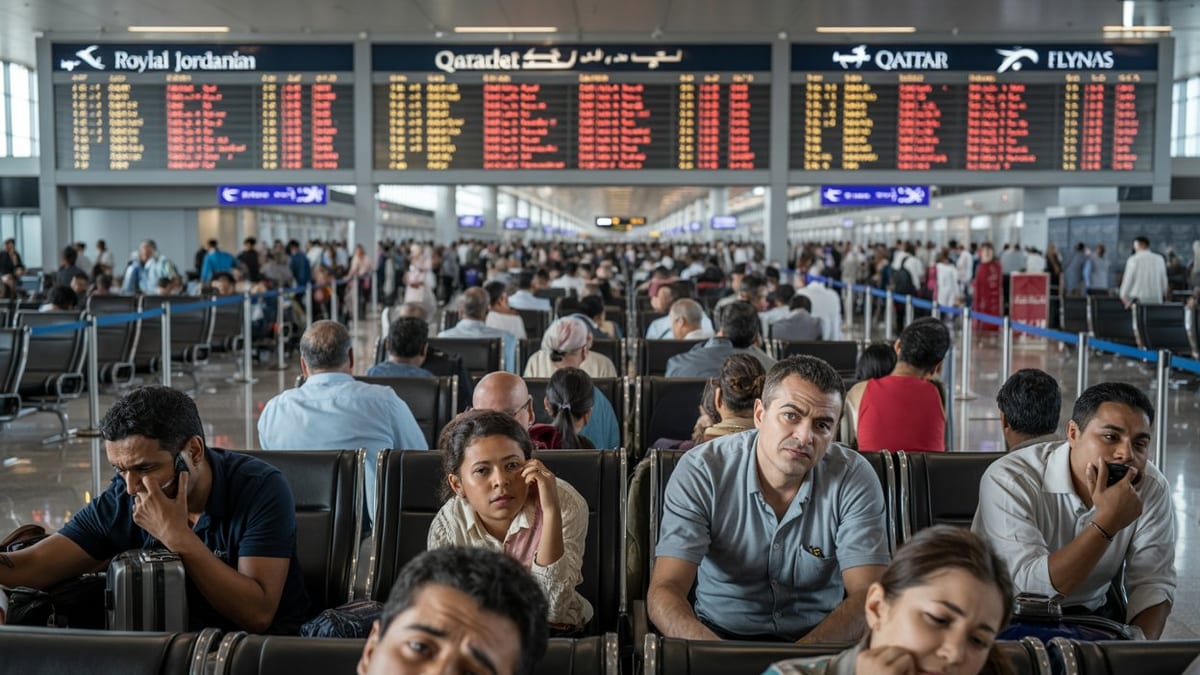
Reports from airports across the affected network describe crowded gate areas, long queues at customer service desks and busy call center and chat channels as passengers seek rebooking options. Even when flights eventually operate, lengthening delays can cause travelers to miss connections at downline hubs, forcing them to wait for the next available departure or, in some cases, stay overnight.
In cities such as Atlanta, Chicago and Orlando, the concentration of connecting traffic has meant that a single period of severe weather or airspace restriction can leave hundreds of travelers in limbo. Some reach their final destination hours later than planned, while others find themselves rebooked through alternative hubs, adding extra segments and travel time to already long itineraries.
In the New York and San Francisco regions, where airports are operating close to capacity, travelers have also had to contend with tight turnaround times and last minute gate changes as airlines work to keep aircraft and crews moving. Public guidance from consumer organizations and travel rights services consistently urges passengers to monitor flight status closely, arrive early at the airport during known disruption windows and consider early morning departures, which are statistically less likely to be affected by knock on delays.
With spring travel demand remaining strong and infrastructure and staffing constraints expected to persist into the summer, industry observers suggest that elevated levels of delay may continue, particularly on days when storms or low visibility affect multiple hubs at once. For now, the latest figures show that while only a few dozen flights may be canceled outright on a given day, the far larger number of delayed services is leaving thousands of travelers across the United States facing unpredictable and often exhausting journeys.