

More news on this day
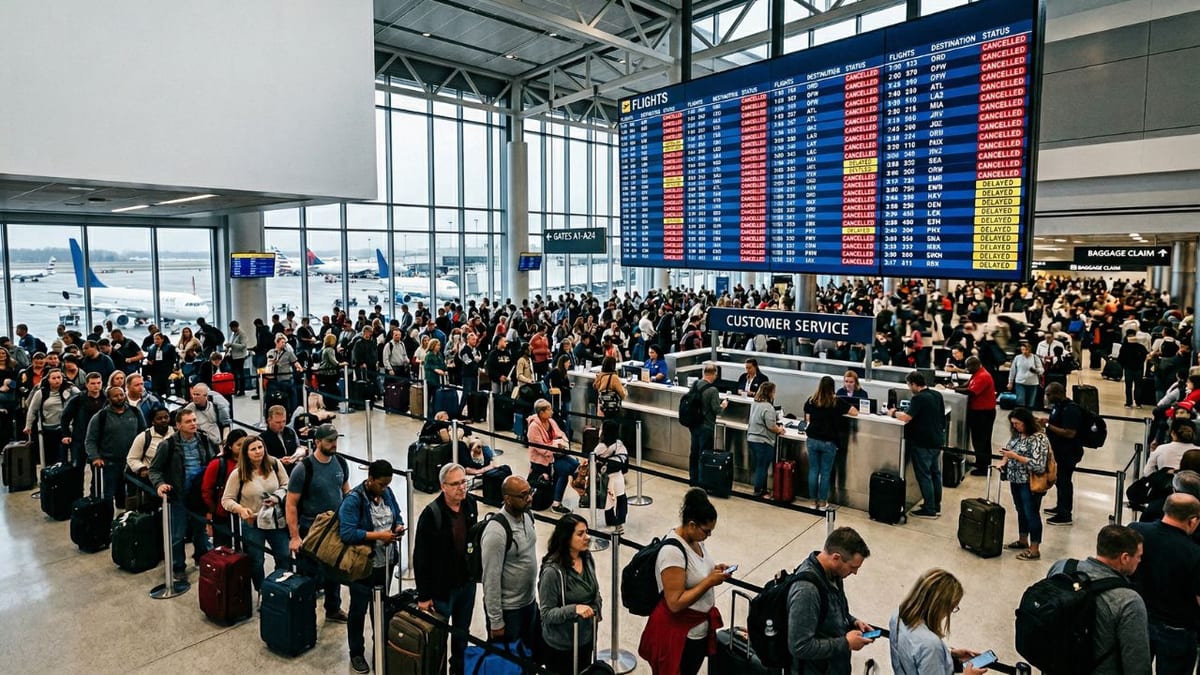
Air travel across the United States has been hit by another day of heavy disruption as flight-tracking data and industry reports indicate roughly 114 cancellations and more than 3,400 delays affecting operations at 27 major airports, snarling travel plans for an estimated 50,000 to 70,000 passengers from New York and Los Angeles to Seattle, Miami, Orlando and Atlanta.
Get the latest news straight to your inbox!
Nationwide Disruptions Concentrated at Key Hubs
Publicly available data from flight-tracking platforms and industry coverage depict a system under acute strain, with disruptions concentrated at the nation’s most important connecting hubs. Reports covering the early April travel period show repeated waves of cancellations and thousands of delays centered on airports such as Hartsfield-Jackson Atlanta International Airport, New York’s LaGuardia and John F. Kennedy airports, Los Angeles International Airport, Orlando International Airport and Seattle-Tacoma International Airport.
Recent tallies compiled from multiple reports describe days when delays alone have surpassed 4,000 flights nationwide, with several hundred cancellations layered on top. On some days, Los Angeles, Atlanta, Boston, Chicago, Houston, Orlando, New York and Seattle collectively accounted for well over 4,000 delays and more than 200 cancellations, illustrating how a relatively small group of hubs can drive disruption across the entire domestic network.
The latest figures of about 114 cancellations and 3,440 delays fit into this broader pattern of rolling instability rather than an isolated event. Even when the absolute number of cancellations is lower than during major winter storms, the scale of delays at busy hubs creates a cascading effect that ripples outward to secondary airports and regional routes.
For travelers, the practical impact is similar whether they depart from a mega-hub or a smaller field: aircraft and crews stranded out of position at the largest nodes in the system can quickly lead to missed connections, overnight stays and last-minute re-routing far from the original itinerary.
Passengers Face Long Lines and Fragmented Journeys
Across the network, the combination of late arrivals, rolling ground delays and short-notice cancellations has translated into long lines at check-in counters, crowded gate areas and mounting frustration for passengers attempting to complete even short domestic trips. Coverage from consumer-focused travel sites and aviation news outlets describes scenes of travelers camped out near power outlets, waiting hours for updated departure times and scrambling to rebook around missed connections.
With delays now frequently measured in the thousands on busy days, estimates that 50,000 to 70,000 passengers may be affected during a single disruptive period are consistent with the volume of scheduled seats moving through the largest airports. Even a modest percentage of flights running late can translate into tens of thousands of people arriving hours behind schedule, missing events or being forced to extend hotel stays.
Recent case studies at hubs such as Miami, Newark and LaGuardia highlight how quickly local problems can snowball. One day of heavy weather or an operational bottleneck at a single airport has been linked to hundreds of delays and dozens of cancellations, which then propagate through the network as aircraft and crews fail to reach their next scheduled departure points on time.
Travel advice published in the wake of these disruptions consistently encourages passengers to build extra buffer time into their journeys, monitor flight status through airline apps, and prepare for the possibility of rerouting through alternative hubs if their primary connection point becomes gridlocked.
Weather, Congestion and System Capacity Under Scrutiny
While no single cause is solely responsible for the latest wave of disruptions, publicly available analyses point to a combination of factors interacting in ways that expose longstanding fragilities in the US aviation system. Recent storms in March and early April produced days with more than 1,000 cancellations and several thousand delays, and lingering weather in key regions has continued to slow operations even after the most intense cells have passed.
Government reports on flight delays and cancellations describe a broad “national aviation system” category that includes non-extreme weather, airport operations, heavy traffic volume and air traffic control constraints. Recent patterns strongly suggest that these overlapping issues are driving much of the current turbulence, particularly at already congested airports where small schedule disruptions have an outsized impact on departure and arrival flows.
Industry and policy analyses have also drawn attention to staffing and capacity challenges. Air traffic control staffing levels have been the subject of recent federal reviews, while airlines themselves continue to balance crew availability, aircraft utilization and robust demand. When storms or bottlenecks disrupt that balance, the margin for recovery can be thin, and the result is a multiday sequence of irregular operations rather than a short, contained event.
For passengers, the distinction between a delay attributed to weather and one linked to the broader aviation system is often academic. What matters most is whether the disruption leads to compensation, ticket refunds or alternative travel options, topics that remain complex and vary by airline, route and regulatory framework.
High-Demand Travel Periods Magnify the Impact
The current wave of disruption has unfolded against the backdrop of a busy late-winter and early-spring travel season, including the Easter and spring break periods. Coverage of recent weekends has repeatedly noted that storms and low visibility struck at precisely the time when passenger volumes through hubs in Florida, the Northeast and major Midwest cities were already elevated.
In practical terms, this means that on days when cancellations and delays spike, there are fewer empty seats available on alternative flights to absorb displaced travelers. Reports on recent events at large hubs describe passengers being rebooked not only later the same day, but sometimes one or two days out, particularly on heavily traveled routes into and out of Florida and coastal gateway cities.
Analyses of historic delay patterns indicate that airports such as Orlando and several New York area fields are consistently among the most delay-prone, particularly during peak holiday periods. When these airports experience simultaneous weather and capacity constraints, the effects are magnified across the network as connecting banks of flights miss their planned departure windows.
As a result, even travelers passing through relatively unaffected airports can find themselves entangled in the aftermath of disruptions originating hundreds or thousands of miles away, as their inbound aircraft originates from or passes through one of the hardest-hit hubs.
What Travelers Can Expect in the Coming Days
Based on recent patterns, today’s tally of 114 cancellations and 3,440 delays may represent only one chapter in a broader spell of choppy operations rather than a single-day anomaly. Industry coverage of earlier disruptions in March and early April notes that recovery often stretches over several days, as airlines reposition aircraft, reset crew schedules and work through backlogs of displaced passengers.
Travel media reports suggest that passengers with upcoming trips through major hubs including New York, Los Angeles, Seattle, Miami, Orlando and Atlanta should prepare for the possibility of extended travel days. Strategies frequently recommended include booking earlier flights in the day, allowing longer connection times, and staying flexible about routing options in case primary hubs become congested.
Observers note that the recent sequence of widespread disruptions has intensified debate around the resilience of the US aviation system. Repeated episodes of multi-thousand-flight delay days, even outside of extreme weather disasters, have prompted questions about scheduling practices, infrastructure capacity and the pace of ongoing modernization efforts in air traffic management.
For now, the immediate reality for tens of thousands of passengers is a familiar one: long waits in terminal corridors, itineraries rewritten on the fly, and renewed attention to the increasingly unpredictable task of getting from one end of the country to the other by air.