

More news on this day
Overlapping crises in Washington and the Middle East are converging on US airports, as a protracted federal government shutdown and an expanding war in Iran raise concerns that flight security gaps and operational strain could leave American air travel more vulnerable to terrorism and hostile state activity.
Get the latest news straight to your inbox!
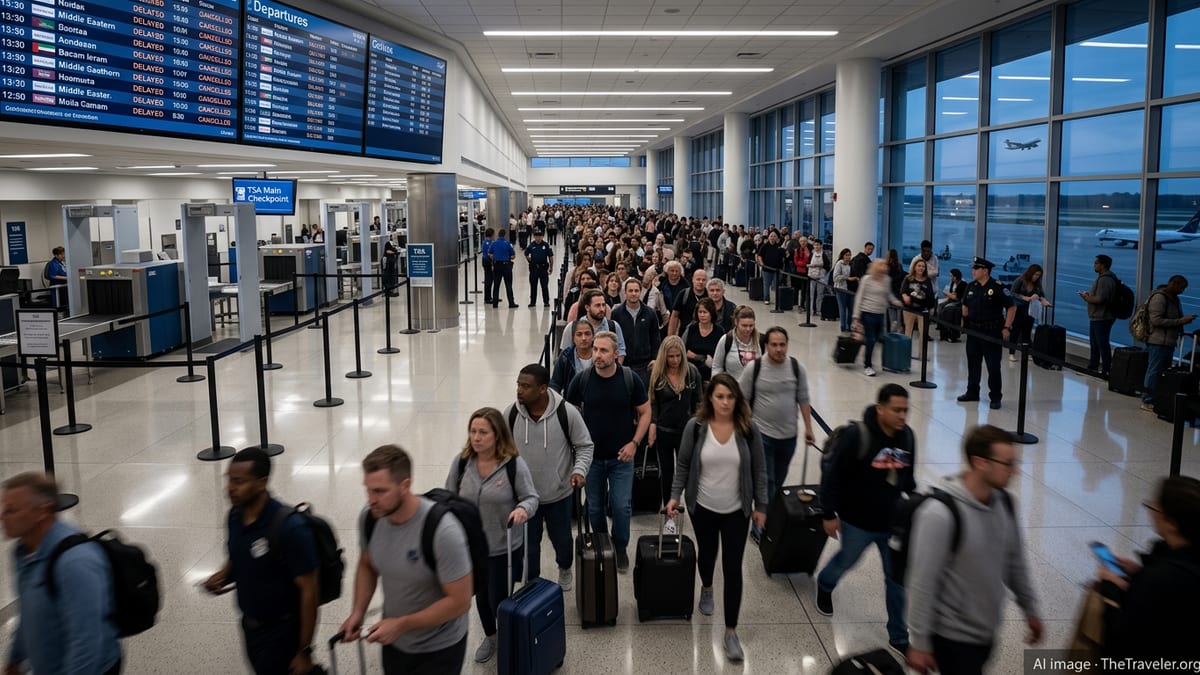
Shutdown Pressures Erode Resilience at US Airports
Federal budget gridlock is once again rippling across the US aviation system, with core safety and security functions forced to operate under intense financial and staffing pressure. Publicly available guidance from travel and industry groups indicates that, while Transportation Security Administration screeners and air traffic controllers remain on the job as essential personnel, many are working without pay and with limited support. Past shutdowns have already shown that this environment can extend passenger wait times, disrupt training, and delay critical safety inspections, collectively weakening the system’s resilience during periods of elevated threat.
Union statements, advisory documents, and media coverage have repeatedly warned that unpaid mandatory shifts, curtailed overtime, and suspended hiring pipelines increase the risk of burnout and attrition among front-line security staff. Reports following the 2025 shutdown described a pattern of longer lines, localized staffing gaps, and reduced tolerance for further shocks. Analysts now caution that entering a new phase of global instability from this weakened baseline leaves less margin for error if a major security incident or attempted attack targets the aviation sector.
Independent analyses of shutdown impacts on travel also highlight a less visible vulnerability: the slowdown or suspension of administrative and analytical functions that underpin aviation security, including some compliance audits, data-driven risk assessments, and modernization projects. While screening lanes and control towers continue to operate, the back-end work that keeps security protocols current, calibrated, and well-tested can fall behind, compounding risks over time.
Travel organizations are advising passengers to arrive earlier at airports and to prepare for uneven conditions across the country, noting that smaller and regional airports often feel staffing pressures first. For counterterrorism specialists who track aviation risk, this patchwork effect is troubling, because actors seeking to exploit gaps are likely to probe the system at its perceived weakest points rather than at the busiest hubs.
War in Iran Rewrites Global Flight Patterns
The rapidly escalating conflict centered on Iran is reshaping global air corridors across the Middle East, Europe, and Asia, with growing knock-on effects for flights to and from the United States. Since coordinated United States and Israeli strikes on Iranian targets at the end of February 2026, open-source assessments and aviation industry reports describe a pattern of retaliatory Iranian missile and drone attacks on US and allied bases in the Gulf, as well as threats to commercial shipping in the Strait of Hormuz. This has turned large swaths of airspace across Iran, Iraq, Israel, and surrounding regions into conflict zones or high-risk areas.
Specialized aviation outlets and regional travel publications report that Iran’s temporary closure of its airspace earlier in the year prompted widespread diversions, with airlines routing flights south via Saudi Arabia and Egypt or along more circuitous northern tracks. European regulators have issued conflict-zone bulletins strongly advising carriers to avoid the Tehran Flight Information Region, while monitoring groups document persistent use of longer routes that add hours of flying time and fuel burn to transcontinental services.
Data compiled by aviation analysts and regional news sites suggest that more than twenty thousand flights have been canceled since the war began, with some major Gulf hubs suffering direct disruptions and significant schedule upheaval. Gulf and European carriers have suspended most flights to Iran and have sharply limited overflights, while US and Asian airlines have quietly reprogrammed long-haul routes that once transited Iranian or Iraqi airspace on the way to South Asia and the Pacific.
Although many of these disruptions are occurring thousands of miles from US shores, their effects are being felt across global networks. Aircraft and crews tied up in rerouted or delayed operations in the Middle East reduce flexibility elsewhere, and congestion along remaining safe corridors can introduce new operational challenges. For US-bound travelers coming from South or Southeast Asia, longer flight times, missed connections, and last-minute cancellations are becoming more common as carriers adjust schedules day by day.
Heightened Terror and Cyber Risks to Aviation
Security specialists who track terrorism and state-sponsored threats note that conflict in Iran and instability across the region typically coincide with elevated risk levels for aviation. Historical precedents, including the 2020 downing of a Ukrainian passenger jet near Tehran, continue to influence how airlines and regulators view the dangers of operating in or near active conflict zones. According to open-source intelligence briefs, the current war features widespread use of missiles, drones, and, in some areas, suspected GPS interference and electronic warfare, all of which can complicate navigation and air traffic control.
Independent monitoring groups and regional media have documented instances of GPS spoofing and degraded satellite navigation in parts of the Middle East since January, forcing crews to fall back on alternative procedures and increasing cockpit workload. When compounded by crowded alternate routes and rapidly changing military activity on the ground and at sea, analysts argue that the overall risk environment for miscalculation or accidental targeting remains elevated, particularly for flights crossing or skirting contested airspace.
Beyond kinetic threats, cyber and insider risks are drawing renewed attention. Aviation security assessments released in recent months refer to growing concern that hostile actors could target airport IT systems, airline reservation platforms, or air navigation service providers during moments of political distraction or institutional stress. With US security agencies operating under shutdown constraints and many personnel focused on immediate operational continuity, experts warn that longer-term projects to harden networks and modernize detection tools may be slowed or deferred.
Counterterrorism researchers also note that extremist propaganda often seizes on major international crises, portraying them as justification for attacks on Western targets, including aviation. Although there is no confirmed large-scale plot publicly linked to the current conflict, online monitoring indicates that militant messaging has intensified since the opening days of the Iran war, increasing pressure on already stretched investigative and screening systems in the United States and allied countries.
US Flight Security Confronts a Global Shock Test
As international carriers reroute around Iran and pressure builds on remaining air corridors, US-bound routes are being tested for flexibility and security resilience. Industry briefings and travel advisories describe an operational environment where airlines must quickly reprogram flight plans, recalibrate fuel loads, and coordinate with multiple air navigation authorities as military notices and airspace closures appear with little warning. For aviation security planners, this complexity creates more opportunities for miscommunication and procedural drift.
Business travel associations and risk consultancies are advising corporate clients to treat the Iran war as a regional escalation with truly global effects. Recommendations emphasize closer coordination between travel managers, security teams, and airline partners, as well as more conservative routing choices and contingency planning. In this context, US airports serve as both entry points to a stressed global network and last lines of defense against threats incubated abroad.
The overlay of a domestic funding crisis on this international turbulence is drawing particular scrutiny. Analysts point out that when federal agencies face hiring freezes, delayed training, and constrained investment at home, their ability to respond adaptively to overseas crises shrinks. Aviation experts warn that even if US skies remain calm, the system’s demonstrated fragility under recent shutdown conditions should be treated as an early warning about how it might perform under a truly severe shock.
For travelers, the immediate impacts are measured in longer lines, extra layover time, and rising uncertainty over last-minute changes. For security professionals, the concern runs deeper: a rare convergence of domestic budget strain and external conflict is exposing weak points in the global aviation architecture, with US flight security standing at the intersection of both trends. How swiftly these vulnerabilities are addressed may determine whether the current turbulence remains a logistical headache or evolves into a more serious test of the system’s ability to deter and withstand terror threats.
What Airlines and Travelers Are Doing Now
Airlines appear to be responding with a mix of caution and improvisation. According to aviation trade coverage, carriers are shifting capacity away from high-risk routes, trimming frequencies into certain Middle Eastern hubs, and accelerating use of dynamic flight planning tools that allow dispatchers to change routings late in the process. Some have publicly acknowledged higher operating costs stemming from longer routings and additional fuel, a burden that could eventually feed into ticket prices on affected long-haul markets, including flights linking the United States with South and Central Asia.
Airports and carriers are also leaning more heavily on real-time intelligence from aviation safety agencies, military notice systems, and commercial risk advisories. While these information streams have long existed, the current situation is testing how quickly they can be translated into operational decisions at scale. Any lag between a new threat assessment and a route adjustment introduces a window in which aircraft could be exposed to emerging risks.
For individual travelers, the guidance remains relatively straightforward but increasingly important: monitor flight status more closely, allow extra time for security, and remain alert to changing advisories, particularly for itineraries involving connections through Europe, the Gulf, or South Asia. Travel risk firms are encouraging clients to maintain updated traveler tracking tools and clear communication protocols so that stranded or rerouted staff can be supported quickly.
Behind these practical steps lies a larger strategic question for the United States and its partners: whether the combined strain of a domestic shutdown and an external war will spur lasting investment in aviation security and crisis management, or whether the system will once again revert to business as usual once immediate pressures ease. For now, experts argue that the convergence of these crises offers a stark reminder that flight security is only as strong as the political and fiscal stability that sustains it.