

More news on this day
Air travel across the United States has entered another turbulent phase, with new data showing 114 flight cancellations and 3,440 delays in a single day across 27 major airports, snarling operations for Delta Air Lines, American Airlines and Southwest Airlines from New York and Los Angeles to Miami, Atlanta, Orlando and Seattle.
Get the latest news straight to your inbox!
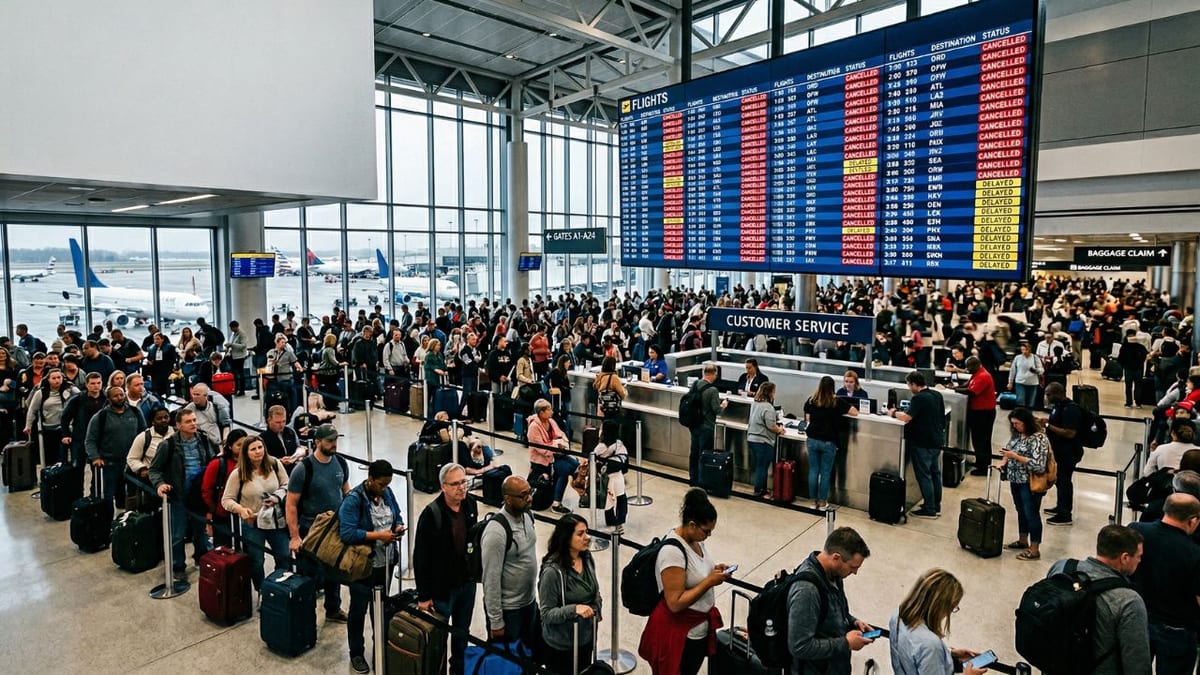
Nationwide Disruptions Concentrated at Major Hubs
Publicly available tracking figures for the current wave of disruption indicate that cancellations and delays are heavily concentrated at the country’s largest connecting hubs, amplifying the impact well beyond the airports where individual problems first arise. New York’s three major airports, Los Angeles International, Miami International, Atlanta’s Hartsfield-Jackson, Orlando International and Seattle-Tacoma International all feature prominently in the latest disruption tallies.
Reports compiled from flight-monitoring platforms show that even a relatively modest number of outright cancellations can trigger a far larger cascade of delays as aircraft and crew rotate through tightly timed schedules. Once a morning departure from a hub like Atlanta or New York is canceled or significantly delayed, knock-on effects often extend deep into the evening across multiple regions, particularly on heavily traveled corridors such as the Northeast to Florida and the West Coast spine.
Recent coverage of U.S. flight performance has highlighted that a small set of large hubs, including Atlanta, Los Angeles, the New York area airports and Orlando, account for a disproportionate share of total passenger delay hours. When simultaneous disruptions hit several of these airports, travelers around the country can quickly feel the impact, even in cities that are not directly affected by adverse weather or local operational issues.
The current pattern mirrors earlier disruption spikes seen during storms in February and March 2026, when thousands of delays were recorded in a single day and large numbers of flights were preemptively canceled at key hubs. While the latest figures of 114 cancellations and 3,440 delays are lower than those peak storm days, the breadth of affected airports underlines the fragility of the system during periods of high demand and constrained capacity.
Delta, American and Southwest Face Fresh Operational Strain
Delta Air Lines, American Airlines and Southwest Airlines are among the carriers most exposed to the latest wave of disruptions, reflecting their dominant positions at the country’s busiest hubs. Data from recent days shows that Delta and American continue to manage large networks centered on Atlanta, New York and Miami, while Southwest’s extensive domestic footprint makes it particularly sensitive to rolling delays that spread from one region to another.
Coverage of recent disruption days indicates that Delta has faced a mix of cancellations and schedule slippages at Atlanta, New York and Seattle, where the carrier has substantial operations. American has seen similar pressure at its gateway airports in New York and Miami, with delays compounded when weather or traffic-management initiatives reduce arrival and departure capacity during already busy travel periods.
Southwest, which focuses heavily on high-frequency domestic routes and uses a point-to-point rather than traditional hub-and-spoke model, has experienced sizable delay counts when congestion or ground stops affect airports such as Los Angeles, Orlando and other high-volume leisure destinations. In those circumstances, late-arriving aircraft can quickly ripple through the network, pushing subsequent flights behind schedule even if conditions have improved at the original trouble spot.
Industry data and government reports have repeatedly shown that the causes of delays and cancellations are often shared among multiple factors, including airline-controlled issues such as crew and maintenance, as well as broader national aviation system constraints like air traffic control staffing, non-extreme weather and heavy traffic volume. The most recent figures appear to follow that pattern, with no single carrier solely responsible for the nationwide totals.
Passengers Confront Missed Connections and Overnight Stays
For travelers, the statistical picture of 114 cancellations and 3,440 delays translates into long lines, missed connections and, in some cases, unexpected overnight stays. Major hubs such as New York, Atlanta and Los Angeles handle vast numbers of connecting passengers, so a delay of even an hour on an early leg can be enough to strand travelers when onward flights are already operating at or near full capacity.
Reports from recent disruption days show that leisure-focused airports like Orlando and Miami have been particularly busy as spring travel demand builds, increasing the chances that passengers will find limited options for same-day rebooking. Families returning from holidays or cruises are often traveling at fixed times, which can make it harder to accept alternative routings or next-day departures without significant additional cost.
Operational strains can also lead to uneven experiences across different parts of the network. While some travelers might encounter only minor schedule adjustments, others may find themselves facing multi-leg re-routings through cities far from their original itinerary as airlines work to reposition aircraft and crews. This can be especially challenging for passengers traveling with young children or tight ground connections, such as cruises, events or international departures from other hubs.
Advocacy groups and travel analysts have noted that such disruption clusters continue to erode traveler confidence in the reliability of domestic air service. They point to recurring episodes of large-scale delays as evidence that airline schedules, airport infrastructure and air traffic management still lack sufficient resilience to handle weather shocks, system outages or surges in demand without causing widespread passenger hardship.
Weather, Infrastructure and System Limits Behind the Numbers
While no single cause explains every cancellation or delay in the latest figures, recent weeks have underscored how quickly weather, infrastructure constraints and systemic limits can converge. Winter storms in January and February 2026 brought heavy snow and ice to key regions, leading to hundreds of cancellations at times and forcing airlines to reset schedules at hubs such as Atlanta, Boston and Chicago. Subsequent early spring systems have added bouts of thunderstorms, low visibility and high winds to an already stretched network.
Government documentation on aviation performance shows that many disruptions fall under broad categories such as national aviation system delay, which covers non-extreme weather, airport operations and congestion. Even on days without headline-making storms, relatively minor disturbances can cause significant slowdowns when airports are close to their maximum throughput and when traffic management measures reduce the number of aircraft that can land or depart each hour.
Infrastructure projects can add further complexity. Runway maintenance, airspace modernization work and terminal improvements at major hubs like Los Angeles, New York and San Francisco have, at times, reduced capacity or altered normal traffic flows, leaving less margin to absorb irregular operations. Published analysis indicates that such constraints are particularly visible during peak travel windows, when schedules are densest and recovery options are limited.
Experts in air traffic and transportation policy have argued that repeated peaks of disruption, such as the ones currently affecting 27 major U.S. airports, highlight long-standing capacity bottlenecks. They point to the need for sustained investment in airport infrastructure, enhanced staffing for air traffic control and more realistic scheduling practices that better reflect the constraints of crowded airspace and runways.
What Travelers Can Do as Delays Persist
Although passengers cannot directly control the operational factors behind cancellations and delays, recent events across New York, Los Angeles, Miami, Atlanta, Orlando and Seattle offer practical lessons for navigating periods of heightened disruption. Travel advisers often suggest building in additional connection time at major hubs and favoring earlier departures, which are statistically more likely to depart close to schedule and provide more options for same-day rebooking if problems arise.
Public guidance from consumer organizations and travel insurers emphasizes the importance of monitoring flight status closely through airline apps and airport information channels, particularly in the 24 hours before departure. When large numbers of delays begin to appear across multiple hubs, travelers may benefit from proactively exploring alternative routings or standby options rather than waiting at the gate for last-minute changes.
Passengers are also encouraged to familiarize themselves with airline policies on rebooking, meal vouchers and hotel assistance during irregular operations, as these can vary significantly by carrier and by the cause of the disruption. While U.S. rules do not guarantee cash compensation for most delays and cancellations, knowing what support a specific airline typically offers can help travelers make faster decisions when options are limited.
With the latest figures showing more than three thousand delays and over a hundred cancellations across 27 major airports in a single day, analysts expect further volatility as the spring and summer travel seasons approach. Unless there are meaningful improvements in scheduling practices, infrastructure capacity and air traffic control staffing, travelers are likely to continue facing pockets of severe disruption, especially when weather or technical problems coincide with peak demand periods.