

More news on this day
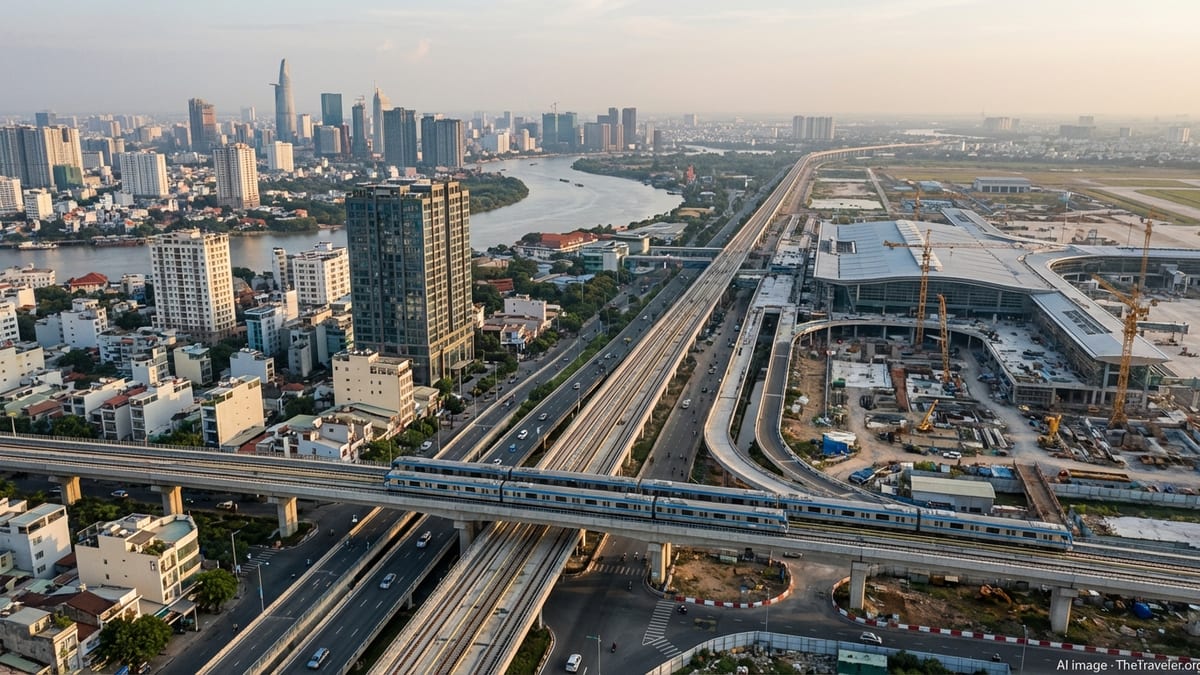
Ho Chi Minh City is accelerating plans for a $13 billion integrated metro and rail spine that would link its two airports and downtown core by 2030, as Vietnam courts engineering expertise and financial backing from partners in the United States and France to ensure rapid, high-capacity access to the new Long Thanh International Airport.
A New Airport Demands a New Urban Spine
Long Thanh International Airport, a flagship Vietnamese infrastructure project with an investment of nearly $13 billion, is preparing to begin commercial operations in mid-2026, but its long-term success hinges on how quickly the wider region can build efficient links to Ho Chi Minh City. Located about 40 kilometers east of the southern metropolis in Dong Nai Province, the airport is designed to handle more than 100 million passengers annually once fully built out, relieving pressure on the congested Tan Son Nhat International Airport and positioning Vietnam as a major Southeast Asian aviation hub.
For now, access to Long Thanh is dominated by highways and expressways already nearing capacity, raising concerns among airlines and investors that travel times from the city center could stretch to two hours at peak periods. That has pushed rail and metro connectivity to the top of Vietnam’s transport agenda. National leaders have repeatedly stressed that cutting the city to airport journey to around 30 minutes will be critical for attracting long haul carriers, business travelers and transit passengers.
City and central government planners have converged on a rail-centric solution: an integrated network linking Tan Son Nhat, downtown Ho Chi Minh City, the emerging Thu Thiem financial district and Long Thanh via a combination of metro and regional rail. The goal is to have the core elements of this network operational before 2030, giving the new airport a modern, high-capacity public transport backbone comparable with leading hubs in East Asia and Europe.
Metro Line 2 and the Thu Thiem–Long Thanh Rail Link
At the heart of the strategy is Metro Line 2, which will eventually run from the busy Tan Son Nhat airport corridor through Ben Thanh in the historic city center and under the Saigon River to Thu Thiem, a new financial and innovation district on the city’s east bank. Authorities are racing to start work on the six kilometer underground Ben Thanh–Thu Thiem segment in the coming weeks, using special urban rail policies approved by Vietnam’s National Assembly to compress permitting and land clearance timelines.
From Thu Thiem, a dedicated rail link of roughly 40 to 50 kilometers is planned to extend eastward to Long Thanh International Airport, with intermediate stations serving fast growing suburbs and industrial zones. Vietnamese conglomerate Thaco has signaled its ambition to build and operate this line under a public private partnership model, targeting construction start in 2026 and completion by 2030, subject to government approval. Preliminary cost estimates put the project in the three to four billion dollar range, reflecting extensive tunneling, bridges and elevated sections.
When combined, Metro Line 2 and the Thu Thiem–Long Thanh railway would form a continuous, high frequency rail corridor connecting Tan Son Nhat, the central business district and Long Thanh. Planners envision through running services that would allow air passengers to transfer between the two airports without entering road traffic, while also serving daily commuters in one of Asia’s most rapidly urbanizing megacities.
United States and France Deepen Transport Cooperation
To realize this vision on an aggressive timetable, Vietnam is seeking technology, funding and management expertise from longstanding partners in both the United States and France. French firms have already played a visible role in Ho Chi Minh City’s urban rail story, including advisory work on earlier metro lines and training programs for local engineers and operators. Paris’s experience in building seamless airport rail links, such as those connecting Charles de Gaulle and Orly to the French capital, is seen as directly relevant to Long Thanh’s needs.
American participation is expected to be strongest on the financing and systems side, leveraging Washington’s growing infrastructure and climate partnerships across the Indo Pacific. US backed development finance institutions and export credit agencies have been in discussions with Vietnamese authorities about potential support for signaling, rolling stock, station design and smart ticketing systems that could integrate metro, regional rail and airport services into a single passenger experience.
Officials in Hanoi and Ho Chi Minh City say that pairing French urban rail know how with American capital markets and technology could help Vietnam leapfrog older models of airport access. The ambition is to deliver a 21st century, low carbon transport spine powered by modern electrified rail, rather than locking greater Ho Chi Minh City into decades of highway expansion and car dependency.
Financing a Thirteen Billion Dollar Corridor
Vietnamese planners estimate that by the time core metro segments, the Thu Thiem–Long Thanh railway and associated flyovers and interchange stations are completed, cumulative investment tied directly to the airport rail corridor will approach or exceed thirteen billion dollars. That figure includes not only the dedicated link to Long Thanh, but also key sections of the wider Ho Chi Minh City metro network needed to move passengers from dense inner districts onto the airport line.
Local authorities are structuring the corridor as a mosaic of projects and financing mechanisms. Some sections, especially inside the city, are likely to be funded through a mix of central government budget, municipal bonds and official development assistance. Others, particularly the longer stretches between Thu Thiem and Long Thanh, are expected to rely heavily on public private partnerships with large Vietnamese conglomerates and foreign investors, supported by export credits and multilateral lenders.
To attract that capital, Ho Chi Minh City is working on updated land value capture policies around future stations, alongside tariff frameworks that balance financial sustainability with the need to keep fares affordable. The government is also signaling that airport rail and metro projects will benefit from streamlined approvals, reflecting their role in unlocking the economic potential of Long Thanh and reducing the environmental footprint of Vietnam’s aviation growth.
Transforming Urban Mobility by 2030
If construction proceeds on the current schedule, the first phase of Long Thanh International Airport will open for commercial flights in 2026 with road based access, while rail and metro links come online in stages toward 2030. City officials acknowledge a tight window, but argue that the long term gains in connectivity, investment and quality of life justify the accelerated push.
By the end of the decade, the combined network is expected to reshape daily mobility across southern Vietnam. Fast, frequent trains between Thu Thiem and Long Thanh would shrink commuting times for tens of thousands of workers in new industrial zones, while Metro Line 2 would give residents in older neighborhoods a direct rail option to both airports and the central business district. For international visitors, the promise is a smoother arrival and departure experience that aligns Ho Chi Minh City with other major Asian gateways.
The stakes are high. Long Thanh is intended not only as an aviation project, but as the anchor of a broader economic corridor stretching from central Ho Chi Minh City to the coast. Whether the United States, France and Vietnam can successfully align their expertise and financing to deliver a complex, thirteen billion dollar metro and rail program by 2030 will go a long way in determining how fully that vision is realized.