

More news on this day
Cross-border travel across parts of North and Central America has been thrown into turmoil as the United States moves to sharply curb movement with Mexico, joining Guatemala, Belize and other countries in tightening controls at key land crossings and airports after a wave of cartel-linked violence prompted security alerts, flight cancellations and temporary checkpoint closures that have left thousands of travelers stranded.
Rapid Escalation After Jalisco Security Operation
The immediate trigger for the latest disruption was a large-scale security operation in Mexico’s Jalisco state on 22 February 2026, in which Mexican authorities announced the killing of cartel leader Nemesio “El Mencho” Oseguera Cervantes. The operation, part of a broader push against organized crime, was followed within hours by road blockages, vehicle fires and clashes reported in multiple cities.
Authorities and airlines say the unrest has been most acute in and around Puerto Vallarta and Guadalajara, two of Mexico’s busiest tourism and transit hubs, but security alerts have since expanded to other states and border regions. As images of burning vehicles and blocked highways circulated, airlines began suspending services and foreign governments moved quickly to warn or restrict their citizens’ travel.
While Mexican federal forces have been deployed to secure airports and main roads, officials concede that access to several airports and border crossings remains unpredictable, with closures, reopenings and detours changing from hour to hour. Against that backdrop, neighboring countries and the United States have opted for aggressive, short-term curbs on cross-border movement with Mexico.
United States Tightens Land Crossings and Advises Against Travel
US authorities have not declared a blanket closure of the entire southern border, but they have sharply restricted cross-border movement at select high-traffic corridors and urged citizens to avoid nonessential travel to a long list of Mexican states. Security alerts issued over the weekend and updated on Monday highlight Jalisco, Baja California, Quintana Roo, Nayarit, Sinaloa and parts of numerous other states as areas where Americans are advised to shelter in place or defer travel.
As part of those measures, operations at certain pedestrian and vehicle crossings near San Diego and Tijuana have been scaled back, with only limited essential or pre-screened traffic being processed during reduced hours. Travelers arriving at the San Ysidro and Otay Mesa ports of entry have faced sudden closures of specific lanes, temporary suspension of routine crossings and intensified inspections that have dramatically slowed movement in both directions.
US government staff in several Mexican cities, including Tijuana and Guadalajara, have been instructed to shelter in place and avoid road travel until at least midweek. That decision has been mirrored by private companies and universities, many of which have suspended cross-border shuttles, fieldwork and study programs involving overland travel between California and Baja California.
Guatemala, Belize and Regional Neighbors Move to Contain Risk
South of Mexico, governments across Central America have also responded with new restrictions and advisories, underscoring concern that the violence and associated criminal activity could spill across borders. Guatemala and Belize, whose citizens and businesses rely heavily on road links into southern Mexico, have stepped up security and, in some cases, temporarily curtailed cross-border movements.
In Guatemala, additional checks have been introduced on routes leading toward the Mexican frontier, and authorities have warned bus operators and tour companies to reroute or postpone services connecting Guatemala City to northern corridors that transit through or toward Mexico. Officials are particularly focused on monitoring movements connected to commercial transport and informal migration routes, which can be rapidly exploited amid instability.
Belizean authorities have gone further, issuing a detailed advisory that urges citizens to avoid nonessential travel to several Mexican states affected by recent anti-narcotics operations and retaliatory violence. Travelers from Belize who would normally cross via Corozal into neighboring Quintana Roo and onward to other Mexican destinations have been advised to delay trips, remain vigilant if already in country and closely follow local news and official instructions.
Regional security officials say these steps are intended to be temporary but emphasize that they could be extended or tightened if unrest spreads or if road blockages and attacks increase near shared borders. Neighboring governments are in regular contact with Mexican authorities and with US diplomats monitoring the situation.
Selective Checkpoint Closures in San Diego, Tijuana, Guatemala City and Corozal
Reports from travelers and local authorities indicate that the greatest disruption has centered on a series of key checkpoints and crossings that function as gateways between Mexico and its neighbors. In the San Diego-Tijuana urban corridor, one of the world’s busiest land-border regions, restricted operations at inspection points have led to long queues, sudden stoppages and confusion for those attempting to cross for work, family visits or tourism.
Local officials say that some lanes and pedestrian routes have been closed outright for security reasons, forcing traffic into fewer controlled channels. That has slowed processing for everyone and, at times, prompted authorities to suspend crossings altogether for specified periods. Travelers who reached the border unaware of the latest measures have reported waiting for hours only to be turned back or told to return on a later date.
Further south, travelers moving between Guatemala City and northern border regions have encountered heightened checks at internal security posts and transport terminals, designed to stem potential spillover of criminal activity linked to Mexican cartels. In Belize, the Corozal crossing, a vital point for tourism and small-scale trade with Mexico’s Quintana Roo state, has experienced intermittent closures and tight screening, disrupting what is normally a relatively fluid flow of vehicles and buses.
Officials stress that these restrictions are not uniform or permanent but are being adjusted in real time based on evolving security assessments. Nonetheless, the practical effect for many travelers on Monday has been a near-total halt to their planned cross-border journeys, whether on daily commutes, holiday trips or longer itineraries across the region.
Airlines Cancel More Than Two Dozen Flights as Chaos Spreads
The aviation sector has moved swiftly to limit exposure to affected regions. Major US, Mexican, Canadian and European carriers have canceled or suspended flights to several Mexican cities, with Puerto Vallarta and Guadalajara the hardest hit. Industry data and airline statements indicate that at least 29 flights to and from Mexico were canceled over the weekend and into Monday, a figure that is expected to rise if unrest continues.
US airlines, including United, Southwest, Delta and Alaska, have canceled services to Puerto Vallarta and, in some cases, Guadalajara through at least 24 or 25 February. Canadian carriers such as Air Canada and WestJet have temporarily halted operations to the same destinations, while Mexican airlines including Aeromexico, Volaris and Viva Aerobus have scrubbed numerous domestic and international rotations because of access problems, staffing shortages and security concerns along approach roads.
Airports in affected regions remain technically open in many cases, but authorities acknowledge that road blockages, sporadic violence and uncertainty about staff availability have made regular operations nearly impossible. Flight waivers that allow passengers to rebook without penalties have been introduced across multiple airlines, but those measures have not prevented substantial congestion at terminals where confused or stranded travelers continue to arrive.
Airport operators say they are working closely with federal security forces to keep facilities secure and to restore reliable access. However, they are cautioning passengers that schedules may change at short notice and that standby capacity on remaining flights is extremely limited.
Thousands Stranded: Inside the Airport Experience
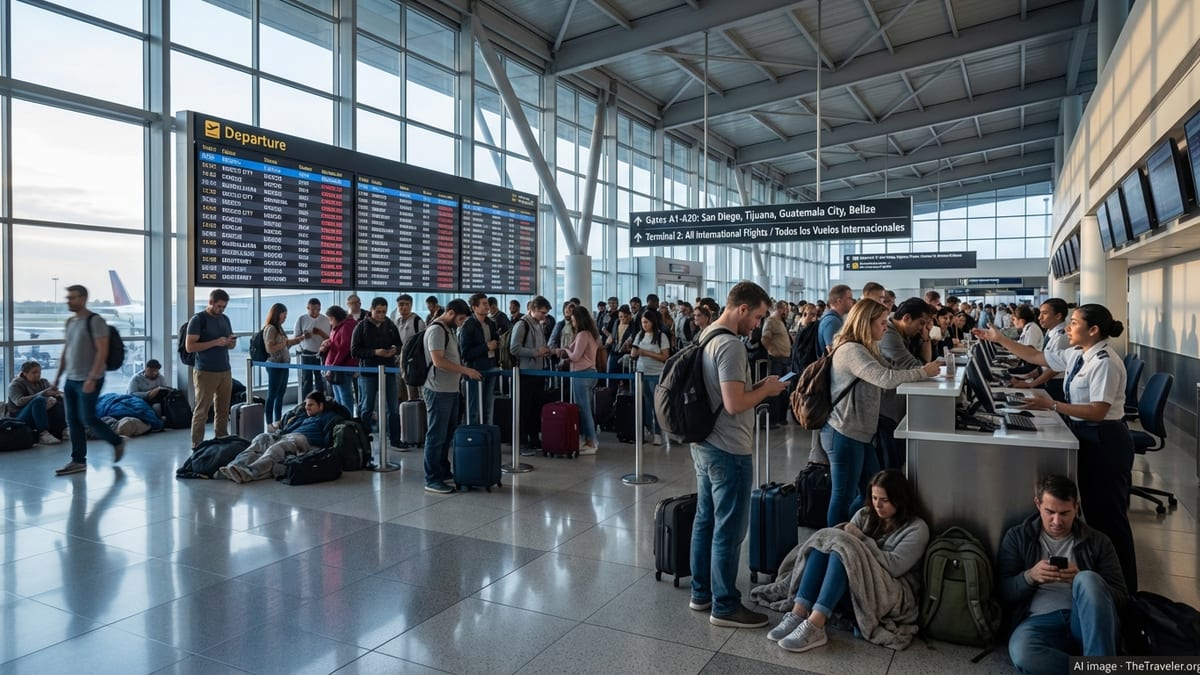
For travelers on the ground, the disruption has translated into long queues, limited information and difficult choices. At airports serving the affected regions, passengers have reported spending hours in check-in halls or departure areas waiting for updates on whether their flights would depart, turn back mid-journey or be canceled outright.
Families returning from holidays, migrant workers in transit and business travelers have all found themselves competing for scarce seats on the few flights still operating or searching for last-minute accommodation in cities advising people to stay indoors. Airline customer-service desks have struggled to keep up with demand, while call centers and mobile apps have been inundated with rebooking and refund requests.
Some travelers arriving from the United States and Canada have learned only after landing that the roads leading away from the airport were blocked or deemed unsafe, forcing them to shelter in hotels near the terminals. Others have opted to remain inside secure airport areas rather than risk traveling into city centers, particularly in Jalisco, where authorities have warned that conditions remain fluid.
With security alerts in place and shelter-in-place guidance affecting both government staff and private citizens, the usual fallback options such as intercity buses, ride-hailing services and rental cars are either suspended or operating at reduced capacity. That has limited alternatives for those trying to leave affected areas or reach safer hubs for onward travel.
What Travelers Should Do Right Now
Officials and travel-industry experts stress that the most important step for anyone planning to travel to, from or through Mexico in the coming days is to check the status of their journey before leaving home. That means confirming whether flights are operating, whether airports are accessible by road and whether land borders or checkpoints on planned routes are open or subject to reduced hours.
Travelers already in affected parts of Mexico are being urged to follow local security guidance, including any shelter-in-place instructions issued by authorities or their home governments. Those who can safely do so should register contact details with consulates or embassies, monitor official advisories and local news, and avoid nonessential movements, particularly at night or in areas where road blockages have been reported.
Anyone who is currently stranded at an airport should first reach out directly to their airline via official channels to request rebooking, refunds or vouchers under the irregular-operations policies that many carriers have activated. If lines at service desks are long, airline mobile apps and websites, as well as dedicated customer-service phone numbers, may offer faster access, although call volumes remain high.
Travel insurance providers may also be able to assist with emergency accommodation, itinerary changes and, in some cases, evacuation or repatriation support, depending on the level of coverage and whether civil unrest is included in the policy. Travelers are advised to keep receipts for unforeseen expenses and to document any changes or cancellations in writing to support later claims.
Planning Ahead as the Situation Evolves
Even for those not currently on the move, the events of recent days carry important implications for future travel in the region. Analysts say the combination of a major security operation, cartel retaliation, and rapid, coordinated responses by airlines and neighboring governments illustrates how quickly conditions can change in popular cross-border corridors linking the United States, Mexico and Central America.
Prospective travelers to Mexico and nearby countries in the weeks ahead are being advised to build flexibility into their plans. That can include booking refundable fares and accommodation where possible, allowing extra time for connections, and staying informed about security and transport conditions in specific states rather than relying on a single, nationwide assessment.
Officials in Washington, Mexico City, Guatemala City and Belmopan emphasize that they are working together to restore normal cross-border traffic as soon as security conditions permit. However, they caution that the priority in the near term will remain public safety, even if that means extended disruptions at checkpoints, along highways and in the skies.
For now, the message from authorities across the region is clear: if travel is not essential, consider postponing it. For those who must travel, careful preparation, close monitoring of official guidance, and a willingness to adjust plans at short notice will be critical to staying safe and avoiding being caught up in the next wave of sudden closures or cancellations.