

More news on this day
New federal data for February 2026 indicates that international air travel to and from the United States has surged past eighteen million passengers, reinforcing signs that global mobility and outbound demand from U.S. travelers are entering a new phase of growth despite geopolitical tension, higher fuel costs and ongoing capacity constraints.
Get the latest news straight to your inbox!
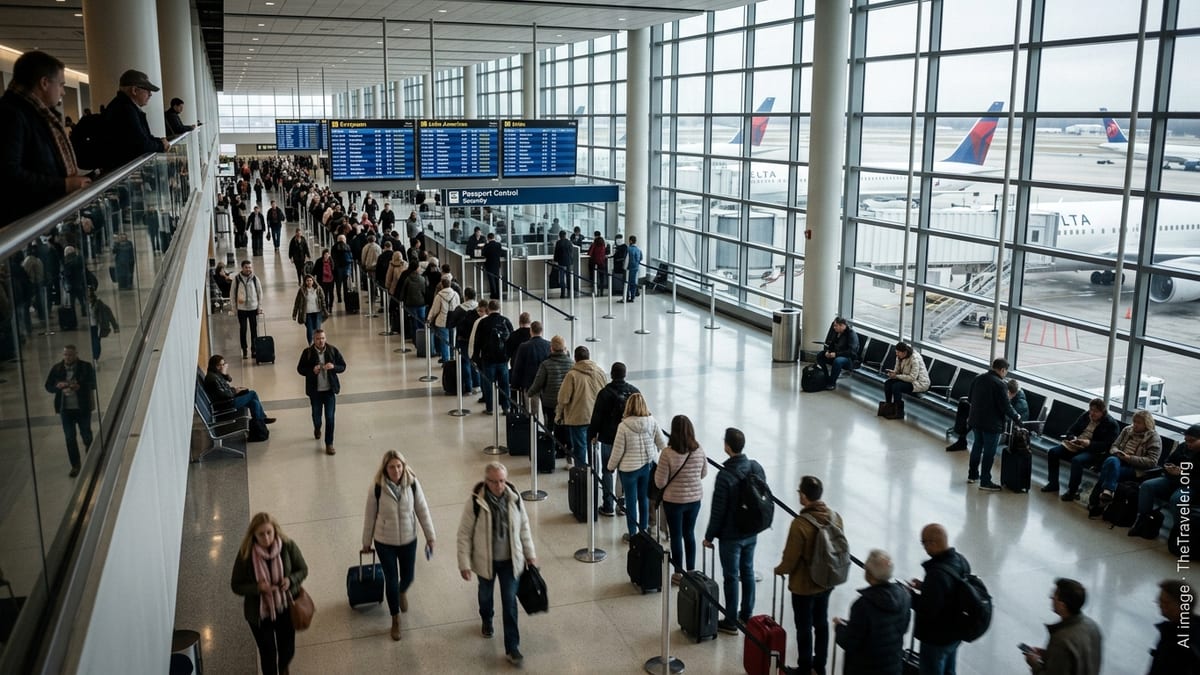
February Passenger Volumes Mark a New Post-Pandemic High
Publicly available transportation statistics and aggregated airline traffic reports point to more than eighteen million international air passengers moving through U.S. gateways in February 2026, counting both arrivals and departures. That total places the month among the strongest since borders began reopening, with year-on-year gains supported by resilient outbound leisure travel, recovering business demand and steadily improving connectivity across the Atlantic and Pacific.
Industry data for early 2026 already signaled a strong season ahead. A seasonal outlook released in late February projected that U.S. airlines would carry around 2.8 million passengers per day in March and April, up from the previous year, with international itineraries accounting for an expanding share of bookings. The February figures now provide a concrete midpoint, showing that long-haul traffic was already accelerating before the peak spring and summer schedules ramped up.
Forecasts from the U.S. National Travel and Tourism Office anticipate that total international arrivals for the full year 2026 will climb into the mid-80-million range, up sharply from 2025. February’s performance, with international passengers already exceeding eighteen million in a single off-peak month, puts that projection within reach if capacity growth and consumer confidence hold through the remainder of the year.
Analysts note that the recovery is uneven across markets, with North America lagging behind some regions in overall inbound tourism last year. Even so, the latest monthly numbers suggest that U.S.-linked air corridors are regaining momentum, with cross-border flows rebounding more quickly on the aviation side than earlier headline tourism statistics might imply.
Transatlantic and Latin American Routes Lead the Upswing
Much of February’s international uplift is concentrated on transatlantic and intra-Americas routes, where capacity has expanded significantly since 2024. Data from airline and government traffic summaries show that the U.S.–Europe market remains the single largest long-haul segment by seats, with carriers continuing to restore frequencies to major hubs and add seasonal links to secondary cities.
Latin America also remains a powerhouse for international passenger flows. Major hubs in Texas, Florida and California have reported strong growth in traffic to Mexico, Central America and the Caribbean, fueled by both U.S. leisure demand and growing regional business ties. Recent airport planning documents and traffic reports from large Sun Belt airports highlight double-digit percentage increases in year-round international seats compared with the pre-pandemic baseline, particularly on routes to beach and resort destinations.
By contrast, transpacific recovery has been more gradual. While traffic to destinations such as Japan, South Korea and parts of Southeast Asia is trending upward, official tourism data from several Asian markets still show visitor counts below 2019 levels. Diplomatic tensions and shifting visa policies have restrained Chinese outbound tourism to some key destinations, which in turn has limited the pace of recovery on historically important U.S.–China corridors.
Even with these regional discrepancies, carriers have used fleet flexibility to redeploy widebody capacity into the strongest performing markets, ensuring that overall international volumes remain high. This has contributed directly to the February surge, as airlines seek to maximize aircraft utilization on profitable long-haul routes during the shoulder season.
Stronger Outbound Demand and Evolving Traveler Behavior
The February 2026 numbers reflect not only inbound tourism to the United States but also a notable expansion in outbound travel by U.S. residents. Market reports focused on source markets highlight rising demand from North American travelers for cultural city breaks, long-haul beach escapes and experience-driven itineraries in Europe, Asia and the Middle East.
In parallel, several destination marketing organizations have identified the United States as a top or priority growth market for 2026, tailoring campaigns to higher-spend segments and extended-stay travelers. Recent briefings on source-market performance point to robust growth in U.S. visitor numbers to selected long-haul destinations, even where overall global arrivals remain constrained by airline capacity and geopolitical factors.
Traveler behavior appears to be evolving with the new environment. Industry surveys and airport feedback indicate that passengers are increasingly mixing business and leisure on single trips, taking advantage of flexible work policies to extend stays. There is also rising interest in multi-stop itineraries that combine major hubs with secondary cities connected by low-cost or regional carriers, a pattern reflected in booking and connection data at large U.S. gateways.
At the same time, higher airfares and concerns about disruption have encouraged more travelers to enroll in trusted traveler programs and use digital tools to streamline border crossings. Government statistics show record participation in expedited-entry schemes in 2025, saving inspection time and helping airports accommodate February’s heavy international flows without proportionate increases in staffing.
Capacity, Infrastructure and Operational Pressures
The February surge in international passengers has further tested the capacity of U.S. airports and airspace. Traffic statistics from major hubs show millions of enplaned and deplaned passengers each month, with international segments growing faster than many domestic flows. This has spotlighted long-running infrastructure challenges, from gate availability and baggage systems to security checkpoints and immigration halls.
Some operational strains have been highlighted by recent airspace disruptions. Temporary flight restrictions in parts of Texas and New Mexico in February 2026 led to localized suspensions of civilian flights, briefly affecting schedules at regional airports and forcing reroutings through alternate gateways. While short-lived, such events underscore the complexity of managing growing international volumes in an already dense air traffic system.
Airlines and airport operators are responding with targeted investments and operational tweaks. Several large hubs are expanding international concourses, upgrading customs and immigration facilities and adding biometric processing lanes to accelerate throughput. Medium-sized airports with new or expanding overseas services are publishing detailed monthly statistics to track growth and make the case for further infrastructure funding.
Industry commentary also points to risks that could temper growth later in the year. Rising fuel prices, aircraft delivery delays and limited spare capacity leave airlines with less room to maneuver when disruptions occur. In this environment, achieving February’s level of international volume required careful coordination between carriers, airports and federal agencies responsible for security and border management.
Global Context: US Growth Amid Uneven Tourism Recovery
The surge to more than eighteen million international passengers in February comes as global tourism continues to recalibrate after setting a new worldwide record in 2025. International organizations tracking cross-border travel have reported that overall arrivals surpassed pre-pandemic levels last year, even as North America underperformed other regions due in part to weaker results in the United States.
Against that backdrop, the latest U.S. air traffic figures suggest that 2026 may look different from 2025 in terms of international performance. Stronger outbound demand, an uptick in inbound visitors from selected markets and a full season of restored long-haul capacity could narrow the gap between North America and faster-recovering regions such as Europe and parts of Asia.
Nonetheless, the international travel landscape remains volatile. Conflict zones, weather extremes and policy shifts continue to alter flight paths and booking patterns on short notice. Some tourism ministries have reported softening demand from traditional source markets even as they record record-breaking inbound totals from others, illustrating how quickly traveler flows can be redirected by cost, convenience and perception of safety.
For now, February 2026 stands out as a milestone in the U.S. aviation recovery story. More than eighteen million international passengers in a single winter month indicate that long-haul travel appetite remains strong, and that the systems built to manage it are operating near the limits of their current capacity. How airlines and policymakers respond through the rest of 2026 will determine whether this surge becomes a new normal or a high-water mark in an exceptionally dynamic period for global mobility.