

More news on this day
Thousands of passengers across Europe faced cancellations, rolling delays and missed connections on Saturday as escalating US–Iran hostilities and sweeping Middle East airspace closures rippled into major hubs from Istanbul to London, Paris, Frankfurt and Amsterdam.
Chain Reaction From US–Iran Strikes Hits European Hubs
The latest wave of disruption followed joint US and Israeli strikes on Iran and subsequent retaliatory actions, prompting multiple countries in the Middle East to close their airspace and forcing airlines to redraw long-haul routes in real time. With Iran, Iraq, Israel, Jordan, Qatar, Bahrain, Kuwait and the United Arab Emirates among those restricting overflights, carriers operating between Europe and Asia had little choice but to cancel, divert or significantly extend flight times.
Aviation data from major European airports indicated that Turkey, the United Kingdom, France, Germany and the Netherlands together recorded 397 cancellations and 1,997 delays within hours of the airspace moves, affecting tens of thousands of travelers. Istanbul, London, Paris, Frankfurt and Amsterdam bore the brunt of the chaos as waves of delayed long-haul aircraft arrived out of sequence, overwhelming already tight schedules.
With many aircraft and crews stranded out of position, knock-on disruptions spread quickly to short-haul networks. Even passengers flying only within Europe found their services scrubbed or heavily delayed as airlines tried to recover from an increasingly complex operational puzzle.
Emirates, Air France, KLM and ITA Scramble to Reroute
Long-haul carriers that rely on Middle East corridors were among the first to react. Emirates cut a swathe of services and rerouted others around the closed airspace, warning customers that extended flight times, technical fuel stops and last-minute schedule changes were likely throughout the weekend. Gulf rivals and European partners issued similar alerts as they reprogrammed routes to skirt the conflict zone.
In Paris, Air France faced mounting delays on services to India, Southeast Asia and southern Africa after losing access to some of the most direct routings. The airline advised passengers to expect rebookings and re-accommodations, prioritising those with missed long-haul connections and vulnerable travelers stuck overnight at Charles de Gaulle and Orly.
Amsterdam’s Schiphol Airport reported widespread disruption for KLM, which has already been trimming services to Tel Aviv and other regional points amid rising tensions. The sudden closure of key air corridors forced additional cancellations and extended detours for flights to and from Asia, putting further pressure on an operation still constrained by staffing and slot limits.
Italy’s ITA Airways and other European carriers with extensive networks into the eastern Mediterranean and Gulf states reported cascading knock-on effects, even on routes that do not directly touch the conflict area. Aircraft held on the ground for safety or routing reasons left gaps elsewhere in the schedule, pushing back departure times across the continent.
Passengers Stranded in Istanbul, London, Paris, Frankfurt and Amsterdam
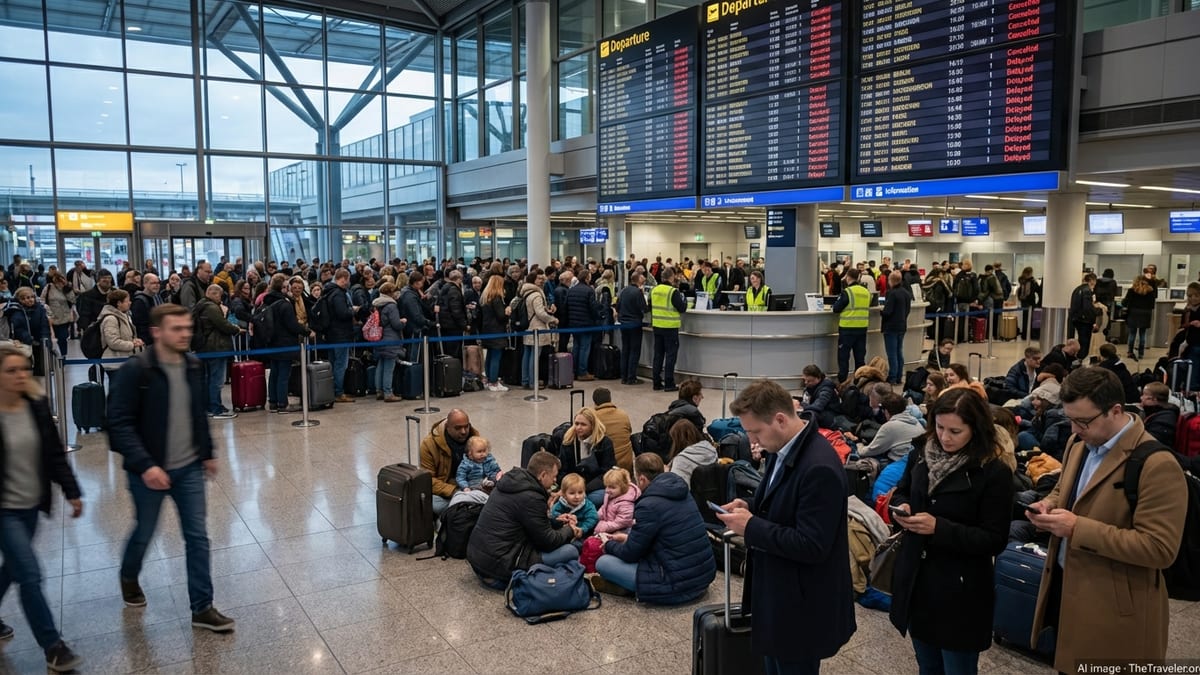
Scenes of long queues, packed information desks and improvised sleeping areas became common at several major European airports as the day wore on. At Istanbul Airport, one of the primary gateways between Europe and Asia, departures boards filled with red as services to Iran and neighboring countries were scrubbed, while connecting travelers from Asia found themselves stuck mid-journey.
London Heathrow and Gatwick saw clusters of stranded passengers from disrupted flights to the Gulf, India and East Asia, many of whom had already been airborne when the closures took effect and were diverted or sent back to their origin. Similar stories played out in Paris, Frankfurt and Amsterdam, where transfer hubs struggled to find spare hotel rooms and rebooking options during peak travel hours.
Travelers described waiting in snaking lines for hours as airline staff dealt with a wave of rebookings, refunds and inquiries. With alternative routings limited and many long-haul flights already full days in advance, some passengers were being reprotected on itineraries involving circuitous detours and extended layovers, stretching journeys that normally take seven or eight hours into marathon trips lasting 20 hours or more.
Airports urged passengers not to travel to the terminal without a confirmed new reservation, warning that walk-up assistance desks were overwhelmed and that same-day alternatives were increasingly scarce on heavily affected routes.
Safety Advisories and Airspace Bans Drive Operational Decisions
The operational turmoil was underpinned by a series of formal safety advisories from aviation regulators, who highlighted a high risk to civil operations in parts of the Middle East and Gulf region following the strikes. Conflict zone bulletins urged airlines to avoid Iranian airspace and neighboring high-risk areas, citing the possibility of further military activity and interceptions.
European and North American carriers, already unable to use large portions of Russian airspace because of the war in Ukraine, suddenly faced a new set of restrictions along one of the busiest east–west corridors in global aviation. With traditional shortcuts over Iran, Iraq and the Gulf effectively removed, flight planners were left to stitch together longer routings that added fuel burn, pushed crew duty times to their limits and squeezed already tight fleets.
Analysts warned that even a short-lived closure would come at a steep cost for airlines, thanks to higher fuel bills, disrupted crew rotations and reduced aircraft utilisation. If the disruption persists, it could further erode margins on long-haul routes that depend on efficient high-altitude transits through the region, potentially forcing some carriers to trim frequencies or temporarily suspend select destinations.
Despite calls from some travellers for airlines to “fly around” the problem, carriers emphasised that safety considerations and regulatory directives leave little room for flexibility. They also noted that insurance and war-risk premiums tend to spike sharply whenever conflict zones expand, adding another layer of financial and operational pressure.
What Stranded Travelers in Europe Can Expect Next
For now, industry experts expect irregular operations to continue for at least several days after airspace restrictions are eased, as airlines reposition aircraft and crews and work through backlogs of displaced passengers. Even once direct overflights resume, aircraft that have been out of rotation for maintenance or crew-rest reasons will need to be carefully reintegrated into schedules.
Airlines across Turkey, the UK, France, Germany and the Netherlands are offering varying degrees of flexibility, including free date changes, rerouting on alternative carriers where interline agreements permit, and in some cases refunds for passengers who choose to cancel. Travelers are being urged to use airline apps and digital channels as a first resort, rather than joining physical queues at airport desks, which remain under severe strain.
Consumer advocates in Europe reminded passengers that standard compensation rules may not always apply when cancellations are caused by armed conflict and related airspace closures, which are typically classified as extraordinary circumstances. However, carriers are still required to provide care, including meals and accommodation where reasonably available, particularly for those left overnight far from home.
With no clear timeline for a political de-escalation between Washington and Tehran, airlines and passengers alike are bracing for a protracted period of uncertainty. For thousands of travelers who found themselves unexpectedly stuck in Istanbul, London, Paris, Frankfurt, Amsterdam and beyond on Saturday, the priority is simply finding a way home, no matter how long the detour.