

More news on this day
Escalating military strikes between the United States, Israel and Iran are rippling across Asia’s aviation network, leaving hundreds of passengers isolated at major Chinese airports as carriers from Air China to Qatar Airways juggle diversions, rolling delays and fresh waves of cancellations.
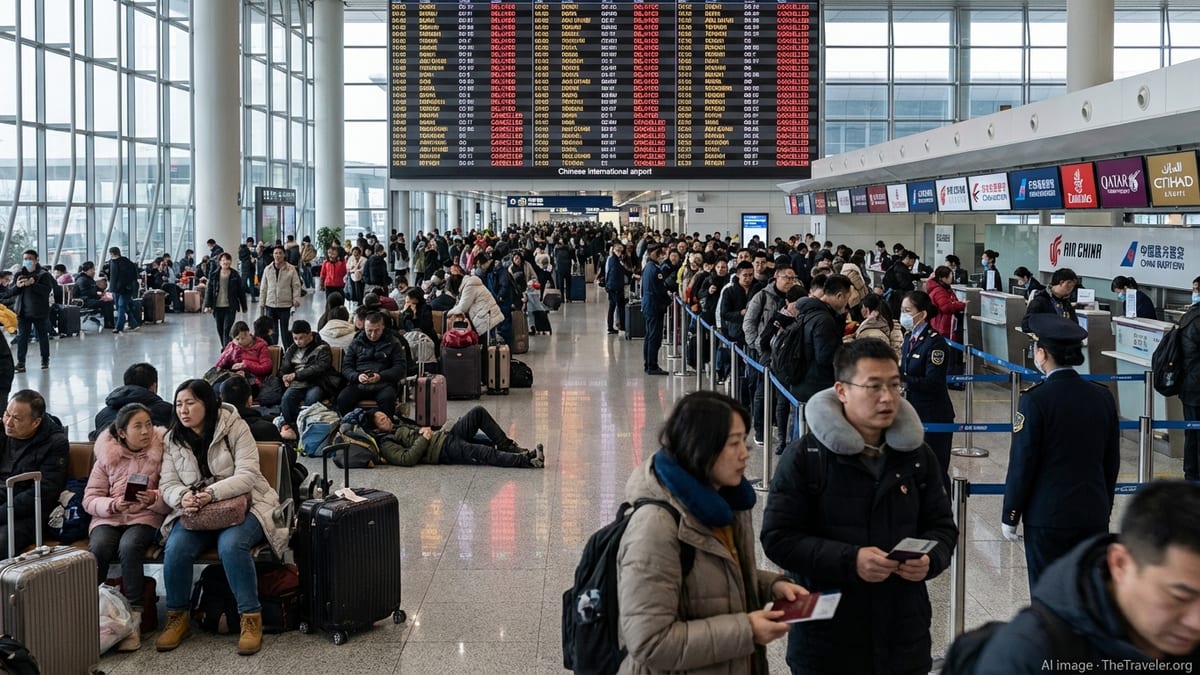
China’s Hubs Buckle Under Global Shockwaves
While airspace closures have centered on the Middle East, operational stress is acutely visible across China’s biggest gateways. Fresh aggregated data from Chinese aviation trackers indicates at least 71 cancellations and 1,697 delays affecting services through Beijing, Shanghai, Guangzhou, Chengdu, Zhengzhou and other hubs over the latest 24-hour period, as airlines rework routings around conflict zones and contend with knock-on congestion.
Beijing Capital and Shanghai Pudong, already among the world’s busiest international gateways, have reported mounting queues at security and check-in as passengers on flights operated by Air China, China Southern, China Eastern and Hainan Airlines wait for revised departure slots. At Guangzhou Baiyun and Chengdu Tianfu, large groups of travelers have been held in cordoned-off gate areas while crews and aircraft are reassigned following extended duty-hour limits and diversion-related delays.
Domestic sectors that usually feed long haul departures have also been disrupted, with Shenzhen, Xi’an, Wuhan and other regional airports reporting elevated delay totals in recent days. Although weather and China’s structurally constrained airspace remain core factors, airline planners say the latest US–Iran escalation has tipped an already tight network into a new phase of fragility.
In Zhengzhou, which has emerged as a bellwether for inland disruption, cancellations have outpaced many coastal hubs on a percentage basis. Passengers bound for onward services to Europe, the Middle East and Southeast Asia via Beijing and Shanghai have seen itineraries unravel overnight as minimum connecting times are repeatedly breached.
Middle East Airspace Closures Snarl China’s Global Links
The shock to China’s aviation system is being driven largely by widespread airspace closures across Iran, Israel and multiple Gulf states following coordinated US and Israeli strikes on Iranian military targets and subsequent missile and drone retaliation. Key hub airports in Dubai, Abu Dhabi and Doha have dramatically reduced operations or suspended departures at various points, severing some of China’s most important one-stop corridors to Africa, Europe and the Americas.
Emirates, Qatar Airways and Etihad Airways all carry significant volumes of China-origin passengers over their Gulf hubs. With large parts of regional airspace closed and infrastructure at some airports damaged or operating under heightened security restrictions, these carriers have cancelled or rerouted scores of services, leaving China-based travelers facing uncertain onward options and multi-day waits for available seats.
Cirium and other analytics firms estimate that more than 3,000 flights to, from and within the Middle East were cancelled over the weekend, on top of tens of thousands of delays worldwide. That disruption is now cascading into Chinese schedules as code-share partners adjust departure banks to match sharply reduced connection windows via the Gulf, Istanbul and other junction points.
For China’s aviation authorities, the crisis underscores how deeply integrated the country’s outbound travel market has become with Middle Eastern super-connectors over the last decade. Routes from Chinese secondary cities to Gulf hubs, once a niche, are now critical arteries for tourism and trade that cannot be easily replicated through alternative routings over Europe, Central Asia or the Pacific.
Passengers Isolated in Terminals as Rebooking Backlogs Grow
On the ground, the human impact is playing out in crowded terminal halls from Beijing to Chengdu. With spare capacity scarce and many international routes already operating close to load limits, stranded passengers on services involving Air China, China Southern, Emirates, Qatar Airways, Etihad, Hainan Airlines and other affected carriers are finding rebooking options limited and slow.
Travelers with itineraries touching the Gulf report being held in designated waiting areas and transit zones for extended periods as airlines seek updated security clearances and airspace permissions. In some cases, groups of passengers have been escorted to offsite hotels; in others, they have remained in restricted zones overnight, effectively isolated while airlines determine whether onward segments remain viable.
Ground staff at Beijing Capital and Shanghai Pudong say they are struggling to provide precise departure times as slot allocations shift repeatedly in response to evolving military activity and air traffic control directives. Standard delay management protocols, such as issuing meal vouchers and rolling SMS updates, have been strained by the sheer volume of affected passengers and the fast-changing situation.
Families traveling during the busy late-winter holiday period, including tour groups bound for Europe and the Indian Ocean, have been particularly hard hit. Many report losing nonrefundable hotel nights and tour bookings as their journeys stall at the first or second leg, with travel insurance policies varying widely in how they treat war-related disruptions.
Chinese and Foreign Carriers Adjust Networks
Airlines operating into and out of China are now racing to redesign schedules for the coming days as analysts warn that the conflict and associated airspace restrictions could last for weeks. Air China and China Southern are prioritizing aircraft and crews on core trunk routes to Europe and North America, in some cases adding fuel stops in Central Asia to circumvent closed corridors and avoid sensitive airspace.
Foreign carriers with a strong China presence, including Emirates, Qatar Airways and Etihad, have introduced rolling travel waivers for affected dates, allowing passengers to rebook or reroute without change fees, subject to seat availability. Some are shifting widebody aircraft onto alternative Asia routes such as Bangkok, Kuala Lumpur and Singapore while Middle East-bound demand remains constrained.
Qatar Airways and Emirates, both key connectors for traffic between Chinese secondary cities and Africa, are also negotiating with regulators for temporary access to alternative flight levels and routings that balance safety with operational continuity. Aviation experts note that rerouted flights can add two to three hours to some journeys, significantly increasing fuel burn and squeezing margins at a time of elevated operating costs.
Low cost and regional Chinese carriers, which typically rely less on Gulf connections, are not immune. Congestion at major hubs has forced slot reshuffles that ripple back into purely domestic networks, compounding the delays reflected in national statistics and testing the resilience of China’s post-pandemic air travel recovery.
What Travelers Should Expect in the Coming Days
Industry observers say the immediate priority for airlines and regulators is passenger safety, followed by restoring predictability where possible in an environment that remains highly fluid. In practical terms, travelers across China should be prepared for longer check-in queues, last-minute gate changes, technical fuel stops on long haul routes and rolling schedule updates as carriers digest overnight developments in the US–Iran confrontation.
Airports including Beijing Capital, Shanghai Pudong, Guangzhou Baiyun, Chengdu Tianfu and Zhengzhou Xinzheng have stepped up public announcements and on-site assistance teams, but the sheer volume of delayed and cancelled services means that information lags remain common. Travelers transiting via the Middle East or holding tickets with affected airlines are being urged by agents to build in generous connection times or, where feasible, shift to routings via Northeast Asia or Europe.
Analysts expect that once Middle Eastern airspace begins to reopen, a secondary wave of disruption is likely as airlines reposition aircraft, clear passenger backlogs and normalize crew rotations. For Chinese travelers in particular, the episode is a stark reminder of the fragility of global air connectivity at a time of heightened geopolitical tension, and of how quickly a conflict thousands of kilometers away can strand them at home or halfway around the world.