

More news on this day
Escalating US–Iran tensions and sweeping Middle East airspace closures are rippling across global aviation, abruptly weakening Gulf megahubs and positioning Southeast Asia’s airports to pick up displaced traffic and investment.
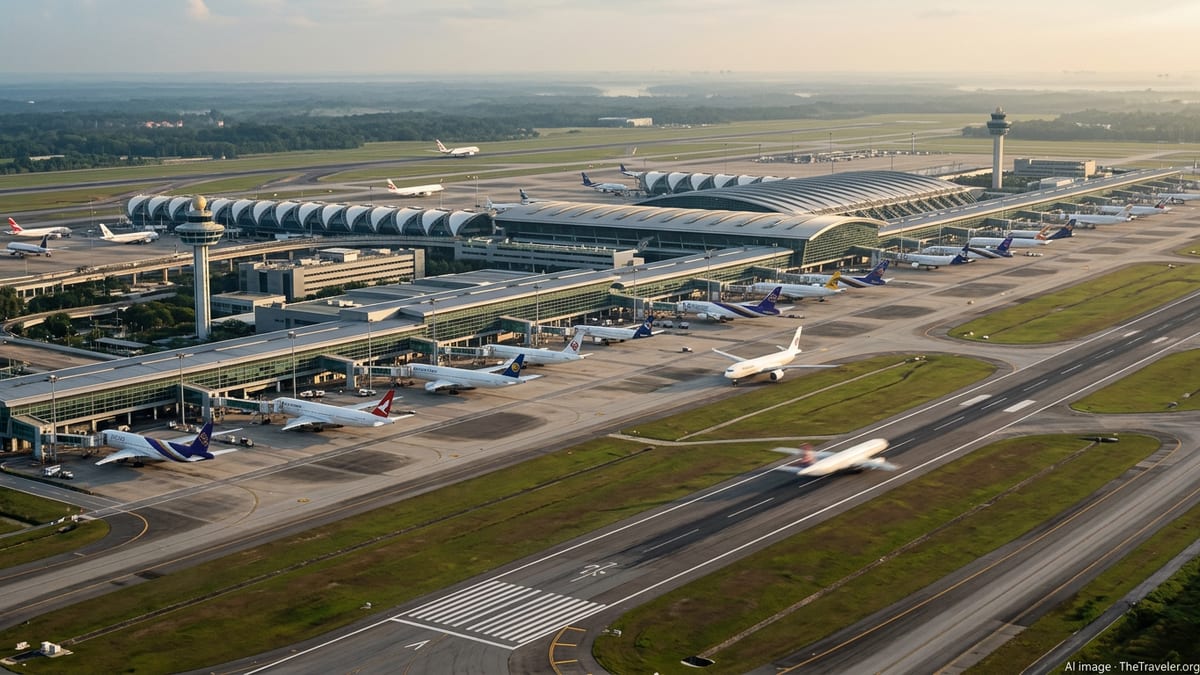
Middle East Gridlock Forces a Global Reroute
Since February 28, sweeping airspace closures over Iran, Israel, Iraq, Syria, Qatar, Kuwait, Bahrain and the United Arab Emirates have shut or curtailed operations at Dubai, Abu Dhabi and Doha, grounding thousands of long-haul connections between Europe and Asia. Airlines from Europe, India and East Asia have been forced into emergency diversions and cancellations as planners scramble to redraw timetables around a region that normally functions as the primary bridge between continents.
The disruption follows weeks of rising US–Iran tensions and Iranian missile and drone activity around the Strait of Hormuz, which prompted regulators and carriers to treat much of the Gulf as high-risk airspace. Gulf giants including Emirates, Etihad, Qatar Airways, Air Arabia and Gulf Air have extended suspensions or imposed stringent restrictions on flights in and out of their hubs, with analysts warning that a prolonged closure would erode their role as the default connecting points between Europe, Africa and Asia.
Travel data firms estimate that the current shutdown and rerouting phase has already affected tens of thousands of flights and millions of passengers, with knock-on effects expected for weeks as aircraft and crews are repositioned. For long-haul travelers seeking alternatives, and for airlines trying to preserve key flows between Europe, Australia and Asia, attention is swinging rapidly toward Southeast Asia’s relatively stable hubs.
Singapore and Bangkok Step In as Strategic Connectors
Among the biggest immediate beneficiaries are Singapore’s Changi Airport and Bangkok’s Suvarnabhumi, which sit on natural north–south and east–west corridors that can be adapted to bypass the Gulf. Singapore Airlines and Thai Airways have long maintained strong networks into Europe and Australia, and while they have suspended or altered some Middle East services, their core transcontinental routes remain open, giving them a platform to absorb demand that would normally pass through Dubai or Doha.
Analysts say new itineraries are rapidly appearing that stitch together Europe–Southeast Asia–Australia routings, replacing Europe–Gulf–Asia flows that have dominated the last decade. Longer northern paths over Central Asia and Turkey and southern tracks across the Indian Ocean are now being layered onto existing schedules from Singapore and Bangkok, even at the cost of added flight time and fuel burn, because they avoid the most volatile airspace.
For travelers, that shift is already visible in booking engines, where itineraries that once favored Gulf connections are now defaulting to one-stop options via Singapore, Bangkok and, to a lesser extent, Kuala Lumpur and Jakarta. Aviation consultants note that if the current pattern holds for more than a few months, airlines could lock in new codeshares and alliances centered on Southeast Asian gateways, baking in a more permanent redistribution of global traffic.
Airlines Pivot Capacity and Partnerships Toward Southeast Asia
Carriers from Europe, India and East Asia are actively reassessing how much capacity they can redeploy into Southeast Asian hubs while Gulf access remains constrained. European airlines that previously relied on interline agreements with Gulf partners to reach secondary Asian cities are exploring additional frequencies into Singapore and Bangkok, where they can tap onward regional networks run by local and low cost carriers.
Indian and Southeast Asian airlines are also adjusting. Malaysia Airlines, Singapore Airlines, Scoot and others have cancelled or diverted services into the Gulf itself but are preserving and in some cases increasing capacity on Europe and Australia routes that can be reoriented around safer corridors. Thai Airways has highlighted that its European schedule is largely intact, with only modest routing adjustments adding minutes rather than hours to flight times, positioning Bangkok as a resilient alternative staging point.
Industry sources say alliance planners are now modeling medium term scenarios in which a portion of Europe–Asia traffic permanently bypasses the Gulf, especially high yielding corporate and premium leisure segments that prioritize predictability and geopolitical stability. That would reinforce the role of Southeast Asian hubs not just as regional gateways but as anchor points in a rebalanced global network.
Economic Upside for Southeast Asian Gateways
If traffic continues to be redirected for an extended period, the economic consequences for Southeast Asian cities could be substantial. Extra long haul arrivals funnel more spending into hotels, airport retail, maintenance and catering, while also supporting jobs in tourism and logistics clustered around major terminals. Airport authorities in Singapore and Thailand have already invested heavily in terminal capacity, multimodal transport links and digital border processing, leaving them well placed to handle surges in connecting traffic.
Tourism boards across the region are watching closely, seeing an opportunity to convert forced transits into actual visits. With passengers facing longer routings and potential layovers, destinations such as Singapore, Bangkok and Kuala Lumpur are expected to push stopover programs and visa on arrival schemes that encourage travelers to spend a night or two in the city rather than simply changing planes.
Over time, a sustained shift of routes could accelerate broader ambitions to position Southeast Asia as a logistics and aviation finance hub to rival the Gulf. As airlines consider where to base aircraft, crews and regional offices to hedge against future geopolitical shocks, cities that can combine stable politics with strong infrastructure and a large local market stand to gain the most.
Risks, Bottlenecks and the Battle for the “New Normal”
Despite the apparent upside, Southeast Asian hubs are not immune to the risks created by the US–Iran standoff. Alternative routes that skirt the Gulf often run over Central Asia, the Indian Ocean or the South China Sea, each with their own operational and geopolitical sensitivities. Congestion in these corridors could increase air traffic control delays and heighten safety concerns if the rerouting trend accelerates faster than regulators and infrastructure can adapt.
Capacity constraints are another concern. Changi and Suvarnabhumi are emerging from the pandemic recovery phase and already dealing with strong demand rebounds. A sudden, sustained influx of rerouted long haul services could strain runway slots, terminal space and ground handling, potentially eroding the reliability advantage that makes these hubs attractive to airlines and travelers.
For now, industry executives stress that the situation in the Middle East remains fluid, and that a diplomatic breakthrough could reopen Gulf airspace and restore previous patterns. Yet each day of disruption pushes more airlines to test and refine new routings and commercial relationships centered on Southeast Asia. If those arrangements prove efficient and profitable, Singapore, Bangkok and their regional peers may find that today’s crisis has nudged them into a more prominent and enduring place on the world’s aviation map.