

More news on this day
Spain’s two busiest gateways, Madrid and Barcelona, are grappling with mounting disruption as fallout from the US Iran conflict chokes key Middle East air corridors, leaving hundreds of travelers stranded and dozens of long haul flights delayed or canceled.
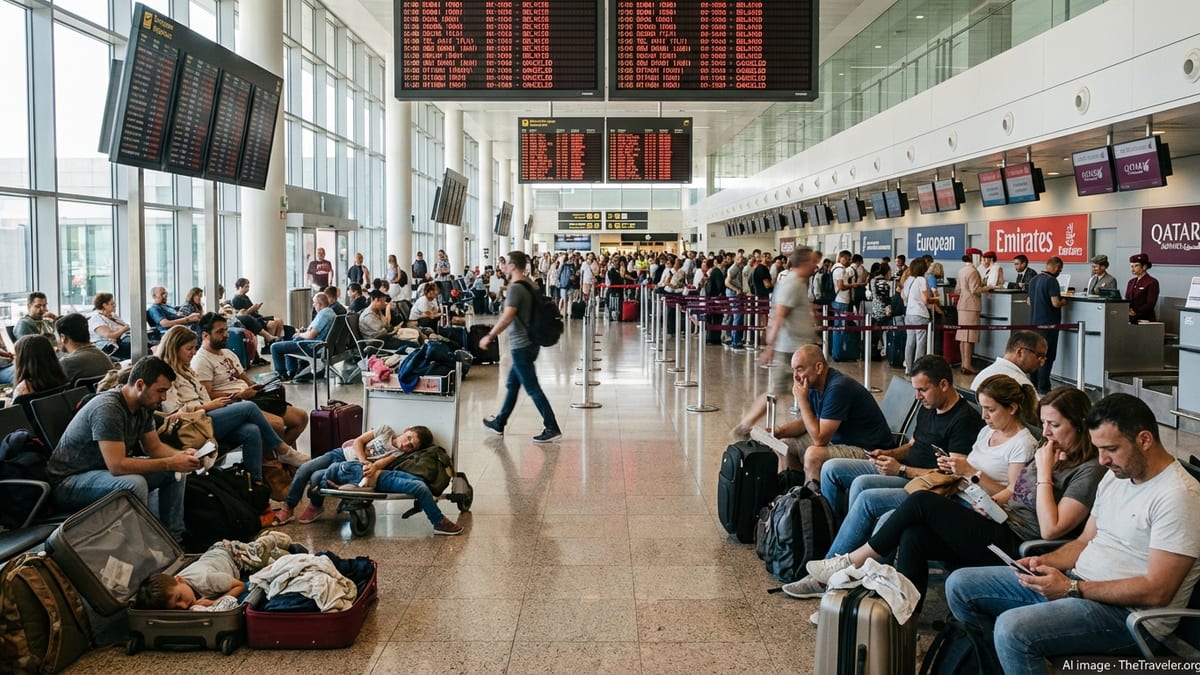
Spain Feels the Shockwaves of Middle East Airspace Closures
The US and Israeli strikes on Iran on February 28, followed by retaliatory attacks and widespread airspace closures across the Middle East, have triggered a cascade of operational problems for airlines connecting Europe with Asia and Africa. Spain, heavily reliant on long haul connections via Gulf hubs, is now seeing the impact on the ground at Adolfo Suárez Madrid Barajas and Barcelona El Prat airports.
According to aviation disruption data compiled on March 1, a total of 31 cancellations and 276 delays were recorded across Madrid, Barcelona, Málaga and Valencia in a single day, with Madrid and Barcelona bearing the brunt of the chaos. While not all of these disruptions are directly linked to the conflict, airport and airline officials acknowledge that the closure of airspace in Iran, Iraq, Qatar, Bahrain and the United Arab Emirates, and the temporary shutdown of hubs in Dubai, Abu Dhabi and Doha, have sharply reduced operational flexibility.
With key long haul connectors out of rotation and aircraft and crews displaced across multiple regions, carriers are being forced to trim schedules, consolidate services and reroute flights over longer, more congested corridors. The result for passengers in Spain is a patchwork of rolling delays, last minute cancellations and missed onward connections.
Hundreds Stranded as Gulf Carriers Cut Back
Among the most affected airlines in Spain are Gulf and Middle Eastern carriers that usually funnel Spanish travelers through Dubai, Doha and Abu Dhabi to destinations in Asia, Oceania and East Africa. Emirates has canceled ten flights across Madrid and Barcelona, while Qatar Airways and Etihad Airways have also pulled several services from Barcelona, reflecting the squeeze on their home hubs.
El Al has scrapped flights linking Spain with Israel, removing another key connecting option for travelers heading onward to the Eastern Mediterranean and beyond. These cancellations come on top of broader suspensions and groundings across the region, as Emirates, Qatar Airways and Etihad drastically reduce operations while their primary hubs operate on a limited or stop start basis.
For passengers at Madrid and Barcelona, that has meant hours spent in departure halls as departure boards flicker with revised times and sudden status changes. Travelers report long queues at airline service desks, difficulty rebooking onto alternative routings and limited availability on remaining services to the Middle East and Asia. Some have been offered hotel accommodation and meal vouchers, while others are choosing to abandon or significantly shorten their trips.
European and Low Cost Carriers Caught in the Ripple Effect
The disruption is not confined to long haul operators. Iberia and its regional partner Air Nostrum recorded dozens of delays at Madrid, while low cost carriers Ryanair and Vueling faced widespread schedule slippage across Barcelona, Málaga and Valencia. Although many of these delays are short in duration, the cumulative effect is a day of rolling congestion that complicates aircraft rotations and crew scheduling.
In Barcelona, Vueling and Ryanair together account for a large share of short haul connectivity across Europe and North Africa. Even minor timetable disruptions can cause knock on delays for passengers with separate tickets who had planned to connect to Gulf carriers for long haul legs. With Emirates, Qatar Airways and Etihad trimming services, those informal self made connections are now largely unworkable, stranding independent travelers who lack the protection of a single through ticket.
Analysts say that as airlines reroute around closed or restricted airspace, flight times on many Europe Asia routes are increasing by hours, leading to additional fuel stops and tightening crew duty time limits. That in turn forces further schedule adjustments in European markets such as Spain, even on flights that do not transit the Middle East.
Travelers Face Uncertainty and Limited Alternatives
For stranded passengers in Madrid and Barcelona, the most immediate challenge is uncertainty. With Middle East airspace closures officially framed as temporary and subject to change depending on security conditions, airlines are reluctant to publish firm timetables beyond a short horizon. Many travelers are being rebooked on later dates without precise confirmation of departure times or routings.
Some Spain based passengers bound for Asia are being shifted to alternative connecting hubs such as Istanbul, Frankfurt, Paris and London, but capacity there is tightening quickly as demand surges. Seats in premium cabins are particularly scarce, and even economy class inventory is shrinking on popular routes, pushing some travelers to accept long, multi stop itineraries or prolonged layovers.
Families and holidaymakers are especially exposed, with school vacation plans disrupted and prepaid arrangements at hotels and resorts thrown into doubt. Business travelers, meanwhile, are turning to videoconferencing and postponing non essential trips to affected regions, as corporate travel managers reassess risk and duty of care obligations.
Outlook: Prolonged Disruptions Possible if Tensions Persist
Aviation experts caution that disruptions in Spain and across Europe could persist for days or even weeks if tensions between the United States, Israel and Iran do not ease and Middle East airspace remains constrained. Even a partial reopening of key corridors will take time to translate into normalized schedules, as airlines reposition aircraft and crews and work through extensive backlogs of displaced passengers.
Spanish tourism officials are monitoring the situation closely, wary of any prolonged hit to long haul arrivals from Asia and Oceania that increasingly rely on Gulf and Middle Eastern hubs. While intra European travel to Spain remains largely intact, a protracted reduction in long haul connectivity could weigh on high spending visitor segments and complicate recovery plans for destinations beyond Madrid and Barcelona.
For now, airlines and airports in Spain are urging travelers to check flight status frequently, sign up for real time alerts, and allow extra time at airports in case of security or check in bottlenecks. With the broader geopolitical situation still fluid, industry insiders say flexibility and patience will be essential for anyone planning to transit through or near the affected corridors in the coming days.