

More news on this day
Escalating confrontation between the United States and Iran has upended commercial aviation across the Middle East, forcing mass flight cancellations, long diversions, and last‑minute schedule changes for travelers moving between Europe, Asia, Africa, and North America.
Get the latest news straight to your inbox!
Conflict Drives Closures Across Key Middle East Airspace
The current wave of disruption began on February 28, when US and Israeli forces launched large-scale strikes on military targets in Iran. Subsequent Iranian missile and drone attacks across the Gulf prompted multiple states to close or heavily restrict their airspace, according to publicly available flight operations notices and industry tracking data.
Airspace over Iran itself remains closed to most civil traffic following the initial strikes, while risk warnings also apply to portions of Iraq and surrounding flight information regions. European aviation safety bulletins advise operators to exercise extreme caution or avoid large swaths of the Middle East and Persian Gulf airspace at all altitudes, citing the risk from military activity and advanced air defense systems.
The knock-on effects have rippled far beyond the immediate conflict zone. With direct overflight of Iran and parts of Iraq largely off the table, many long-haul routes that once used the Gulf as a convenient bridge between continents have been forced to reroute through Central Asia, the Caucasus, or East Africa, significantly reshaping global traffic flows.
Aviation analytics firms report that scheduled capacity in the Middle East has fallen sharply since late February, with some estimates indicating that about a third of seats planned for late winter and early spring have been removed from schedules as airlines adjust to the new operating environment.
Flight Cancellations and Hub Disruptions from Dubai to Doha
Gulf megahubs such as Dubai, Abu Dhabi, and Doha have been among the hardest hit. Published coverage shows that Emirates, Etihad Airways, Qatar Airways, Flydubai, and Air Arabia all slashed frequencies in the weeks after the first strikes, with some carriers temporarily grounding a large share of their fleets as airspace closures upended carefully timed connection banks.
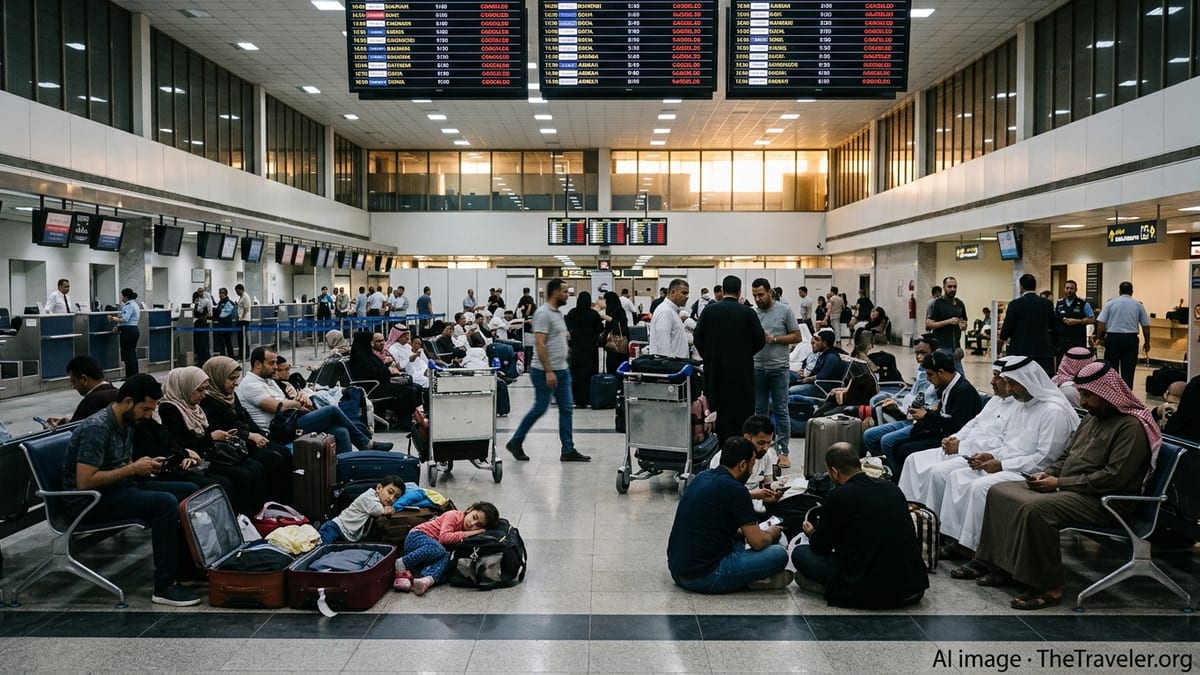
In the first days of the conflict, data from aviation analytics company Cirium cited in regional media indicated that tens of thousands of passengers were stranded as roughly half of all scheduled flight arrivals and departures in the broader Middle East were canceled. Airports from Beirut to Kuwait City reported large crowds of travelers seeking rebooking or alternative routings as airlines struggled to rebuild viable schedules.
While some services have since resumed on a limited basis under special corridors cleared by national aviation authorities, operations remain patchy. Hamad International Airport in Doha, Dubai International, Abu Dhabi’s Zayed International, Bahrain International, Kuwait International, Tehran’s Imam Khomeini, and Tel Aviv’s Ben Gurion all continue to see rolling cancellations and delays tied to rapidly changing security assessments.
For passengers, that has translated into longer journeys, extended layovers, and a higher risk of last-minute changes, even when flights are technically still operating. Many itineraries that rely on tight connections at Gulf hubs are now particularly vulnerable to disruption.
Rerouted Long-Haul Flights Mean Longer Journeys and Higher Fares
With direct routings over Iran and parts of Iraq severely constrained, airlines operating between Europe and Asia have been forced to thread their way around the conflict zone. Industry and media reports describe carriers shifting traffic south via the Arabian Sea and East African airspace, or north via Central Asia and the Black Sea region, depending on daily risk assessments and available corridors.
These workarounds typically add hours of flight time on routes that once flew almost straight over the Gulf, increasing fuel burn and crew costs. Aviation data providers note that some operators have responded by trimming frequencies, upgauging aircraft on remaining services, or temporarily suspending marginal routes where detours render operations uneconomic.
Travel industry analysis suggests that global fares have already moved higher as a result. With capacity out of key Middle East hubs reduced and operating costs elevated, economy and premium cabin prices on many Europe–Asia and Asia–North America itineraries are under upward pressure, especially for departures in the coming weeks.
Business aviation has not been spared. Specialist tracking firms report a double-digit drop in private jet departures across the conflict-affected region since late February, as charter operators reroute or avoid certain airfields and overflight zones, adding yet another layer of complexity for high-end and corporate travelers.
Guidance and Risk Levels for US and Other International Travelers
For US citizens and other foreign nationals, the disruption is unfolding against a backdrop of elevated security advisories. The US Department of State has urged Americans to leave a broad list of countries in the region and reconsider all nonessential travel, citing the risk of further escalation and limited evacuation options if commercial routes are curtailed further.
Separate from diplomatic advisories, aviation-risk resources used by airlines and corporate security teams highlight continuing dangers to civil aviation in Iranian airspace and parts of neighboring states. These assessments reference past incidents in the region and stress that fast-moving military operations can pose grave hazards to commercial flights in the wrong place at the wrong time.
Travel publications and consumer outlets note that many US and European airlines have suspended nonessential services to Israel, Iran, Iraq, and several Gulf destinations, or are operating only skeleton schedules. Where flights continue, carriers often rely on dynamic risk assessments and may change routings or cancel sectors at very short notice when threat levels rise.
Travelers transiting the region en route to Asia or Africa are therefore being advised, in publicly available guidance, to maintain flexible plans, monitor advisories from their airline and government, and be prepared for rebooking if their original routing is no longer viable on the day of travel.
Practical Steps for Passengers Caught in the Disruption
For those already ticketed on itineraries touching the Middle East in the coming weeks, the first step is to check whether the journey involves an affected hub or overflight area. Airlines and booking platforms have been encouraging passengers to verify their contact details and app notifications so that rebooking options and schedule changes can be communicated quickly.
Many major carriers have introduced temporary flexibility policies for travel through the region, allowing one or more free date or routing changes for impacted tickets. Industry reports indicate that some airlines are waiving change fees and fare differences for travelers willing to avoid certain hubs entirely or reroute via Europe, South Asia, or Africa instead.
Passengers currently stranded in Gulf cities or other regional hubs are being urged by travel advisors to speak directly with their airline or travel agent about alternative paths home, which may include positioning by bus or short-haul flight to less affected airports in Saudi Arabia or Oman, where commercial operations remain comparatively more stable.
Given how quickly the situation is evolving, experts recommend that travelers build in extra time for connections, avoid nonrefundable ground arrangements where possible, and keep essential items such as medication, chargers, and basic clothing in carry-on baggage in case of unexpected overnight stays due to rolling delays and cancellations.