

More news on this day
Joint US-Israeli strikes on Iran and swift retaliation from Tehran have shattered commercial air links across the Middle East, forcing mass flight cancellations at major hubs in Dubai, Doha, Tel Aviv and beyond and leaving hundreds of thousands of travelers stranded or diverted worldwide.
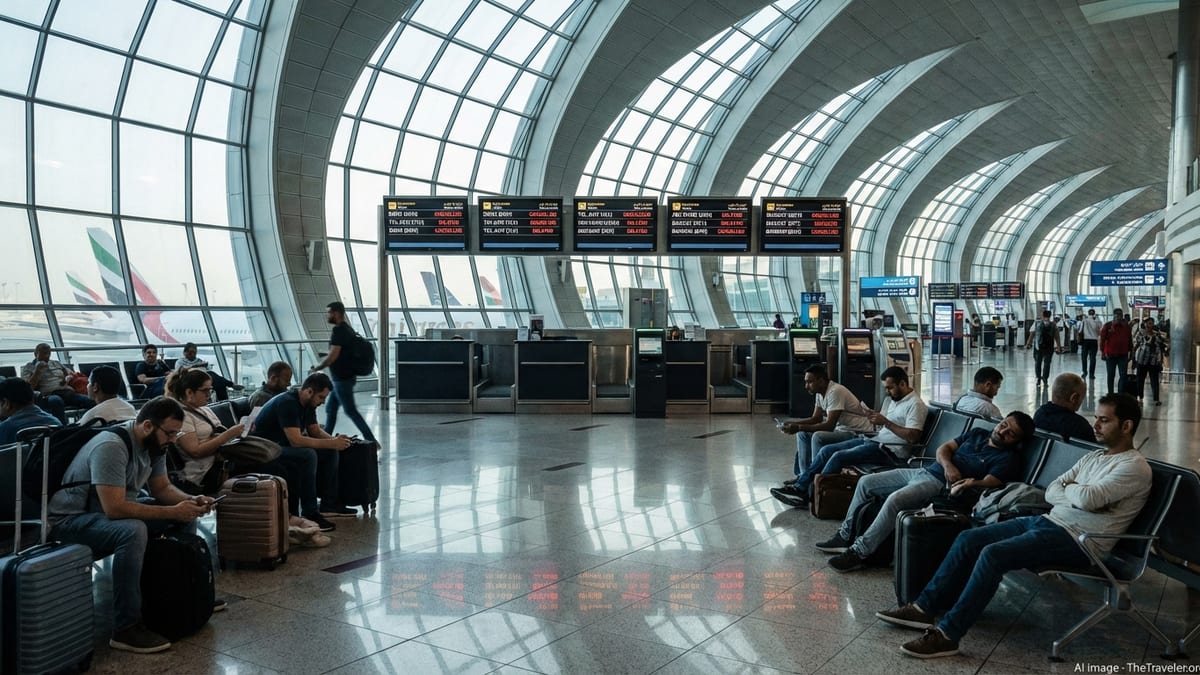
Airspace Closures Empty Skies Over the Gulf
Vast stretches of the Middle East were effectively removed from global aviation maps over the weekend after Iran, Israel, Iraq, Jordan, Qatar, Bahrain, Kuwait and the United Arab Emirates moved to close or severely restrict their airspace. The decisions followed coordinated strikes by the United States and Israel on Iranian military targets and subsequent Iranian missile and drone attacks on sites across the region.
Flight tracking platforms showed near-empty skies on Saturday above some of the world’s busiest corridors as commercial jets diverted around the Gulf and Levant, adding hours to journeys between Europe and Asia. The shutdown is particularly disruptive because Middle Eastern routes have grown even more critical since most Western carriers stopped using Russian and Ukrainian airspace.
Authorities framed the measures as urgent safety precautions amid fears of misidentification in crowded skies and the risk of stray or intercepted missiles. Civil aviation regulators in multiple states issued emergency notices barring civilian traffic from contested air corridors until further review, with some stressing that closures would remain in force "until further notice" as military operations continue.
Analysts say the moves highlight a vulnerability in global aviation: a heavy reliance on a small number of chokepoints, from the skies over the Gulf to the Suez Canal. With several of those now compromised at once, knock-on effects are rippling far beyond the immediate conflict zone.
Dubai, Doha and Tel Aviv Grind to a Halt
At the epicenter of the disruption are the region’s heavyweight transit hubs. Dubai and Abu Dhabi in the United Arab Emirates, Doha in Qatar and Tel Aviv in Israel all experienced sweeping cancellations and suspensions as airlines paused operations and airport authorities limited movements.
Dubai-based Emirates temporarily suspended operations to and from its main hub after the UAE partially closed its airspace, while fellow Emirati carrier flydubai acknowledged that the shutdown of several regional airspaces had forced it to cancel or reroute numerous services. In neighboring Abu Dhabi, Etihad Airways halted all departures from Zayed International Airport for several hours on Sunday, warning passengers of significant delays and urging them not to travel to the airport unless their flight was confirmed.
Qatar Airways, which has built Doha into a key east–west transfer point, said it had stopped flights after Qatar’s airspace was temporarily closed. The airline indicated it was reviewing the situation hour by hour, but advised that even after restrictions are lifted, schedules may remain volatile as aircraft and crews are repositioned.
In Israel, Tel Aviv’s Ben Gurion Airport largely shut to civilian traffic after the government ordered the country’s airspace closed during the initial barrages. US carriers Delta Air Lines and United Airlines suspended their Tel Aviv services through at least the weekend, joining a growing list of airlines from Europe and Asia that have halted Israel routes until security conditions improve.
Global Airlines Pull Back as Risks Mount
The cascading airspace closures have triggered a wave of cancellations from major international airlines that either serve the Middle East directly or rely on its airspace as a bridge between continents. Lufthansa suspended flights to Tel Aviv, Beirut and Oman and added Dubai to its no-fly list for the weekend, while also pledging to avoid certain regional skies. Air France and KLM canceled services to Tel Aviv and Beirut, with KLM accelerating a planned suspension of its Amsterdam–Tel Aviv route.
Low-cost carrier Wizz Air halted all flights to and from Israel, Dubai, Abu Dhabi and Amman until early March, while Aegean Airlines, Pegasus and other regional players cut services to Tel Aviv, Beirut and Erbil. Virgin Atlantic said it would route around Iraqi airspace for now, increasing flight times on services between Europe, India and the Gulf, and several Asian carriers, including Japan Airlines, canceled flights to Doha and other affected cities.
In India, where Gulf and Levant routes are critical for labor migration and onward connections, the shock was immediate. Air India and IndiGo suspended all flights across the Middle East, including to Dubai, Abu Dhabi, Doha, Riyadh, Jeddah and Tel Aviv, prompting India’s aviation regulator to warn of a "high-risk environment" across multiple West Asian airspaces. Other Indian carriers, including Air India Express, SpiceJet and Akasa Air, also scrubbed departures to Gulf destinations.
US and European airlines not directly serving the Gulf are being forced into complex rerouting decisions. Many had already been skirting both Russian and Iranian skies, and must now thread remaining corridors through Turkey, Egypt or the eastern Mediterranean, burning more fuel and sometimes requiring technical stops for refueling on what were previously nonstop legs.
Travelers Stranded From Mumbai to Munich
The operational chaos is translating into long lines, packed departure halls and uncertain itineraries for passengers worldwide. In India, Mumbai’s busy Chhatrapati Shivaji Maharaj International Airport reported dozens of cancellations and diversions on Saturday, with authorities later warning they could no longer accept additional diverted aircraft overnight due to a lack of parking space.
Hundreds of thousands of travelers are estimated to have been stranded or significantly delayed as flights are canceled outright or forced to turn back mid-route. One Delhi–Tel Aviv service operated by Air India had to reverse course and return to India when restrictions were announced while the aircraft was already en route, leaving passengers waiting for information about rebooking and eventual onward travel.
At airports across Europe, from London to Frankfurt and Amsterdam, departure boards showed clusters of flights to Dubai, Doha, Abu Dhabi, Tel Aviv, Beirut and other Middle Eastern destinations marked as canceled or delayed. Airlines have offered a mix of waivers, refunds and free rebooking, but capacity on alternative routings is limited, and some travellers face waits of days before a new connection becomes available.
Travel agents report a surge in calls from passengers seeking to reroute via Istanbul, Cairo or Riyadh, where airspace remains open but schedules are tightening. Many long-haul travelers between Europe and Asia are discovering that journeys that once took seven or eight hours may now stretch to 10 or more, as aircraft arc south over the Arabian Sea or north around Turkey and the Caucasus to avoid conflict zones.
Economic Fallout for Global Aviation and Tourism
Industry analysts warn that if the US-Israel-Iran confrontation and resulting airspace restrictions persist for more than a few days, the economic impact on airlines, airports and tourism-dependent economies could be severe. Gulf carriers such as Emirates, Qatar Airways and Etihad, which have built business models around high-volume transfer traffic through Dubai, Doha and Abu Dhabi, stand to lose millions of dollars in revenue for each day their hubs operate below capacity.
Airlines that continue to fly around the region’s danger zones are contending with sharply higher fuel bills, longer crew duty times, and complex rescheduling that can ripple across global networks. Those costs are likely to filter through to consumers in the form of higher fares, particularly on Europe–Asia routes where options are narrowing.
Tourism boards from the Gulf to the eastern Mediterranean are also bracing for fallout. Cities such as Dubai and Doha, which rely heavily on short-break visitors and conference delegates arriving on dense flight schedules, risk a sudden drop in arrivals if travelers conclude that the region is too unstable or too inconvenient to reach. That concern is amplified by memories of previous shutdowns triggered by regional conflicts and the pandemic, which took months to unwind.
For now, aviation authorities advise passengers with bookings through Middle Eastern hubs to stay closely in touch with their airlines, avoid heading to airports without confirmed itineraries, and prepare for significant delays. With no clear timeline for a deescalation between Washington, Jerusalem and Tehran, airlines are planning on a rolling basis, leaving global travelers facing an uncertain and fast-changing landscape in the skies.