

More news on this day
Global air travel has been thrown into turmoil after coordinated U.S. and Israeli air strikes on Iran prompted a cascade of airspace closures across the Middle East, forcing the shutdown of major transit hubs in the Gulf and leaving hundreds of thousands of passengers stranded or scrambling for alternative routes.
Airspace Closures Ripple Across the Middle East
The conflict, which erupted on February 28 with initial strikes on Iranian targets, has rapidly morphed into a full-blown aviation crisis. Iran was among the first to close its skies to civilian traffic "until further notice," swiftly followed by Israel, Iraq, Qatar and several Gulf states as military tensions escalated.
By the first weekend of March, commercial operations at Dubai International, Abu Dhabi’s Zayed International and Doha’s Hamad International had been cut back to a trickle of emergency and repatriation services. Data from global flight trackers indicate that more than 3,000 flights were cancelled on Sunday alone, with further waves of cancellations and delays rippling into Monday and Tuesday as airlines adjusted to the evolving security picture.
Regional carriers including Emirates, Etihad Airways, Qatar Airways, flydubai and Air Arabia have either halted or severely curtailed services through their Gulf hubs. In Saudi Arabia, flag carrier Saudia has extended widespread cancellations across multiple Middle Eastern destinations, underscoring how quickly the conflict has upended what is normally one of the world’s busiest aviation corridors.
Authorities in the United Arab Emirates, Qatar and Bahrain have framed their decisions as precautionary, citing the risks posed by ongoing missile and drone activity, as well as the need to keep airspace clear for military and humanitarian operations. Officials have warned that restrictions could be adjusted with little notice as the security situation evolves.
Global Airlines Scramble to Reroute and Suspend Services
The disruption is not limited to Middle Eastern carriers. European, North American and Asian airlines have embarked on an extraordinary bout of last-minute schedule surgery, cancelling flights into the region and redrawing long-haul routes that traditionally cross Iranian and Iraqi skies.
Major European players such as Lufthansa, Air France, KLM and British Airways have suspended flights to key destinations including Tel Aviv, Dubai, Doha, Riyadh, Dammam and Beirut for several days, in some cases stretching into mid-March. Finnair, Norwegian and Wizz Air have pulled or rerouted services to Gulf and Levant destinations, while many carriers have instituted flexible rebooking and refund policies for affected travelers.
Transatlantic and Asia–Europe flows have also been hit. Delta Air Lines has cancelled New York–Tel Aviv services into at least next week, while American Airlines has suspended its link between Doha and Philadelphia. Air Canada has halted flights to Tel Aviv and Dubai for much of March as it reassesses routings that typically rely on Middle Eastern overflight permissions.
Indian carriers, which depend heavily on Gulf hubs to connect South Asia with Europe and North America, have been forced into large-scale cancellations and limited recovery flights. Air India, IndiGo and other regional airlines have temporarily suspended services to the United Arab Emirates, Saudi Arabia, Qatar and Israel, adding further strain to already stretched airport operations as they work to bring home stranded nationals.
Travelers Stranded, Itineraries Upended Worldwide
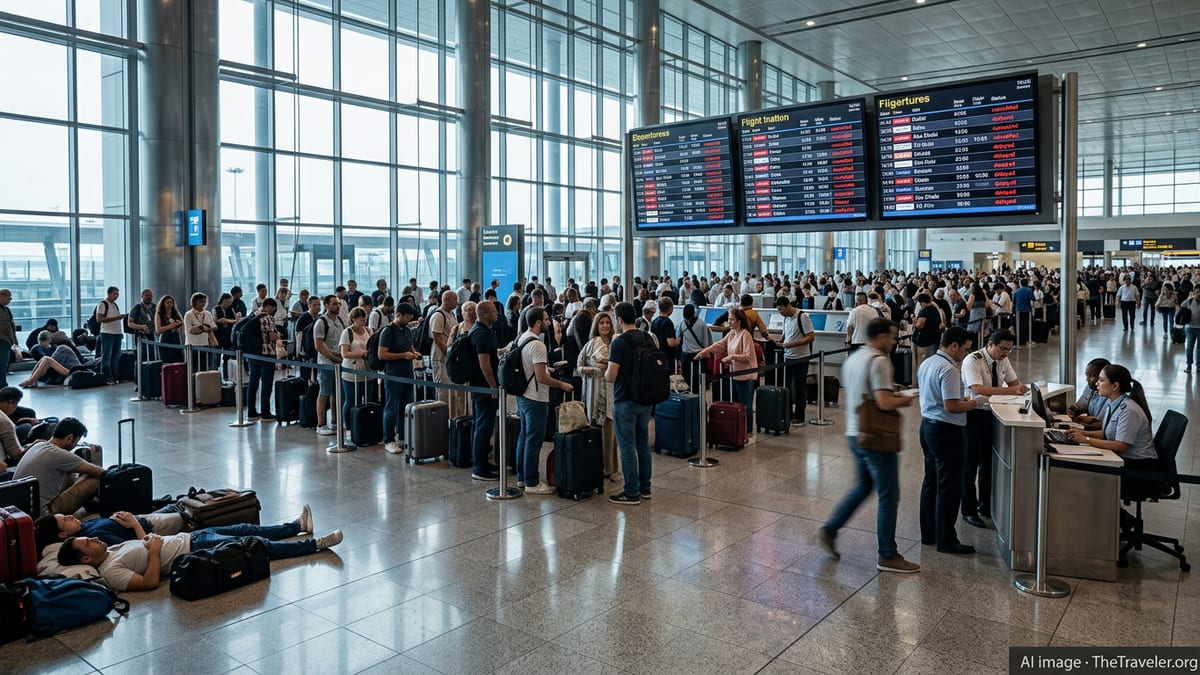
For travelers, the geopolitical crisis has translated into snaking queues at airline counters, crowded terminal floors and frantic searches for scarce alternative routings. Airports from Dublin and London to Mumbai, Singapore and New York have reported clusters of passengers whose journeys were meant to transit through Dubai, Abu Dhabi or Doha but are now in limbo.
In Ireland, Dublin Airport confirmed the cancellation of multiple daily services to Dubai, Doha and Abu Dhabi, warning that further disruption is likely as Gulf hubs remain constrained. Similar scenes have played out at major European gateways, where long-haul passengers have faced last-minute diversions, overnight delays and multi-stop rebookings that add many hours or even days to their trips.
In Asia, video and images from Mumbai, Delhi and other large airports show departure boards filled with cancellations and travelers camping out near check-in islands or immigration halls. Many had been heading to jobs in the Gulf or connecting onward to North America and Europe. With regional airspace still volatile, consular staff from several governments have been deployed to assist citizens with accommodation, visas and emergency travel documentation.
Global travel agencies and online booking platforms report a surge in calls and messages from anxious customers seeking clarity on whether future departures will operate. Some tour operators have begun to cancel or reroute itineraries that rely on Gulf stopovers, while cruise and pilgrimage organizers are rethinking their logistics in response to the rapidly shifting flight map.
Rerouting Around a Closed Corridor Drives Costs Higher
The closure or restriction of large swaths of Middle Eastern airspace has forced airlines to redraw some of the world’s most important long-haul corridors almost overnight. Routes that used to cross Iran, Iraq and the Gulf in near-straight lines between Europe and Asia now hug the Caspian Sea, skirt via Central Asia or swing wide over Egypt and the Red Sea, adding fuel burn, time and complexity.
Aviation analysts say detours can add anywhere from 30 minutes to more than two hours to certain flights, depending on the origin and destination, which in turn drives up operating costs at a time when airlines were already grappling with high fuel prices and tight capacity. Carriers are also constrained by crew duty-time limits, aircraft availability and congestion in alternative corridors that suddenly carry a far higher share of global traffic.
For passengers, the financial impact is already visible. With seat supply through the region sharply reduced and demand for alternative routings surging, fares on remaining services between Europe and Asia, as well as between South Asia and North America, have jumped. Flexible tickets and itineraries that avoid the conflict zone are commanding a premium, while last-minute one-way fares in some markets have spiked severalfold.
Freight operators are feeling similar pressure. Dedicated cargo flights that once relied on Gulf and Iranian overflight rights are now competing for space on more circuitous paths, complicating logistics for time-sensitive shipments ranging from electronics to pharmaceuticals. Some forwarders are warning shippers to expect longer transit times, higher surcharges and potential bottlenecks at secondary hubs as the situation persists.
What International Travelers Should Do Now
For global travelers with upcoming itineraries touching the Middle East or using it as a transit bridge, experts stress the need for vigilance, flexibility and patience. Airlines are updating schedules and safety assessments daily, meaning that a flight shown as operating one day can still be cancelled or rerouted at short notice.
Passengers are being urged to monitor airline apps and notifications closely, verify flight status before leaving for the airport and keep contact details up to date in booking records. Many carriers have introduced temporary waivers allowing free date or route changes for trips involving cities such as Dubai, Abu Dhabi, Doha, Tel Aviv, Riyadh and Amman, and in some cases are offering full refunds for those unwilling to travel amid the uncertainty.
Travelers stranded en route are advised to work directly with airlines before turning to third-party agents, particularly in cases where complex interline tickets are involved. Priority is generally being given to vulnerable passengers, families with children and those on expiring visas, while governments assess whether to stage additional assisted departures from heavily affected hubs.
With security advisories from the United States and other countries now urging citizens to reconsider non-essential travel to large parts of the region, industry observers say the shock to Middle Eastern aviation could extend well beyond the current wave of cancellations. For now, the world’s airlines and their passengers are adjusting, day by day, to a global route map reshaped by war.