

More news on this day
Coordinated US and Israeli strikes on Iran have triggered an unprecedented cascade of airspace closures across the Middle East, stranding hundreds of thousands of travelers and forcing airlines to redraw global flight paths in real time.
Central Middle East Corridor Falls Silent
The aerial corridor that usually carries a major share of traffic between Europe, the Middle East, Africa, and Asia has effectively gone dark since the first waves of strikes on February 28. Aviation notices issued over the weekend and into this week confirm that the flight information regions covering Iran, Iraq, Qatar, Bahrain, Kuwait, and Syria remain closed to civilian traffic, while Israel’s airspace is shut to almost all commercial operations.
Regional regulators and international safety agencies have warned airlines to avoid the conflict zone entirely, citing the risk from missiles, drones, and potential misidentification of civilian aircraft. The result is a patchwork of no‑fly zones and narrow corridors that has shattered the predictable east–west flows that global carriers rely on.
Limited slivers of controlled airspace in the United Arab Emirates and Saudi Arabia have reopened under tight restrictions, allowing only a fraction of normal traffic to edge around the Persian Gulf. Operators describe the area as a moving maze, with routings revised hour by hour as fresh military activity is reported.
For travelers, that strategic shift is translating into cascading delays, missed connections, and itineraries that suddenly stretch several hours longer than advertised. For the industry, it represents the most disruptive Middle East airspace shutdown since the first Gulf War.
Hubs from Dubai to Doha Grind to a Halt
The closures have hit hardest at the Gulf super‑hubs that have transformed long‑haul travel over the past two decades. Dubai International and its secondary airport have operated at a fraction of normal volume since Saturday, with many passenger services cancelled outright and others converted to repatriation or cargo‑only operations.
In Doha, Qatar’s airspace remains shut to regular traffic as authorities focus on air defense and emergency movements. Hamad International Airport, usually a 24‑hour interchange for Europe–Asia and Africa–Asia flows, has seen waves of cancellations ripple outward to partner airlines on every continent.
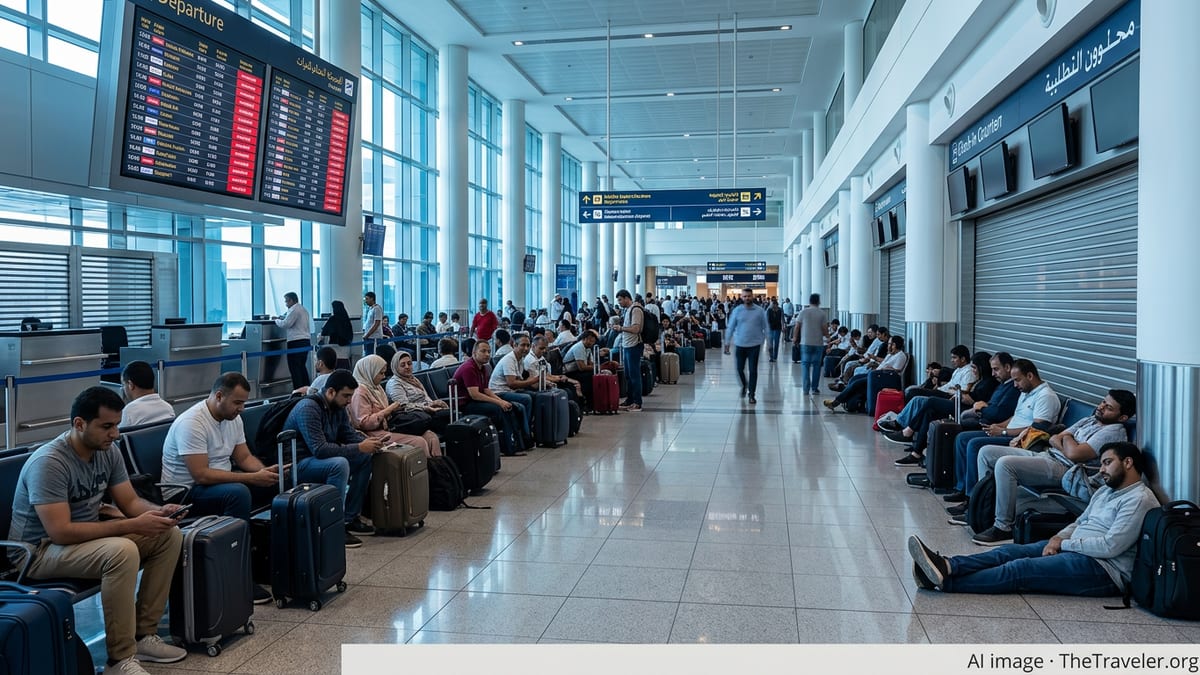
Bahrain, Kuwait, and several other states around the Gulf report near‑total suspensions of commercial flying, with some national carriers grounding their fleets or focusing on limited evacuation missions. Car parks and terminal halls that would normally cycle passengers through in a matter of hours have turned into makeshift waiting areas, as travelers sleep on floors and cluster around departure boards that rarely change.
Airlines from outside the region are also scrambling. European and Asian carriers have cancelled or curtailed flights to Tel Aviv, Beirut, Dubai, Riyadh, and other major cities, while selectively operating relief services when governments secure military escorts or protected corridors.
Global Reroutes Add Hours and Cost
With much of the central Middle East airspace off limits, long‑haul flights between Europe and Asia have been forced into sprawling detours. Carriers are threading aircraft through narrow airspace corridors over the Caucasus or sending them south across Egypt and the Red Sea, then skirting the edge of the Arabian Peninsula before turning east.
Aviation data firms report that typical flight times on key routes have lengthened by two to five hours or more, depending on aircraft type and available routings. Extra fuel burn is substantial, and some wide‑body jets are stopping en route to refuel at secondary airports, adding further complexity and potential points of delay.
The knock‑on effects are already visible in schedules and fares. Airlines are trimming frequencies on some long‑haul routes to free up aircraft and crews for the longer detours, and revenue managers are warning that sustained closures could drive up ticket prices in the coming weeks. Travelers with imminent trips are being advised to expect rolling schedule changes and to monitor bookings closely rather than relying on printed itineraries.
Air cargo is feeling similar pressure. Freighter operators that normally use Gulf hubs as staging points are now competing for scarce safe corridors, which threatens to slow delivery of time‑sensitive goods and humanitarian supplies into parts of the region.
Stranded Passengers and Patchwork Evacuations
As the conflict has widened, the human toll at airports across the Middle East has become more visible each day. From Beirut and Amman to Dubai and Muscat, terminal lounges are crowded with passengers carrying rebooked boarding passes and little certainty about when they will actually fly.
Embassies and consulates, particularly those of the United States and European countries, are working with host governments and airlines to organize special evacuations from key hubs. Charter flights, military transports, and ad hoc commercial services have begun lifting out citizens and permanent residents, but demand far exceeds available seats.
Families separated by earlier cancellations are struggling to reconnect as itineraries are rebuilt around what few flights remain. Some travelers are busing or driving across borders in search of open airports, only to discover that new closures or curfews have taken effect while they were en route.
Industry analysts caution that even when regular schedules begin to return, clearing the backlog of stranded passengers could take days or weeks. Priority is likely to go first to those holding original tickets, then to travelers on emergency or repatriation lists, which may leave leisure travelers and those on complex multi‑stop itineraries waiting longest.
Travel Advisories and What Flyers Should Expect Next
Governments are steadily tightening their travel guidance as the security situation worsens. The United States and several European states have urged citizens to leave multiple countries across the broader region while commercial options still exist, and have raised their advisories for nonessential travel to the highest warning levels.
Regulators in both the United States and Europe have issued strong warnings to airlines to avoid the conflict zone, aligning with many carriers’ own risk assessments. Most major international airlines now assume that they will not be able to use central Middle East routes at least through the end of this week, and are planning schedules on that basis.
For travelers whose itineraries touch the region, flexibility has become essential. Many airlines are offering waivers that allow free date or route changes, subject to spare capacity, while online travel agencies and booking platforms are struggling to keep real‑time information synced with rapidly shifting timetables.
Travel experts recommend that anyone with upcoming trips involving Gulf or Levantine hubs build in additional buffer time, maintain updated contact details with their airline, and consider alternative routings that avoid the region entirely if timing is critical. For now, the once‑routine practice of connecting through Dubai, Doha, or other Middle Eastern gateways has turned into one of the most uncertain bets in global aviation.