

More news on this day
The United States has sharply escalated its travel warning for Saudi Arabia, urging Americans to avoid or leave the kingdom as Iranian drone and missile attacks, damaged infrastructure and cascading flight cancellations roil air travel across the Middle East.
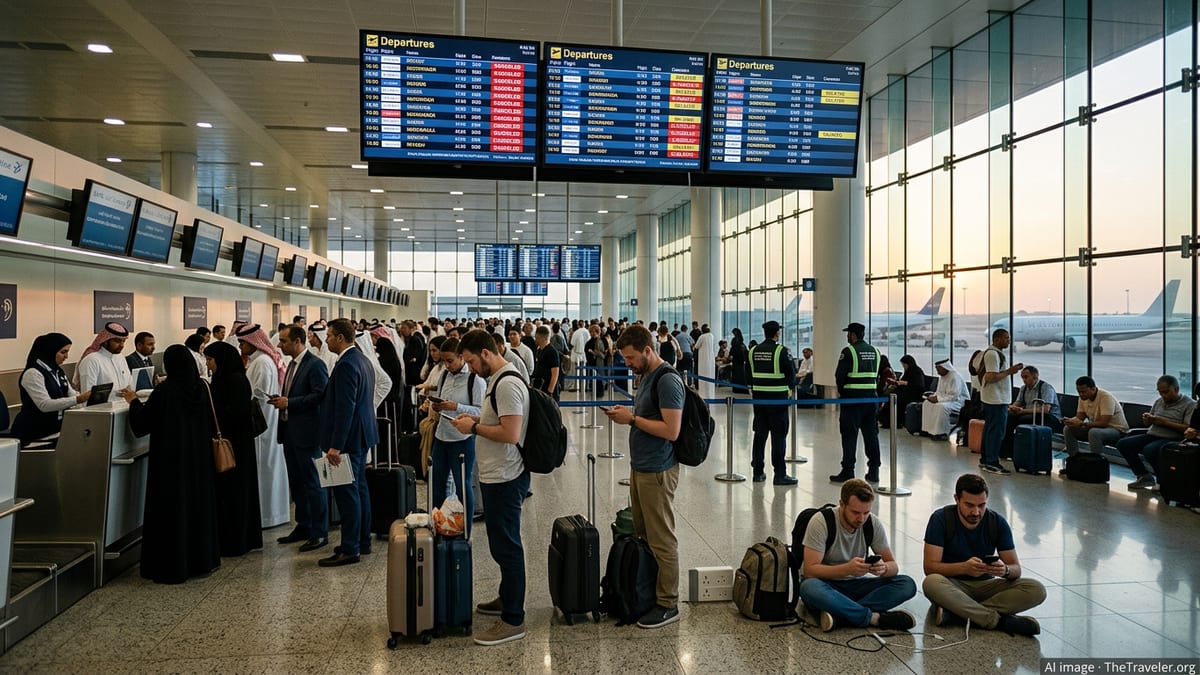
State Department Raises Alert as Conflict Intensifies
The State Department this week raised its advisory for Saudi Arabia to at least “reconsider travel,” part of a sweeping warning that covers more than a dozen countries amid the fast‑moving war involving Iran, the United States and Israel. Officials are strongly urging Americans already in the region, including in Saudi Arabia, to depart while commercial options still exist, noting that flight availability can change without notice.
While the formal country‑level advisory for Saudi Arabia has hovered between Level 3 and Level 4 in recent days, embassy security alerts and public statements have taken on a more urgent tone. Travelers are being told to register with consular authorities, maintain a low profile and be prepared to move quickly if an evacuation or government‑facilitated departure is offered.
US officials say the combination of targeted attacks, regional airspace closures and the potential for further escalation justifies treating all non‑essential travel to Saudi Arabia as high risk for the foreseeable future. The guidance marks one of the most sweeping US warnings for the kingdom since the 1991 Gulf War.
Drone Strikes Bring the Conflict Inside Saudi Borders
The warning comes as Iranian forces have widened their campaign of drone and missile strikes to include multiple targets inside Saudi Arabia, directly exposing foreign residents and visitors to the fallout of the conflict. In one of the highest‑profile incidents, an Aramco oil facility at Ras Tanura on the kingdom’s Gulf coast was hit on March 2 by an Iranian drone, part of a broader barrage on energy infrastructure and security installations.
Saudi and US officials say air defenses have intercepted many incoming projectiles, but not all. Recent strikes and attempted attacks have targeted or passed near airports, military bases and government facilities, highlighting the difficulty of insulating civilian travel from the fighting. At least one reported strike on a site in or near Riyadh underscored that even the capital, usually perceived as distant from front‑line tensions, is now potentially within range.
Security analysts warn that while Iran’s declared targets are military and strategic assets, the risk of miscalculation, malfunction or debris falling into populated areas is high. For travelers, that means that critical infrastructure they depend on such as airports, highways and energy facilities could be disrupted or briefly shut down with little advance warning.
Air Travel Disruptions Hit Riyadh and Regional Hubs
The escalating conflict has upended air travel throughout the Gulf, creating a chaotic patchwork of cancellations, diversions and last‑minute route changes that is now hitting Saudi Arabia more directly. After initial strikes on Iran prompted widespread regional airspace closures, many airlines began routing flights south over Saudi territory to avoid high‑risk corridors farther north.
As Iranian attacks have spread, however, Saudi cities have themselves experienced significant disruption. Riyadh’s King Khalid International Airport has remained open but has seen waves of delays, diversions and at times ground stops as airlines reassess risk and authorities briefly restrict operations following nearby missile or drone activity. Domestic routes to sensitive areas such as the eastern oil‑producing region and the southern border with Yemen have been among the most affected.
Regional hub airports that many travelers use to connect to and from Saudi Arabia, including Dubai and Abu Dhabi, have also sustained damage or temporary shutdowns from drone and missile strikes, stranding thousands of passengers. With schedules volatile and capacity constrained, even travelers not directly targeted by cancellations in Saudi Arabia are finding that their onward connections through the Gulf are no longer guaranteed.
Travel experts say that flight search results are increasingly unreliable for departures more than a few days out, as airlines repeatedly rebuild schedules. Passengers are being advised to confirm flights directly with carriers, consider flexible tickets and prepare for abrupt changes, including possible overnight stays near airports.
Americans Ordered Out and Consular Services Curtailed
The US government has already ordered the departure of some non‑essential diplomats and family members from posts in Saudi Arabia, reflecting heightened concern about the trajectory of the conflict. Consular services have been curtailed, with many routine visa and passport appointments cancelled as embassies focus on crisis response and security.
For private US citizens, the State Department is urging self‑evacuation while commercial routes still function. Officials caution that government‑organized flights, if they materialize, should be considered a last resort and may not reach all parts of the country. Americans are being told to keep travel documents on hand, ensure their mobile phones are charged and capable of receiving local alerts, and keep several exit strategies in mind, including overland routes to neighboring states if borders remain open.
Those who choose to stay are being advised to stock basic supplies, identify safe areas within their residences and follow local authorities’ shelter‑in‑place instructions in the event of incoming missile or drone alerts. Security specialists emphasize that foreign nationals should avoid taking photos or sharing detailed information about attack sites or security installations on social media, which could draw unwanted attention.
What the Warning Means for Future Travel Plans
The heightened US advisory for Saudi Arabia is already reshaping travel planning for spring and summer, from religious tourism to business trips and major events. Many US‑based companies have imposed blanket travel freezes for staff, shifting meetings online or relocating them to alternative hubs in Europe and Asia. Some tour operators have suspended departures to Saudi Arabia and neighboring countries entirely, while others are offering credits or free rebooking rather than immediate refunds.
Travel insurers are responding unevenly, and travelers are being urged to read policy language closely. Many standard policies exclude coverage for war‑related disruptions, meaning that cancellations prompted by missile threats or airspace closures may not be reimbursed unless a specific security rider is in place. Policies purchased before the latest wave of violence may include broader protections than those sold after the conflict escalated.
For now, US officials are offering no timeline for when the warning might be eased, stressing that the situation remains fluid and that further Iranian attacks or retaliatory actions cannot be ruled out. Prospective visitors are being told to delay non‑essential trips, monitor official advisories frequently and remain prepared for a protracted period in which travel to Saudi Arabia and the broader region carries significantly higher risk than in recent years.