

More news on this day
The US Embassy in Cairo has issued an urgent security advisory for American citizens in Egypt, warning of heightened regional risks and potential travel disruption as US and Israeli strikes on Iran and subsequent Iranian retaliation trigger a broader security crisis across the Middle East.
New Security Warnings for Americans in Egypt and the Region
The alert from the US Embassy in Cairo follows the launch of major US combat operations in Iran on February 28, 2026, and a rapid series of retaliatory missile and drone attacks across the Gulf. In parallel, the State Department has renewed its worldwide caution notice, urging Americans, particularly those in the Middle East, to exercise increased vigilance and closely follow instructions from local authorities and US missions.
While Egypt itself has not been directly targeted in the latest strikes, US officials stress that the proximity of the conflict, volatile regional airspace, and the risk of opportunistic attacks or unrest mean that American travelers should review their plans and be prepared for sudden changes. The embassy highlights the possibility of demonstrations, heightened security at sensitive sites, and temporary movement restrictions.
Egypt remains under a Level 2 State Department advisory, which calls on travelers to exercise increased caution due to terrorism, crime and health risks, with “do not travel” guidance still in place for parts of Sinai, the Western Desert and border regions. The new message does not alter that baseline rating but emphasizes that the wider regional conflict could amplify existing security concerns and complicate consular assistance if conditions deteriorate.
US citizens in Egypt are being encouraged to ensure that their travel documents are current, maintain a low profile, avoid political gatherings and closely monitor local news and embassy communications as the situation evolves from hour to hour.
Flight Cancellations, Airspace Closures and Transit Chaos
The most immediate impact for many travelers is unfolding in the skies. Airlines around the world have begun cancelling and rerouting flights that cross or serve the broader Middle East, responding to airspace restrictions and new risk assessments following the strikes on Iran. Aviation data cited by industry analysts shows that nearly a quarter of scheduled flights to key Middle Eastern destinations were cancelled on February 28 alone, with disruptions already spilling into early March.
Major European and North American carriers, including Air France, KLM, American Airlines, Delta Air Lines and United Airlines, have suspended or curtailed services to hubs such as Tel Aviv, Doha, Dubai, Riyadh and other Gulf cities, while also diverting long-haul routes between Europe, Asia and Australia to avoid Iranian and neighboring airspace. Gulf and regional airlines have likewise reduced frequencies, consolidated services and introduced longer routings that add hours to typical journey times.
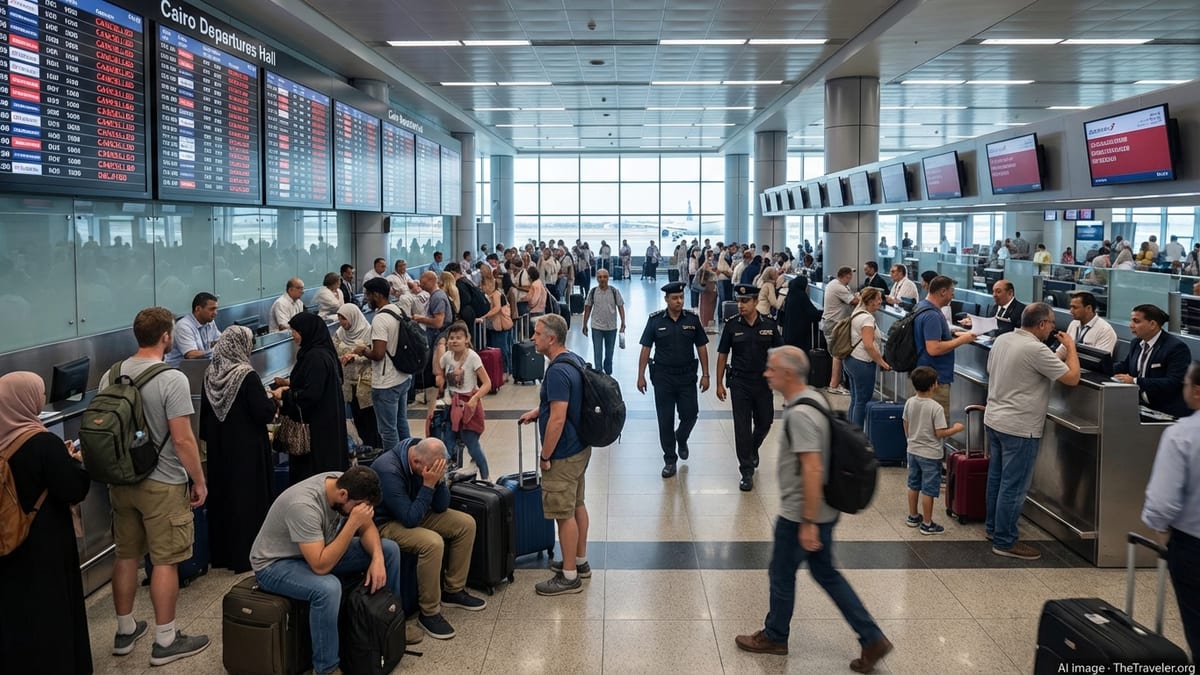
For travelers bound to or from Egypt, most direct flights to Cairo and Red Sea resorts are currently operating, but are exposed to knock-on effects as aircraft and crew are displaced and congested airports struggle to absorb diverted traffic. Overcrowded terminals, extended security checks and last-minute gate changes have been widely reported at several key hubs, creating long queues and missed connections even on flights technically outside the conflict zone.
Industry observers caution that further cancellations and schedule changes are likely in the coming days as governments and airlines reassess the stability of regional airspace and the risk of additional strikes. Travelers are being urged to check flight status frequently, build additional time into connections and be prepared for overnight delays.
Tourism in Egypt: Resilient but Newly Exposed
Egypt’s tourism sector entered 2026 on a stronger footing, buoyed by high-profile archaeological openings, improved infrastructure and the country’s relatively lower risk rating compared with some regional neighbors. Red Sea destinations such as Sharm El Sheikh and Hurghada, as well as Nile cruise routes between Luxor and Aswan, were recording robust bookings from European and American travelers.
The latest regional escalation, however, introduces new uncertainty. Tour operators report an uptick in queries and some cancellations from US travelers concerned about being stranded if airspace closures widen, or about the risk of spillover unrest in major cities. Several international travel companies are now offering more flexible rebooking terms for itineraries touching the Middle East, including Egypt, to accommodate changing perceptions of risk.
Egyptian officials have emphasized that the country remains open for tourism and that no attacks linked to the current confrontation have taken place on Egyptian soil. Security has been visibly reinforced at major tourist sites, airports and resort areas, continuing a long-standing policy of heavy protection of the tourism industry. Nonetheless, analysts note that the perception of the Middle East as a single, interconnected region means that sharp escalations in one country often dampen demand across many destinations, at least in the short term.
Travel industry experts expect that American demand for cultural trips to Cairo and the Nile may soften temporarily, while beach and diving holidays on the Red Sea could prove more resilient if airlines maintain reliable direct links from Europe and key US gateways. Much will depend on whether the current military confrontation stabilizes or intensifies in the coming weeks.
Practical Guidance for US Travelers With Upcoming Plans
For Americans with imminent travel to Egypt or the broader Middle East, the latest advisory effectively urges a shift from “leisure-minded” to “contingency-minded” planning. Travelers are encouraged to reconfirm every leg of their itinerary, including codeshare and connecting flights that may use affected air corridors, and to ensure that their airline and hotel bookings offer flexibility in case of sudden changes.
Travel insurers report increased inquiries about policies that cover war-related disruption, emergency evacuation and trip interruption. Not all policies provide such coverage, and many standard plans exclude events linked to declared conflicts, making it essential for travelers to read policy terms carefully. Experts recommend that would-be visitors consider comprehensive coverage that addresses medical care, emergency evacuation and unexpected accommodation costs should they become stranded by airspace closures.
On the ground, the State Department continues to advise that US citizens in Egypt avoid border regions, parts of Sinai and other high-risk areas, travel only with reputable operators to remote desert locations and stay alert in crowded public spaces such as transport hubs, markets and religious sites. Recent history in the region shows that security environments can change quickly, often with little or no warning.
Americans already in Egypt are being urged to keep phones charged, maintain access to cash in case of disruptions to digital payment systems, and share their itineraries and contact details with friends or family at home. Those planning future trips are watching closely to see whether hostilities and airspace restrictions begin to ease or harden into a longer-term constraint on travel.
Regional Diplomatic Efforts and Outlook for Travel
Regional governments, including Egypt, are closely monitoring the unfolding crisis and positioning themselves diplomatically as they seek to avoid direct entanglement in the confrontation between the United States, Israel and Iran. Egypt’s foreign ministry has publicly underlined its concern about the risk of a wider war and highlighted its focus on protecting Egyptian citizens and interests abroad, particularly in countries more directly affected by missile exchanges.
For the travel and tourism sector, the coming days will be critical. If the current spike in military activity is contained and airspace restrictions are gradually relaxed, airlines could begin restoring suspended routes and rebalancing capacity by mid to late March, allowing pent-up travel demand to recover. In that scenario, Egypt’s relative distance from the front lines and its strong tourism proposition could help it rebound faster than some neighboring destinations.
If, however, hostilities broaden or additional strikes target Gulf and Levant hubs used by international carriers, the disruption could stretch for weeks or months, reshaping long-haul routing patterns and discouraging discretionary travel across the region. Industry executives note that corporate travelers and tour groups are often the first to postpone trips in periods of acute geopolitical risk, while independent leisure travelers may follow if images of conflict dominate global news cycles.
For now, the message from US and regional authorities is one of caution rather than panic: Egypt remains accessible, but surrounded by a rapidly shifting security environment. For Americans weighing a visit, the decision increasingly hinges not only on appetite for adventure, but on tolerance for uncertainty in an era when geopolitics and travel are once again tightly intertwined.