

More news on this day
The United States is diverting a three-ship amphibious group carrying about 2,200 Marines toward the Middle East, a move that underscores rising regional tensions and raises fresh questions for travelers and shipping interests that depend on the Red Sea, Gulf of Aden and Strait of Hormuz.
Get the latest news straight to your inbox!
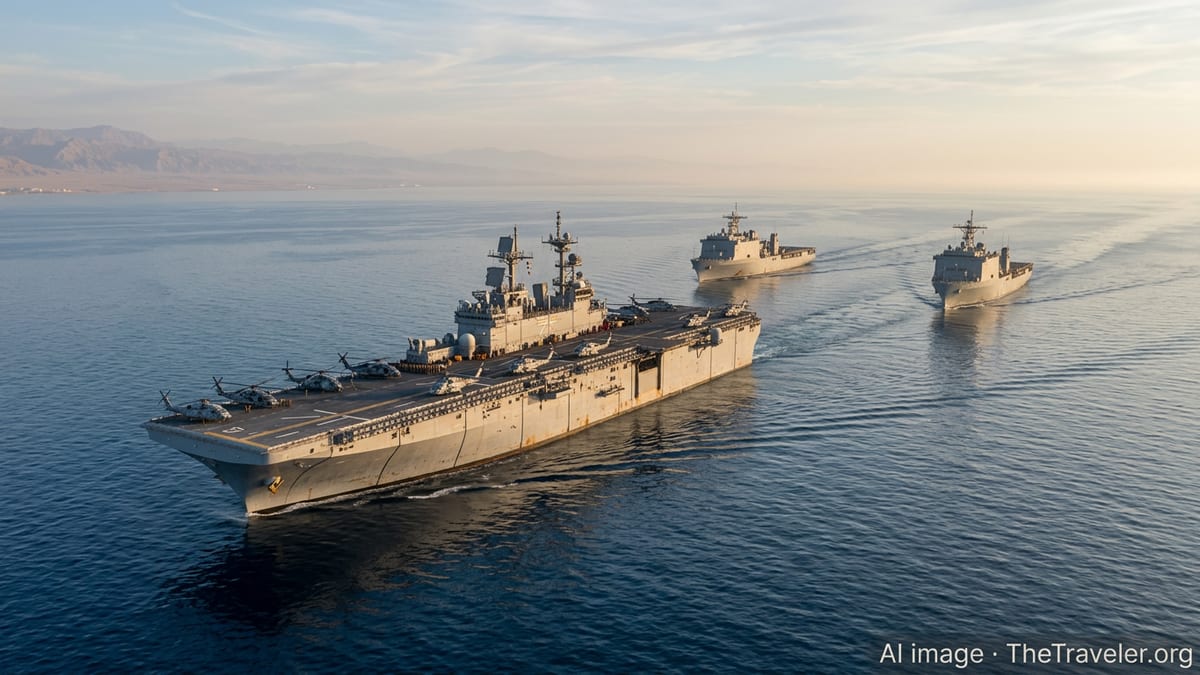
New Amphibious Deployment Signals Heightened Security Concerns
US officials say an amphibious assault ship and two accompanying dock landing and transport ships, together carrying a Marine expeditionary unit, have been ordered to head toward the Middle East as Washington responds to continued missile and drone threats to commercial and energy shipping routes. The force is expected to operate under US Central Command, which oversees military operations from the eastern Mediterranean through the Persian Gulf and Red Sea.
The amphibious group, centered on the Japan-based USS Tripoli, is designed to move Marines rapidly ashore by helicopter and landing craft, giving US commanders a flexible tool for crisis response, maritime security and limited evacuations. Its diversion to the region adds to an already substantial American naval presence that has cycled through the Red Sea, Gulf of Aden and Arabian Sea since late 2023 to counter attacks on merchant vessels and reassure allies.
Defense analysts note that the latest deployment reflects a broader pattern of episodic US buildups in response to flashpoints, from Houthi attacks on shipping around Yemen to periodic escalations involving Iran in the Strait of Hormuz. For travelers and the tourism industry, these force movements are often invisible at sea, but they influence flight paths, cruise itineraries and insurance decisions that shape how people move through the region.
Impact on Key Maritime Chokepoints and Global Travel Routes
The presence of additional US amphibious ships and Marines is expected to focus on safeguarding traffic through some of the world’s most important maritime chokepoints, including the Bab al Mandab strait at the southern end of the Red Sea and the Strait of Hormuz at the mouth of the Persian Gulf. These narrow passages are essential for container ships, bulk carriers and tankers serving Asia, Europe and North America, and disruptions there quickly ripple across global logistics networks.
Over the past two years, repeated missile, drone and small-boat attacks linked to Iran and allied groups in Yemen have already led many shipping lines to reroute vessels around the Cape of Good Hope, adding thousands of miles and several days to journeys between Asia and Europe. The decision to send a Marine expeditionary unit to the region is intended to bolster deterrence and reassure shipowners that the United States can respond quickly to new threats or attacks on commercial traffic.
For travelers, these shifts in maritime risk have contributed to longer delivery times, higher consumer prices and occasional schedule adjustments for cruises transiting the Suez Canal or calling at ports in the Red Sea and Gulf of Oman. While major cruise operators have shown they can adjust routes on short notice, the increased US naval presence underscores that the security picture remains fluid, and itineraries through the region are likely to stay under close review.
Regional Tourism Caught Between Risk Perceptions and Resilience
Tourism hubs across the Middle East and North Africa are watching the latest US deployment closely. Gulf states such as the United Arab Emirates, Oman and Qatar, along with Red Sea destinations in Egypt and Saudi Arabia, have invested heavily in positioning themselves as safe, modern gateways between Europe and Asia. Their fortunes are closely tied to perceptions of stability along the air and sea routes that bring visitors to beaches, desert resorts and cultural landmarks.
Travel advisors say that while most holidaymakers will not notice specific US ship movements, news of additional Marines and amphibious vessels heading to the region can influence how some travelers perceive risk, particularly those considering cruises or adventure itineraries that involve smaller ports and coastal excursions. Carriers and tour operators, in turn, weigh that sentiment when deciding whether to launch new routes or scale back seasonal offerings.
Industry insiders emphasize that key tourist centers remain far from potential flashpoints at sea and benefit from strong security partnerships with Western navies and regional coast guards. However, they also acknowledge that sudden escalations, such as a high-profile attack on a merchant vessel or a closure of a major strait, could prompt a wave of cancellations or diversions, especially among travelers connecting through Gulf hubs en route to Asia, Africa or the Indian Ocean islands.
What the Deployment Means for Travelers and Cruise Passengers
For air passengers, the deployment of additional US amphibious ships and Marines is unlikely to result in immediate, visible changes. Airlines have already adapted many flight paths to avoid specific conflict zones, and the main aviation gateways in the Gulf and eastern Mediterranean continue to operate as normal. Travelers passing through major hubs may see heightened security measures, but for now, schedules remain largely intact.
Cruise passengers, particularly those booked on repositioning voyages between Europe and Asia or on Red Sea itineraries, may experience more direct effects. Operators have previously rerouted ships away from the southern Red Sea and Gulf of Aden when risk levels spiked, sometimes substituting longer ocean segments with additional port calls in the Mediterranean or Indian Ocean. The latest US naval movements suggest that cruise lines will continue to keep contingency plans ready, balancing guest safety, insurance conditions and port access.
Travelers considering itineraries through the broader Middle East are being advised by agents to monitor official travel advisories, remain flexible with routing and pay close attention to operator communications in the weeks leading up to departure. While the presence of US Marines and amphibious ships aims to stabilize key sea lanes, it also signals that tensions remain elevated, and last-minute adjustments to routes at sea should be considered a possibility rather than an exception.
Looking Ahead: Security Presence as a New Normal for Regional Mobility
The dispatch of an amphibious group and Marine expeditionary unit to the Middle East is the latest example of a pattern that many in the travel and shipping industries now regard as a new normal: cyclical deployments of substantial naval forces to safeguard commerce and reassure partners when regional tensions spike. From the eastern Mediterranean to the Indian Ocean, the visual backdrop to many cruise decks and coastal resorts increasingly includes distant silhouettes of warships and patrol aircraft.
For destination marketers and hotel operators from Muscat to Jeddah, the challenge is to maintain a narrative of safe, high-quality experiences even as headlines focus on missile launches, drone interceptions and maritime standoffs. That balancing act requires close coordination with governments, port authorities and carriers, as well as clear communication with guests about the distance between tourism centers and areas of potential military activity.
Travel strategists say the latest US Navy deployment highlights the importance of diversified routing and resilient planning for both leisure and business travelers using Middle Eastern gateways. Whether crossing the Red Sea on a winter cruise, transiting a Gulf hub on the way to Asia, or embarking on a luxury dive trip in the Arabian Sea, visitors are likely to rely increasingly on operators that can adapt rapidly to shifts in the security environment, even as a steady presence of Marines and amphibious ships becomes part of the wider seascape.