

More news on this day
An American Airlines Boeing 787 flying from Philadelphia to Doha was forced to abandon its journey and return to the United States after cascading Middle East airspace closures abruptly severed a key corridor between North America and Qatar, underscoring how fast-moving conflict can upend global travel plans in a matter of hours.
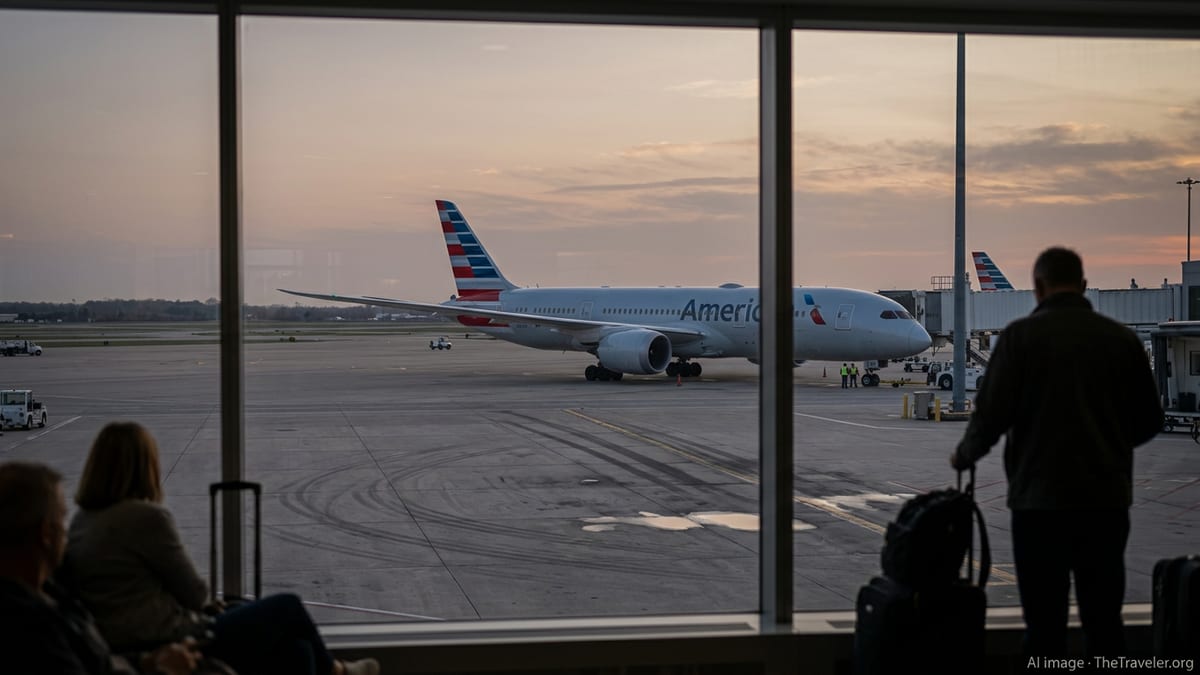
American Airlines 787 Makes 15-Hour Round Trip to Nowhere
American Airlines Flight 120, operated by a Boeing 787 Dreamliner, departed Philadelphia International Airport bound for Doha’s Hamad International Airport with a cabin full of passengers expecting a routine overnight crossing to Qatar. Several hours into the flight, however, the crew received word that a widening ring of airspace closures across the Gulf region made it unsafe and operationally impossible to continue to their destination.
With airspace over Iran already effectively off limits and additional restrictions rapidly coming into force over Qatar and neighboring countries, dispatchers and pilots weighed limited routing options. Ultimately, the decision was made to reverse course near the eastern Atlantic, turning the eastbound long haul into one of the longest “flights to nowhere” on record.
The aircraft landed back in Philadelphia after roughly 15 and a half hours in the air, leaving passengers physically back where they started but with crew duty time exhausted and their onward journeys in limbo. Flight data analysts noted that the odyssey was rare even by the standards of long diversions, comparable only to a handful of similar ultra-long flights that have been forced to return to origin in recent years.
Airline representatives said safety and regulatory compliance were paramount once the scale of the regional airspace shutdown became clear, adding that the company was working with affected customers to arrange refunds, rebookings and hotel accommodation where needed.
Rapid Fire Airspace Closures Across the Gulf
The reversal of the Philadelphia–Doha service came as the Middle East’s aviation map was redrawn in real time. Following coordinated United States and Israeli strikes on Iran on February 28, 2026, Iran’s skies quickly emptied of civilian aircraft as regional authorities issued sweeping flight bans and restrictions.
Within hours, Bahrain, Iraq, Kuwait, Israel, Qatar and the United Arab Emirates moved to close or severely limit their airspace to commercial traffic, according to industry tracking data and notices to airmen. For carriers linking North America and Europe with hubs in Doha, Dubai and Abu Dhabi, those closures effectively shut the door on some of the world’s most heavily traveled long-haul corridors.
Qatar’s own airspace restrictions were closely tied to Iranian missile and drone strikes that targeted sites in and around Doha, including areas near Hamad International Airport and the Al Udeid air base. Qatari officials reported intercepting multiple incoming projectiles and temporarily suspending routine civil operations, sending shockwaves through schedules at the country’s flagship airport.
As the list of restricted flight information regions grew, dispatch centers across the globe were forced into a constant process of replanning, at times seeing routings they had approved only hours earlier suddenly become nonviable as new airspace notices were issued.
Qatar’s Role and the Strain on US–Gulf Connectivity
For travelers between the United States and Qatar, the disruption is especially acute. Doha has emerged in recent years as a central hub for American travelers connecting to South Asia, Southeast Asia and Africa via codeshare and alliance arrangements, even as direct US–Qatar frequencies remained limited compared with pre-pandemic plans.
The suspension of regular American Airlines service to Doha and the forced return of Flight 120 highlight how closely US carriers’ Gulf strategies are intertwined with regional stability. Industry data shows that the three major Gulf superconnectors, including Qatar Airways, typically handle tens of thousands of connecting passengers per day through their hubs, many of them originating in or bound for North American cities.
With Qatar’s airspace effectively constrained, US passengers who would normally fly nonstop or via the Gulf are being pushed onto more circuitous routings through Europe, Egypt or southern pathways via Saudi Arabia and Oman when available. Those alternate paths can add several hours of flight time and may still be vulnerable to further changes if the conflict zone widens.
Aviation analysts warn that prolonged restrictions over Qatar and its neighbors would have a disproportionate impact on high-yield corporate traffic, energy sector workers and migrant labor routes that rely heavily on Doha’s connectivity. For now, airlines are adopting a day-by-day approach, issuing rolling cancellations while watching for any signs that airspace might reopen in a sustained and predictable way.
Global Ripple Effects From a Single Turnback
While the American Airlines 787’s return to Philadelphia may be the most dramatic US–Qatar story so far, it is only one snapshot of a much larger upheaval. By early March, aviation analytics firms were counting thousands of cancellations and diversions tied to the conflict, with some widebody aircraft from Middle Eastern carriers left stranded at airports across North America, Europe and Asia.
With Russian airspace already closed to many Western airlines, the loss or degradation of key Middle East corridors has further squeezed traffic into a narrow band of usable routes, particularly over the Caucasus and eastern Mediterranean. Airlines that can secure viable alternatives are burning more fuel and bumping up against crew duty limits, while others have chosen to freeze entire route networks until risk levels fall.
Travelers in the United States are seeing the effects at home, from Washington Dulles to New York and Chicago, where departure boards show a patchwork of cancellations to Doha, Dubai and Tel Aviv alongside elongated routing times to cities in India and beyond. For passengers booked to Qatar, even those not flying on Gulf carriers themselves, the sudden disappearance of a major hub is translating into missed connections, unexpected stopovers and long waits for rebooking.
Airports that once served primarily as brief transit points for passengers en route to Doha now find themselves acting as ad hoc holding zones, as airlines manage disrupted crews and aircraft that cannot legally or safely continue to the Gulf.
What Comes Next for US–Qatar Air Travel
In the near term, industry observers expect US–Qatar connectivity to remain highly constrained, with only limited or special operations possible until airspace and security assessments improve. Airlines are coordinating closely with regulators and military authorities to determine when limited corridors might reopen and under what conditions commercial overflights could resume.
For American Airlines, the experience of operating a 15-hour round trip that begins and ends at the same airport will factor into how it evaluates future risk, fuel planning and diversion strategies on ultra-long-haul routes. Carriers are already revisiting their contingency playbooks to account for scenarios in which several adjacent airspaces close simultaneously, leaving only narrow and congested corridors available.
Travel advisers recommend that passengers booked on itineraries touching Qatar or neighboring countries remain flexible, monitor airline messages closely and consider alternative routings through Europe or other regional hubs where seats are available. With demand far outstripping capacity on the remaining viable routes, last-minute options are limited and premium cabins in particular are under heavy pressure.
For now, the American Airlines Dreamliner that traced an expensive circle over the Atlantic stands as a potent symbol of the way geopolitical flashpoints can instantly redraw the world’s flight paths, turning a routine US–Qatar crossing into a long journey back to where it began.