

More news on this day
Thousands of holidaymakers and business travellers are stranded in the United Arab Emirates, Qatar and Bahrain as the United States, Russia, the United Kingdom and France race to mount emergency airlifts amid widespread airspace closures and intensifying conflict across the Middle East.
Regional hubs fall silent as skies close
Dubai, Abu Dhabi, Doha and Manama, usually among the busiest aviation crossroads on the planet, have been transformed almost overnight from bustling transit hubs into holding zones for displaced tourists. Following joint United States and Israeli strikes on Iran and subsequent Iranian missile and drone barrages on Gulf targets, authorities across the region shut large swaths of airspace, choking off routine commercial travel.
Airports in the United Arab Emirates, Qatar and Bahrain remain partially or completely closed after strikes and interception debris damaged infrastructure in Dubai and Abu Dhabi and triggered heightened security alerts in Doha and Manama. Flight tracking services report thousands of cancellations and diversions since late last week, as airlines from Emirates and Qatar Airways to major European and Asian carriers suspend operations into the Gulf.
The disruption has rippled far beyond the region, with long-haul services between Europe, Asia and Africa forced to reroute or pause entirely. Travellers who began their journeys days ago are now stuck in transit hotels and departure halls, trying to rebook onward connections that may not resume for days.
Officials and aviation analysts warn that even if limited airspace corridors reopen, it could take considerable time to untangle the global network of aircraft and crews knocked out of position by the cascading shutdowns.
Western governments activate large-scale evacuation plans
With tens of thousands of their citizens caught in the closures, the United States, Russia, the United Kingdom and France have shifted from travel warnings to planning or launching coordinated evacuations from the Gulf. Diplomats describe the emerging effort as one of the most complex multinational airlifts in the region since the first Gulf War, complicated by active missile threats and shifting overflight restrictions.
In Washington, officials say contingency plans call for chartered widebody jets and, if necessary, military transport aircraft to operate controlled evacuation corridors once host governments and air defence commanders deem specific routes safe enough. Priority will go to tourists and short-term visitors in the UAE, Qatar and Bahrain whose stays have been involuntarily extended by closures and hotel shortages.
Russia has been negotiating with Gulf authorities to secure permission for state-operated aircraft to collect stranded nationals and dual citizens, many of whom were using Dubai and Doha as transit points between Europe and Asia. Moscow is also exploring the use of secondary airports on the Arabian Peninsula as staging areas should primary hubs remain restricted.
British and French officials, facing large numbers of holidaymakers in Dubai and Doha during peak travel season, are drawing up joint options with European Union partners, including pooled charter flights and shared use of any safe air corridors over Saudi Arabia or the eastern Mediterranean. Consular services in all four countries are urging citizens to register their presence, monitor official alerts and avoid attempting overland exits without guidance.
Human stories from shuttered terminals
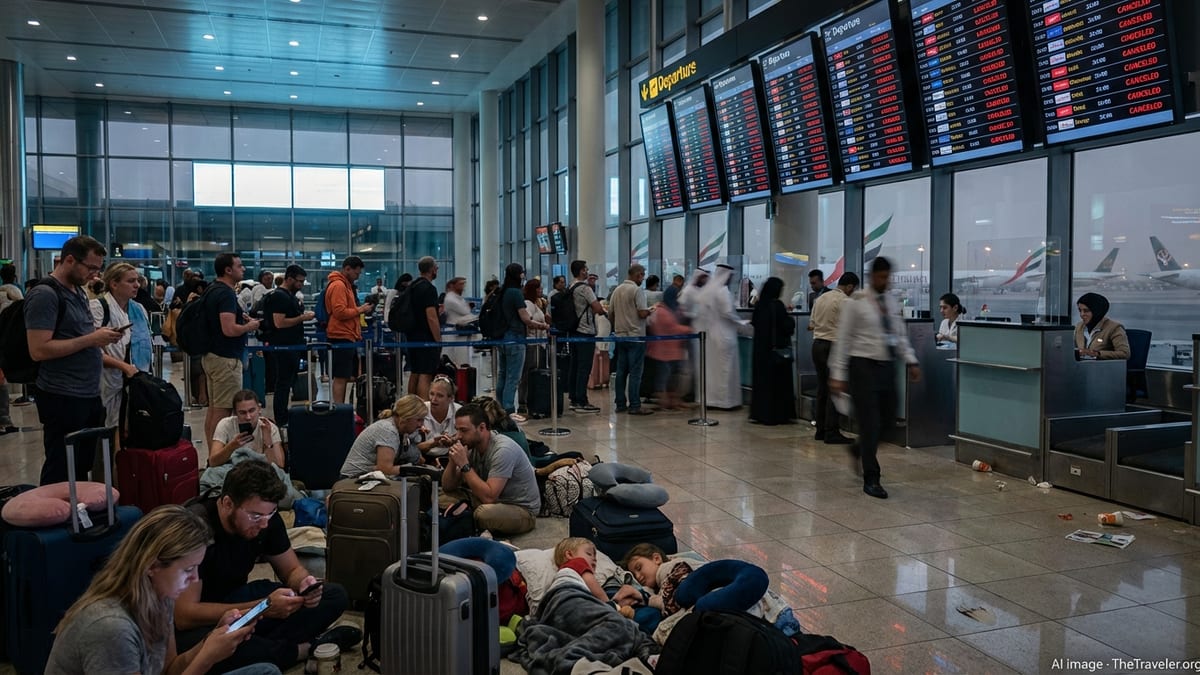
Inside the terminals, the geopolitical crisis is playing out as a succession of personal dramas. Families who had come to Dubai for theme parks and shopping festivals are now sleeping on terminal floors or in overflowing airport hotels, clutching rebooked boarding passes that may or may not be honoured. Business travellers who planned quick stopovers in Doha’s Hamad International Airport are fielding calls from employers as meetings across Asia and Europe are postponed or moved online.
Queues snake through airline service desks as passengers plead for information on when outbound flights might resume, while departure boards cycle through waves of red cancellations. Airport announcements loop in multiple languages, advising travellers not to leave secure areas and to follow instructions from staff and security forces.
Outside the airports, the strain is also being felt in popular tourist districts. In Dubai and Abu Dhabi, beachfront resorts report guests extending stays day by day as they wait for news of evacuation flights or commercial services. In Doha and Manama, tour operators have suspended excursions and are instead coordinating with embassies, trying to keep mixed groups of stranded visitors together so they can move quickly when flights become available.
For many travellers, the most stressful element is uncertainty. With air defence responses and further missile launches still possible, timelines for reopening the most affected airspace remain fluid. Officials caution that emergency flights, when they begin, will likely be announced at short notice and fill quickly.
Logistical and security hurdles for emergency airlifts
Even as capitals announce plans, aviation and defence experts underscore that executing mass evacuations from active conflict-adjacent zones is fraught with risk. Any airlift must contend with overlapping no-fly notices, the possibility of renewed missile or drone attacks, and the need to deconflict civilian and military aircraft in already congested regional corridors.
Governments are working with Gulf civil aviation authorities and regional air defence networks to designate protected corridors and time windows for evacuation flights. These operations will likely favour large, fuel-efficient aircraft capable of flying long detours over the Arabian Sea or Red Sea to avoid the most volatile airspace.
Security concerns extend to the ground. Enhanced screening and restricted access around the main terminals mean that embassies may have to bus groups of tourists from hotels to secure gates at specific times, escorted by local security forces. Authorities are also weighing how to prioritise the most vulnerable travellers, including unaccompanied minors, the elderly and those with medical conditions that may be exacerbated by extended stays in crowded facilities.
Travel industry insiders warn that the unprecedented scale of the disruption will reverberate even after the immediate evacuations conclude. Airlines will face the dual challenge of moving stranded passengers out of the Gulf while gradually restoring regular schedules, all in an environment where insurance costs and risk assessments for the region have sharply increased.
What stranded tourists are being advised to do now
Consular officials and travel experts say the most important step for stranded visitors in the UAE, Qatar and Bahrain is to maintain close contact with their embassy or consulate and with their airline or tour operator. Registration on official crisis or traveller tracking services is now a prerequisite for placement on many planned evacuation flights or priority waiting lists.
Travellers are being urged to conserve cash where possible, keep mobile phones charged, and stay within easy reach of their accommodation or the airport in case short-notice flight opportunities arise. Officials stress that individuals should avoid informal offers of transport or unsanctioned overland routes, which may traverse areas subject to military activity or sudden closures.
For those yet to depart for trips to the region, governments in North America, Europe and Asia are reinforcing blunt guidance: postpone all non-essential travel to Gulf states affected by the closures and be prepared for long-term changes to routing and schedules once flights resume. Insurers are already reviewing coverage for new bookings to and through key hubs like Dubai and Doha.
While the immediate focus is on extracting those already in harm’s way, travel analysts say the crisis will likely reshape perceptions of the Gulf as a frictionless global transit point. For now, however, the priority for the United States, Russia, the United Kingdom and France remains clear: carve out enough safe airspace to fly their citizens home from suddenly isolated desert hubs.