

More news on this day
The United States is sending roughly 2,500 Marines and at least one amphibious assault ship toward the Middle East as the conflict with Iran intensifies, redirecting a major amphibious force from the western Pacific to waters near the Strait of Hormuz in a move widely interpreted as an effort to bolster deterrence and protect vital shipping routes.
Get the latest news straight to your inbox!
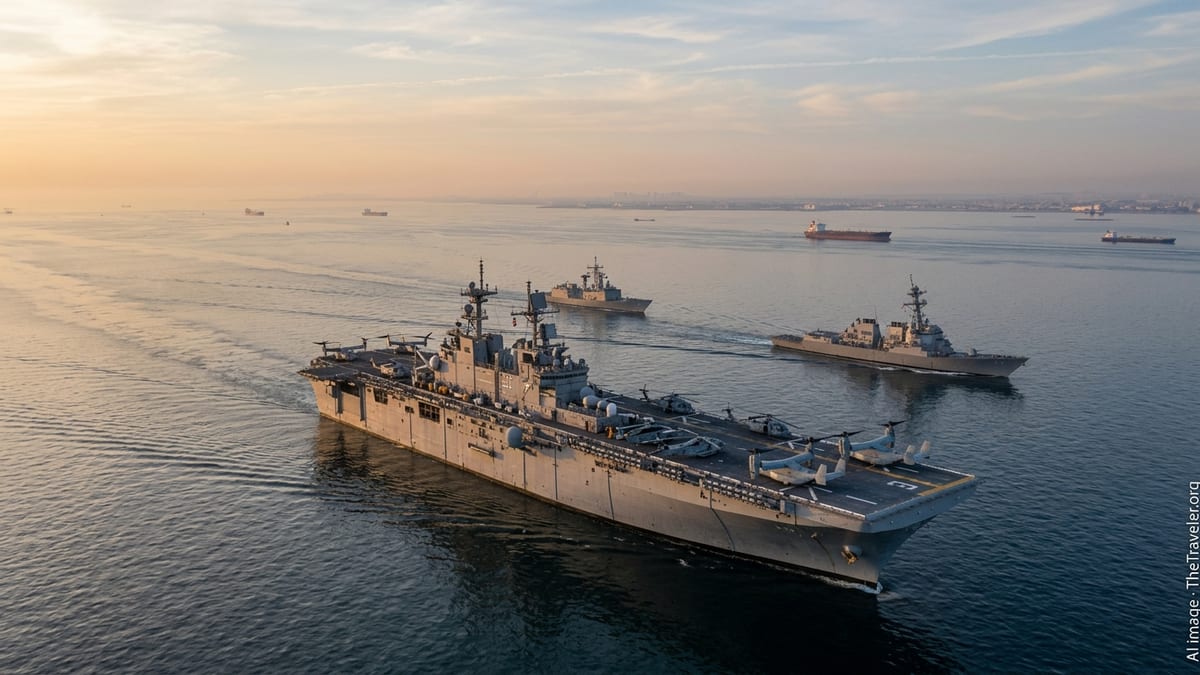
Marines Redeployed From Indo-Pacific to Gulf Theater
According to multiple news reports, the core of the deployment consists of Marines from a forward-based Marine expeditionary unit embarked on the amphibious assault ship USS Tripoli. The warship, which had been operating in the western Pacific, departed waters near Japan earlier in March and has been tracked moving through the Strait of Malacca toward the Indian Ocean. Publicly available vessel-tracking data cited in recent coverage indicates the ship group is expected to reach the Arabian Sea and broader Gulf region in the coming days.
Reports indicate that the deployment involves roughly 2,500 Marines and several thousand sailors spread across Tripoli and accompanying amphibious warships. The force adds to an already significant American military presence in the Middle East that includes an aircraft carrier strike group, land-based air power, and ground forces positioned across multiple Gulf states.
US officials have framed recent troop movements as part of a broader effort to reinforce existing operations against Iran and to give commanders more flexibility as the war evolves. The deployment of an amphibious assault ship and embarked Marines provides an additional option for sea-based crisis response, ranging from evacuation operations to more robust combat missions if ordered.
The movement of Marines from the Indo-Pacific to the Gulf also signals a temporary rebalancing of US military priorities. In recent years, Washington has emphasized the importance of the Pacific theater, particularly in relation to China, but the current Iran crisis has drawn substantial naval and air assets back toward the Middle East.
Escalating Iran Conflict and Threats to Shipping
The decision to dispatch Marines and amphibious warships comes amid a sharp escalation in hostilities between the United States, its partners, and Iran. Over recent weeks, joint US and Israeli strikes have targeted Iranian military infrastructure, while Tehran has intensified efforts to pressure maritime traffic around the Strait of Hormuz, a narrow chokepoint through which a large share of the world’s oil exports pass.
Commercial shipping has faced mounting risks in the region, with reports of drone activity, missile launches, and attempts to interfere with tankers and container vessels transiting the Gulf. Analysts note that Iran has previously used threats to the strait as leverage during periods of confrontation, and that the current conflict raises renewed concerns about the security of global energy supplies.
Publicly available information shows that Washington is reinforcing its naval presence partly to reassure shipping companies and regional partners that key sea lanes will remain open. The presence of additional Marines, amphibious ships, and accompanying escorts is intended to strengthen the ability of US forces to monitor, deter, and potentially interdict hostile activity near major maritime routes.
Travel and logistics specialists are monitoring the situation closely, as heightened military activity in and around the Gulf can affect air routes, port operations, and insurance premiums for vessels operating in the region. While most commercial flights and shipping services continue to operate, contingency planning has intensified as the security environment becomes more volatile.
Role of Amphibious Assault Ships in the Middle East
Amphibious assault ships such as USS Tripoli are often described as small aircraft carriers, capable of launching helicopters, tiltrotor aircraft, and short-takeoff fighter jets, while also transporting Marines, armored vehicles, and landing craft. This combination allows the United States to project ground forces ashore directly from the sea without relying on local ports or airfields.
In the Middle East context, this kind of capability is particularly relevant around constrained waterways like the Strait of Hormuz and nearby islands that control access to shipping lanes. The embarked Marine force can be configured for a range of missions, including securing key terrain, protecting critical infrastructure, conducting limited raids, or supporting humanitarian and evacuation operations.
Defense analysts quoted in recent coverage emphasize that the deployment of an amphibious ready group does not necessarily indicate an imminent amphibious invasion of Iran, which would require a far larger ground contingent and extensive logistical preparation. Instead, the presence of Marines afloat is often used as a flexible deterrent, signaling the ability to respond quickly to emergencies or sudden escalations without committing to large-scale land operations.
For travelers and regional businesses, the arrival of additional amphibious ships may not be immediately visible, but it contributes to a denser and more complex military environment in the Gulf. Increased naval patrols, surveillance flights, and occasional temporary restrictions around exercises or operations can affect timelines for cargo movements and, in some cases, cruise or ferry itineraries.
Regional Reactions and Implications for Travelers
Governments across the Gulf and wider Middle East are closely watching the buildup of US forces and Iran’s response. Some regional states see the additional American presence as a stabilizing factor that may discourage further attacks on shipping and energy infrastructure. Others worry that the concentration of naval and air power in confined waters could raise the risk of miscalculation and unintended clashes.
Travel advisories from various countries already urge visitors to exercise increased caution in and around the Persian Gulf, particularly near coastal areas adjacent to key oil export terminals and shipping corridors. While major tourist hubs in the region remain open and continue to welcome visitors, travelers are being encouraged to monitor developments and review the latest government guidance before transiting the Gulf by air or sea.
Industry reports indicate that maritime insurers have adjusted premiums and risk assessments for vessels operating near high-tension zones, particularly around the approaches to the Strait of Hormuz. Cruise operators and shipping lines are also reviewing potential route diversions or schedule changes should the security situation deteriorate further.
For now, commercial aviation remains largely unaffected, with airlines relying on established deconfliction procedures to avoid military operating areas. However, as more warships and patrol aircraft converge on the region, airspace management will require close coordination to keep civilian routes safely separated from ongoing military operations.
What Comes Next for US Presence in the Gulf
Publicly available analyses suggest that the Marines and their amphibious assault ship will likely integrate into an existing lattice of US forces already deployed around Iran, including an aircraft carrier group and land-based strike aircraft. This creates a layered posture combining sea, air, and limited ground capabilities intended to respond rapidly to shifts in the conflict.
Future adjustments to US force levels will depend on developments in the Iran war, the security of maritime traffic, and diplomatic efforts to de-escalate tensions. Additional rotations of naval assets from Europe or the Indo-Pacific remain possible if the crisis persists or widens, while a reduction in attacks on shipping and regional infrastructure could eventually allow some forces to redeploy elsewhere.
Observers note that the deployment highlights the ongoing centrality of the Gulf region to global trade and energy markets, even as the United States has sought to diversify its strategic focus. The presence of Marines and amphibious ships underscores that Washington remains prepared to commit substantial resources to protect access to key waterways when they are threatened.
For travelers, logistics companies, and regional tourism authorities, the coming weeks will be shaped by how both sides manage this new phase of the confrontation. A sustained period of high tension without major new attacks could allow commercial activity to continue with elevated but manageable risk, while any significant escalation at sea or along the coastlines would likely have more immediate consequences for routes, schedules, and perceptions of safety across the wider Middle East.