

More news on this day
The United States is deploying thousands of Marines and sailors to the Middle East as the war with Iran enters a more volatile phase, with new amphibious forces moving toward the region and concerns mounting over the security of vital shipping routes and regional tourism hubs.
Get the latest news straight to your inbox!
Fresh Marine Deployments Mark a New Phase of the Conflict
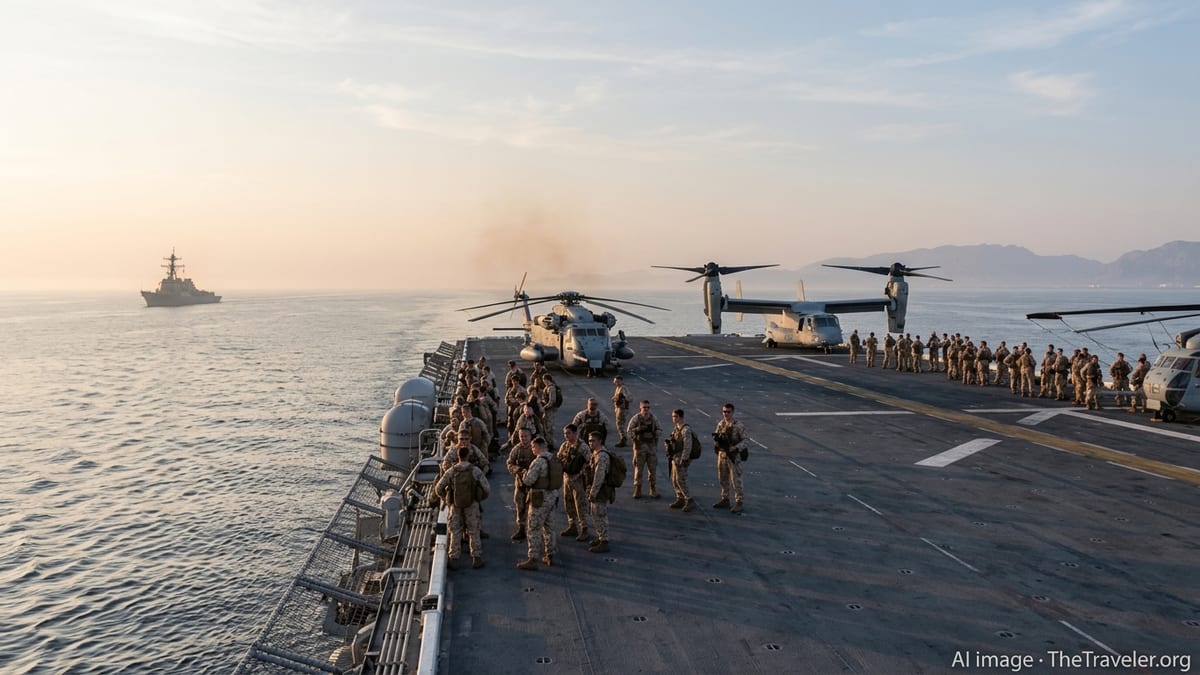
Publicly available reporting indicates that the United States has ordered multiple Marine expeditionary units and amphibious warships toward the Middle East in March 2026, reinforcing an already large buildup linked to the ongoing war with Iran. Recent coverage describes roughly 2,200 Marines from the Okinawa-based 31st Marine Expeditionary Unit embarking on an amphibious ready group led by the assault ship USS Tripoli and steaming toward the region, while additional warships and Marines are being diverted from other theaters.
Associated Press coverage indicates that three additional warships and about 2,500 Marines are being sent to support operations against Iran, on top of earlier moves to redirect amphibious assault ships from the Pacific. Other published reporting, including summaries of U.S. news outlet coverage circulating on public forums, describes an even broader reinforcement, with around 5,000 Marines and sailors deploying as part of at least one additional amphibious ready group.
These deployments form part of what open sources describe as the largest U.S. military buildup in the Middle East since the 2003 invasion of Iraq, following a January 2026 decision to surge air, naval and missile-defense assets to the Gulf amid escalating confrontation with Tehran. The latest movements suggest Washington is seeking to add flexible “forcible entry” and crisis-response capabilities as the conflict widens.
Strategic Focus on the Strait of Hormuz and Gulf Shipping Lanes
Analysts note that the composition of the forces being sent underscores U.S. concerns about the Strait of Hormuz, the narrow maritime chokepoint through which a significant share of global oil exports passes. Reporting on the mission set for the 31st Marine Expeditionary Unit indicates that Marines and sailors are expected to help secure sea lines of communication and respond to Iran’s increased use of naval mines and fast-attack craft in and around the strait.
Recent international coverage portrays the Strait of Hormuz as the site of an asymmetric naval contest, with Iranian forces relying on smaller vessels and drones while U.S. and allied navies employ advanced surveillance and unmanned systems to protect commercial shipping. Against this backdrop, an amphibious ready group and attached Marines provide capabilities for boarding operations, maritime interdiction and, if ordered, limited landings on key islands or coastal infrastructure.
In addition to the Tripoli group, other amphibious task forces reported en route are expected to integrate with carrier strike groups and regional bases that host U.S. Fifth Fleet operations. Military experts cited in think-tank analysis emphasize that such a layered naval and Marine presence is designed to deter Iran from attempting a prolonged closure of the Strait of Hormuz, while preserving options for rapid escalation if attacks on shipping intensify.
Iranian Threats Extend to Tourism and Civilian Infrastructure
The military buildup has coincided with increasingly pointed rhetoric from Tehran. According to recent Associated Press reports, Iranian leaders have warned that enemies will not be safe in “parks, recreational areas and tourist destinations” worldwide, framing the threat as potential retaliation for U.S. and Israeli strikes that have heavily damaged Iran’s military infrastructure.
These statements come as Iran has already expanded its response beyond strictly military targets. Reporting from the Gulf highlights attacks linked to the conflict that have affected critical civilian infrastructure, including water desalination facilities that serve populated and tourism-dependent coastal areas. Analysts suggest that threats against tourism sites are intended in part to raise the economic cost of the war for U.S. partners and to unsettle global travelers considering visits to the region.
Travel and security specialists tracking the situation note that popular destinations in Gulf states and across the broader Middle East remain outside any declared combat zones, but the rhetoric has increased pressure on local authorities and hospitality operators to reassess contingency plans. Insurance and risk consultancies are also flagging that a wider campaign against tourism or energy infrastructure could have ripple effects on global travel patterns and fuel prices.
Regional and Domestic Repercussions of the U.S. Buildup
The sustained deployment of Marines and sailors is also reshaping military balances in other theaters. Recent Associated Press analysis notes that air-defense assets such as Patriot missile batteries have been shifted from Europe toward the Middle East to meet demands created by the war with Iran, prompting concern among some European officials and defense commentators about potential gaps in protection against Russia.
Inside the United States, the decision to send thousands of Marines toward a potential ground conflict with Iran is feeding an already intense political debate. Published interviews and commentary highlight that large segments of U.S. public opinion remain skeptical of any new long-running ground war in the Middle East, even as hawkish voices argue that credible coercive power requires visible deployments of amphibious and expeditionary forces.
Budgetary implications are also emerging as a major point of contention. Coverage of recent Pentagon requests indicates that the department is seeking tens of billions of dollars in supplemental funding to sustain operations in and around Iran, at a time when the overall U.S. national debt continues to rise. Policy analysts warn that a prolonged requirement to keep multiple Marine expeditionary units, carrier strike groups and air-defense assets in the region could strain both resources and long-term readiness.
What the Marine Presence Signals for the Trajectory of the War
Experts in military strategy describe Marine expeditionary units embarked on amphibious ready groups as versatile tools of pressure and deterrence. The latest deployments place thousands of Marines within reach of key Iranian coastal areas and islands, but public assessments from defense specialists stress that their presence does not automatically signal an imminent large-scale ground invasion.
Think-tank papers and regional security studies emphasize that amphibious forces can serve multiple roles short of full-scale assault, including evacuating civilians, reinforcing vulnerable bases, and seizing or defending strategically located islands that control shipping lanes. By combining aviation, infantry and logistics capabilities at sea, these units give U.S. decision-makers more options in a rapidly changing theater.
For now, publicly available information indicates that the immediate focus remains on protecting maritime traffic, sustaining air operations and deterring further Iranian escalation, rather than announcing any formal ground campaign. Nonetheless, the visible movement of Marine ships and units across the Indo-Pacific toward the Gulf is being interpreted across the region as a sign that the United States is prepared to accept higher risks to contain Iran, with outcomes for both regional stability and global travel still uncertain.