

More news on this day
A partial shutdown of the US Department of Homeland Security is stoking fresh fears of travel disruption, as Transportation Security Administration officers work without pay and aviation groups warn that prolonged funding uncertainty could trigger longer lines, flight delays and a renewed crisis for the nation’s already strained airport system.
Showdown in Washington Leaves Homeland Security Unfunded
The funding lapse at the Department of Homeland Security began at midnight on February 14 after lawmakers failed to agree on a full-year spending bill or even a short-term extension. Unlike broader shutdowns that halt many federal operations, this impasse is narrowly focused on Homeland Security, but its reach extends directly into airport security and the wider travel economy.
Congress had already approved full-year budgets for most federal agencies earlier this year, insulating departments such as Defense and Veterans Affairs. Homeland Security was kept running only through temporary funding while Democrats and Republicans negotiated over immigration enforcement reforms following high-profile incidents involving federal officers. Those talks stalled, and with lawmakers leaving Washington for the Presidents Day recess, there was no last-minute deal to keep DHS open.
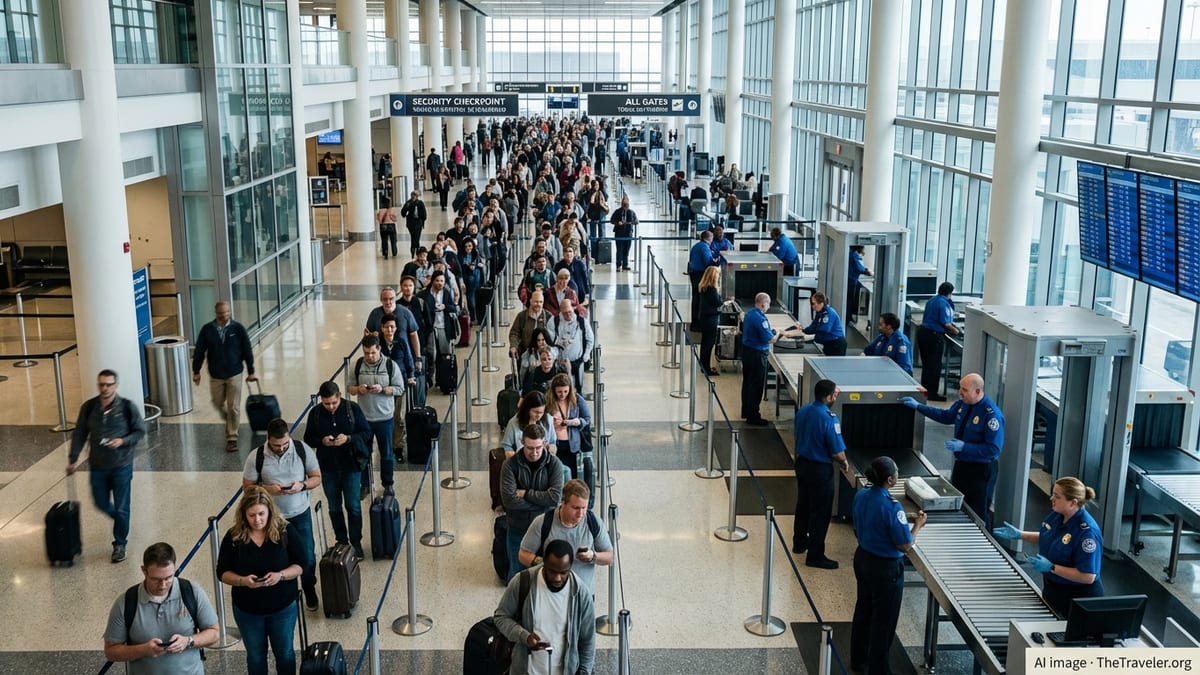
The result is a patchwork shutdown in which some core security functions continue, but thousands of employees across components from the Transportation Security Administration and the Coast Guard to the Federal Emergency Management Agency are either working without pay or have been temporarily furloughed. For travelers, the most immediate concern is at the checkpoint, where TSA officers must keep screening passengers despite their paychecks being frozen.
TSA Officers Ordered to Work Without Pay as Absenteeism Risks Grow
According to Homeland Security’s contingency plans, more than 95 percent of TSA’s roughly 64,000 employees are classified as essential and are required to report for duty during the shutdown. Only about 3,000 workers can be furloughed. That legal designation keeps airport security lines moving in the short term, but it also means tens of thousands of screeners are now working indefinitely without pay until Congress restores funding.
Travel industry groups and union leaders warn that this model quickly becomes unsustainable. During the record 43 day shutdown that ended in November 2025, TSA officers and air traffic controllers reported severe financial strain, with some taking out personal loans, picking up second jobs or even selling plasma to cover basic expenses. As hardship mounted, unscheduled absences rose and screening checkpoints in several major hubs slowed to a crawl.
Officials and worker advocates fear a replay if the current impasse drags on. Even modest increases in sick calls or no-shows can ripple quickly through tightly staffed checkpoints, especially at smaller airports where a single lane closure can double wait times. Major hubs that screen hundreds of thousands of passengers a day are also vulnerable if enough officers seek other work rather than endure another open-ended stretch without pay.
Airlines and Travel Industry Warn of Mounting Disruptions
Airlines, hotels and tourism leaders are pressing Congress to resolve the funding dispute before it cascades into widespread travel disruption during the busy late winter and spring break period. Trade associations representing carriers, hotels and the broader travel sector have issued joint statements warning that each day of uncertainty chips away at traveler confidence and places new strain on frontline federal workers.
Industry groups point to last year’s shutdown as a stark warning. Economic analyses put the cost of that 43 day standoff at around 6 billion dollars in lost output and delays, with an estimated six million passengers impacted by schedule changes, cancellations and missed connections. Executives argue that the aviation system, already grappling with staffing shortages and high demand, has little buffer to absorb another prolonged period of unpaid work for TSA officers and federal aviation staff.
Airlines are particularly concerned about the prospect of uneven impacts across the network. While some airports may maintain near normal flows, others could face sudden bottlenecks if local absenteeism spikes. That dynamic can force carriers to hold departures while passengers clear security or rework schedules at the last minute, adding to operational complexity and customer frustration.
What Travelers Are Experiencing at Airports Right Now
In the immediate aftermath of the shutdown’s start, most major airports have reported largely normal operations, with federal officials stressing that air travel remains safe and that security procedures have not been relaxed. Early wait-time data at the nation’s largest hubs has shown only modest fluctuations, and no widespread ground delays have been formally attributed to the funding lapse.
Still, pockets of strain are emerging. Some airports have closed secondary screening lanes during off-peak hours, consolidating passengers through fewer checkpoints to match available staffing. Others have warned travelers through social channels to arrive earlier than usual as a precaution, particularly in the early mornings and late afternoons when traffic is heaviest.
For individual passengers, the experience can vary widely by location and time of day. A traveler breezing through a checkpoint in one city may read about hours-long lines reported elsewhere. Industry analysts say this unevenness is typical in the early days of a shutdown: the system can appear outwardly stable even as financial and morale pressures start to build beneath the surface.
Lessons From Past Shutdowns: When Delays Turn Into Crises
History suggests that the most serious travel disruptions tend to materialize only after a shutdown has dragged on for weeks. During previous lapses in funding, including the protracted 2025 episode, the first days often looked manageable. It was only as unpaid pay periods multiplied that absenteeism rose sharply among screeners and air traffic controllers, pushing key facilities to the brink.
At the peak of last year’s shutdown, several major airports temporarily closed security lanes or entire concourses as they struggled to staff checkpoints. Some facilities reported a critical mass of controllers calling out, prompting ground stops and widespread delays across the national airspace system. That experience remains fresh for both workers and managers, heightening concern about the current impasse.
Experts also note that the aviation system is more fragile today than it was a decade ago. Post pandemic retirements, training backlogs and high travel demand have left little margin to absorb shocks. A wave of attrition triggered by another long shutdown could take months or years to repair, as it can take new officers and controllers significant time to reach full proficiency.
Policy Standoff Over Immigration Drives the Funding Impasse
Behind the travel uncertainty is a bitter fight over immigration enforcement policy. Congressional Democrats have insisted that any long term Homeland Security funding bill include new restrictions and oversight for immigration authorities, arguing that recent deadly encounters between federal officers and US citizens underscore the need for stronger safeguards.
Republicans counter that Democrats are trying to use the agency’s budget to undercut border enforcement and street-level immigration operations. They note that some immigration functions, including parts of Immigration and Customs Enforcement and Customs and Border Protection, are already funded under separate legislation and would continue operating even as other Homeland Security components remain unfunded.
The result is an unusual shutdown that hits airport security, disaster response and cybersecurity efforts harder than immigration enforcement. Political incentives on both sides have hardened, with party leaders framing the standoff as a test of priorities: border security and officer discretion for Republicans, versus civil rights protections and accountability for Democrats. That dynamic has left travel agencies, airlines and federal employees squeezed in the middle.
Spring Break Travel and Major Events Hang in the Balance
The timing of the shutdown is particularly worrying for the travel industry. March and early April are among the busiest weeks of the year at US airports, as families fan out for school holidays and colleges begin spring recess. Several major conferences and sporting events are also on the calendar, placing added pressure on already crowded hubs and regional airports.
Senior TSA officials have cautioned that continued funding uncertainty threatens not only day to day staffing, but also longer term security investments. New screening technologies, checkpoint redesigns and training programs may be delayed or paused, reducing the agency’s capacity to handle record passenger volumes later this year, including for global events that will draw large numbers of international visitors.
Local tourism boards and hotel operators are watching closely. Memories of last year’s disruptions remain vivid in destinations that rely heavily on air access. Some are already urging visitors to build extra time into itineraries, purchase flexible tickets and monitor airport advisories in case the situation worsens.
How Long Could the Shutdown Last and What Comes Next
For now, there is no clear end date. Talks between congressional leaders and the White House have produced little visible progress, and lawmakers have scattered for a recess with only a general promise to return quickly if a deal appears within reach. Veteran budget watchers note that shutdowns often end only when political pressure from the public and affected industries becomes intense enough to force compromise.
One potential path forward is a short term continuing resolution that would reopen Homeland Security while negotiations over immigration enforcement continue. Another is a broader bargain that pairs policy changes with full year funding. In both scenarios, Congress would also face renewed calls from the travel industry to pass legislation guaranteeing that TSA officers and air traffic controllers receive pay even during future funding lapses, insulating the aviation system from partisan standoffs.
Until that happens, travelers are urged to plan for uncertainty. Airport managers recommend arriving earlier than usual, keeping close tabs on flight alerts and allowing extra time for connections. While the system is designed to keep security standards high even during a shutdown, the prospect of unpaid officers, rising absenteeism and unresolved political conflict means that the risk of disruption will remain elevated as long as the funding dispute continues.