

More news on this day
A prolonged United States government shutdown is triggering cascading disruptions across the aviation network, with major hubs from Newark Liberty and JFK to Hartsfield-Jackson Atlanta, LaGuardia, and even London Heathrow reporting severe delays, cancellations, and overcrowded terminals that have upended travel plans for thousands of passengers.
Get the latest news straight to your inbox!
Shutdown Deepens Strain on an Already Fragile Air System
Publicly available information on recent shutdowns shows that aviation operations are among the most visible pressure points when federal funding lapses. Air traffic controllers and many aviation safety staff are categorized as essential, meaning they must continue working even when paychecks are delayed. Over days and weeks, this dynamic has repeatedly led to rising sick calls, staffing shortfalls and a need to slow traffic, especially at the busiest hubs.
Reports from flight-tracking services and aviation outlets during the most recent shutdowns describe thousands of delays and hundreds of cancellations on peak days, concentrated at large coastal and connecting airports. Newark Liberty, JFK, LaGuardia, and Hartsfield-Jackson Atlanta feature prominently in these tallies, reflecting their role as critical choke points for both domestic and transatlantic traffic. When those hubs struggle, knock-on effects quickly spread throughout the network.
Industry data and past federal analyses also indicate that these airports already operate close to capacity in normal times, with little slack to absorb additional disruption. As shutdown-related staffing constraints converge with seasonal weather systems and heavy leisure demand, the result has been long security queues, extended tarmac waits and rolling ground delay programs that ripple across the country and beyond.
Newark, JFK and LaGuardia Emerge as Epicenter of Disruption
The New York area has repeatedly emerged as a focal point of shutdown-related aviation stress. Local and national coverage has highlighted Newark Liberty in particular as one of the most heavily affected airports during recent funding gaps, with days where a substantial share of scheduled flights encountered significant delays or were canceled outright. On some weekends, publicly reported figures showed more than a hundred cancellations at Newark alone, with average delays stretching beyond two hours.
Spillover has been evident at JFK and LaGuardia, where airlines have trimmed schedules or consolidated flights in response to staffing alerts in regional air traffic control facilities. Travel industry reporting describes occasions when thousands of flights across the United States were delayed in a single day, with New York’s three major airports among the hardest hit as the Federal Aviation Administration responded to controller shortages by slowing the rate of arrivals and departures.
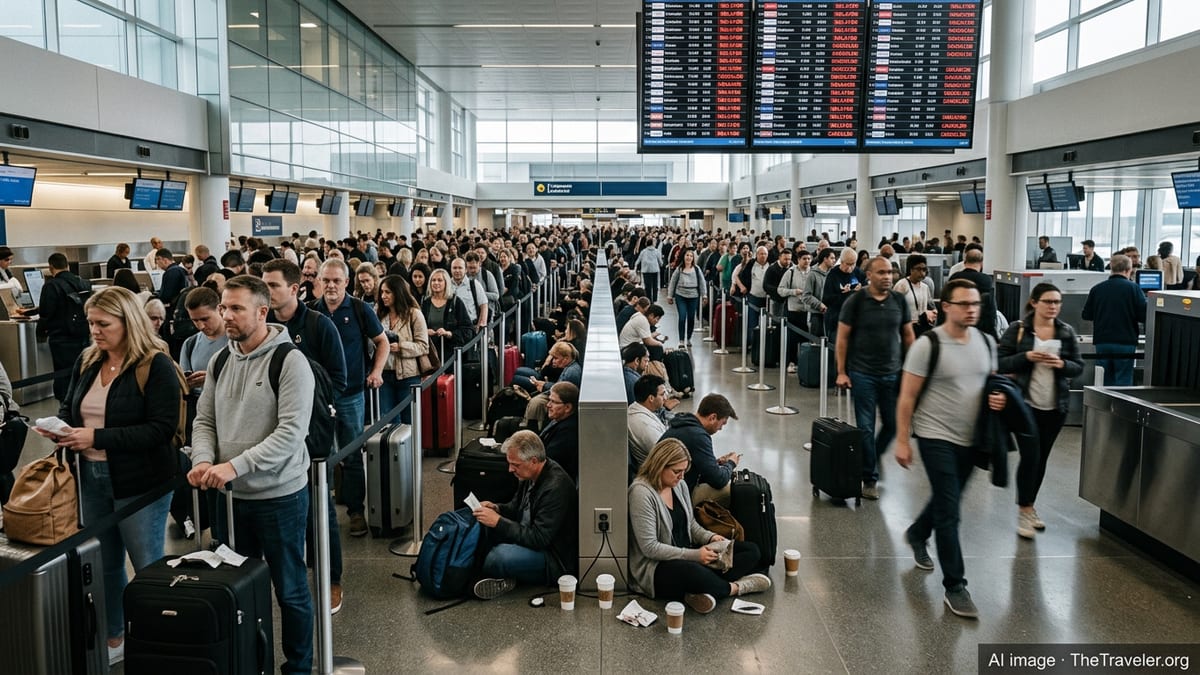
At the terminal level, images and on-the-ground accounts have depicted crowded gate areas, snaking security lines and passengers camped out near power outlets as they wait for new departure times. With the shutdown compounding existing construction projects and weather-related slowdowns in the region, the travel experience for many has become a test of endurance rather than a straightforward journey.
Hartsfield-Jackson Atlanta and Other US Hubs Under Pressure
Further south, Hartsfield-Jackson Atlanta International Airport has faced its own intense pressures as the shutdown drags on. As the world’s busiest passenger airport and a primary connecting hub for the southeastern United States, even modest reductions in arrival and departure rates in Atlanta can echo across dozens of domestic and international routes. Aviation and business media have documented periods in which staffing constraints at key air traffic control centers serving Atlanta contributed to hours-long delays and waves of missed connections.
Similar patterns have been observed at other major US airports, including Dallas Fort Worth, Chicago O’Hare, Los Angeles International and Miami. According to recent operational summaries, ground delay programs and intermittent ground stops have been deployed at multiple hubs when staffing alerts coincide with challenging weather. In those windows, arriving flights are held at origin, outbound departures are metered on the taxiways, and airline recovery plans struggle to keep up with the pace of disruption.
Travelers passing through these hubs have faced increasingly unpredictable itineraries, with onward flights frequently departing before delayed inbound passengers can make their connections. As aircraft and crews fall out of position, some carriers have preemptively reduced schedules or advised customers to consider longer layovers to improve the chances of making onward flights, underlining how the shutdown has introduced an additional layer of risk into already complex operations.
Transatlantic Ripple Effects Reach London Heathrow
The impact of the shutdown has not been confined to North America. London Heathrow, the primary European gateway for many US carriers, has experienced its own share of delays and last-minute schedule changes tied to problems originating across the Atlantic. When departure flows from New York, Atlanta or other US hubs slow down, late inbound aircraft and missed connections frequently cascade into Heathrow’s tightly coordinated arrival and departure banks.
Transatlantic services are particularly sensitive to these shocks because they operate within narrow overnight and early-morning windows on both sides of the ocean. Airline and airport operations reports point to days when late departures from US cities pushed arrivals into Heathrow’s busiest periods, complicating gate assignments and baggage handling. In some cases, crews and aircraft scheduled to operate return flights back to the United States have run up against duty-time limits, leading to cancellations or extended delays for passengers seeking to travel westbound.
For travelers beginning or ending their journeys in Europe, the disruption can feel especially opaque. The root cause may lie in a staffing alert in an American control center or a pause in departures from a US hub, but its effects appear as crowded holding patterns above London, reshuffled gate displays and longer waits at immigration and baggage reclaim. This illustrates how domestic political stalemates can have tangible consequences far beyond US borders when they intersect with global air travel.
Passengers Face Mounting Uncertainty and Limited Options
For passengers, the shutdown’s aviation fallout has translated into missed holidays, abandoned business trips and nights spent on terminal floors. Travel advisories from airlines and tourism-focused outlets now commonly recommend that passengers build additional buffer time into itineraries involving the most constrained hubs, book earlier flights in the day and opt for nonstop services where possible to reduce the number of potential failure points.
At the same time, consumer advocates note that the complex interplay of government staffing, weather and airline scheduling decisions can make it difficult for travelers to understand their rights or secure compensation when plans go awry. Public reports on recent shutdown periods show that while some disruptions are explicitly tied to air traffic control capacity constraints, others arise as carriers rework their networks to cope with the evolving situation, blurring the line between controllable and uncontrollable causes from a passenger perspective.
With political negotiations over federal funding often unfolding on short timelines and with uncertain outcomes, there is limited clarity on when conditions will normalize after each shutdown cycle. Until a more stable funding environment emerges for the aviation system, publicly available data and recent experience suggest that major airports such as Newark Liberty, JFK, LaGuardia, Hartsfield-Jackson Atlanta and Heathrow are likely to remain vulnerable to renewed bouts of chaos whenever the federal budget gridlocks again.