

More news on this day
Amid a rapidly widening conflict centered on Iran and heightened fears of reprisals against US interests, the Department of State has reshuffled its travel advisory map for 2026, placing a growing number of destinations in the highest risk categories and warning Americans that some countries now present an “extreme” danger for civilian travel.
Get the latest news straight to your inbox!
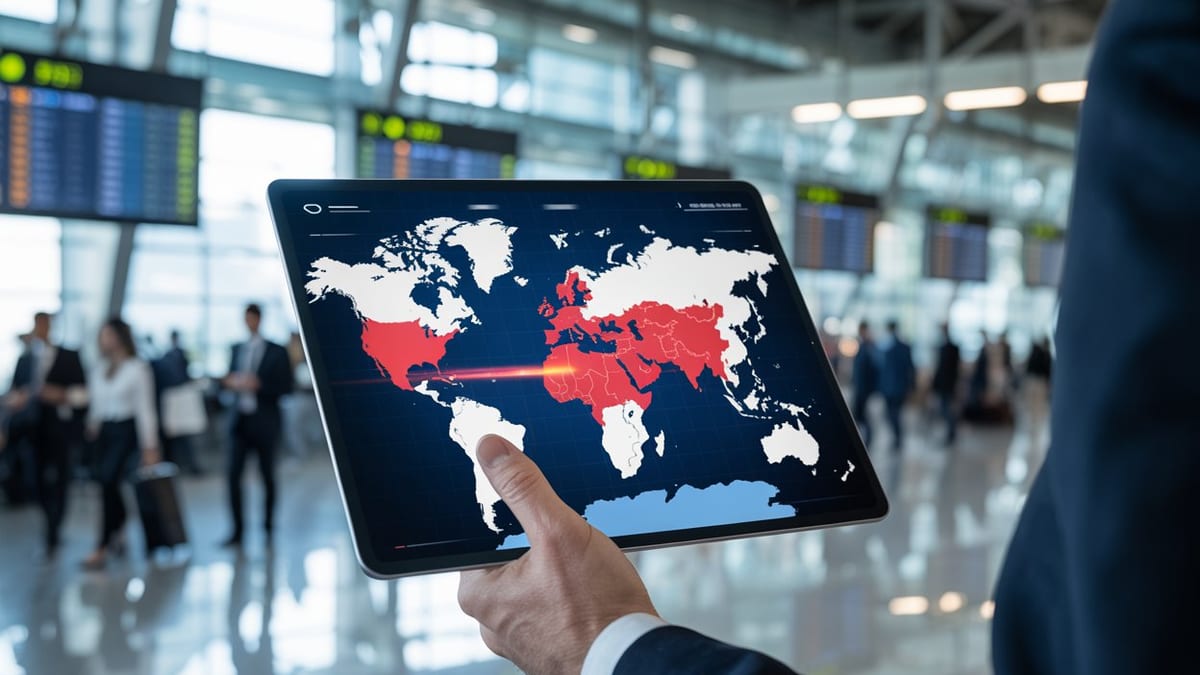
Image by Travel And Tour World
Level 4 “Do Not Travel” Expands Across the Middle East
Publicly available travel advisory data show that the State Department has elevated several countries in the broader Middle East to Level 4, the strictest “Do Not Travel” category, in response to the war that erupted following joint US and Israeli strikes on Iran at the end of February 2026. Coverage in regional outlets indicates that Iran, Iraq, Lebanon, Syria and Yemen are all now listed at Level 4, reflecting the risk of armed conflict, missile and drone attacks, and volatile protests near diplomatic compounds.
Reports describe the changes as a decisive shift from prewar guidance, which already warned of terrorism, kidnapping and civil unrest in parts of the region but stopped short of blanket “Do Not Travel” notices for entire countries. With the latest update, American civilian travel to these destinations is not outright banned but is strongly discouraged, and travelers who choose to go anyway are told to be prepared for severely limited consular assistance if security deteriorates further.
In Iraq, the security picture has been complicated by large protests and clashes around Baghdad’s Green Zone following the strikes on Iran. Open-source reporting notes that the US Embassy in Baghdad has urged US citizens to shelter in place during periods of intense unrest, underscoring how quickly conditions can shift from tense to life threatening. The Level 4 rating for Iraq now reflects both the long-standing danger from armed groups and the new possibility of direct spillover from the Iran conflict.
In Yemen and Syria, where multi-sided wars were already underway, the upgrade to Level 4 formalizes what many private risk consultancies have long described as “extreme” or “unacceptable” risk environments for leisure or routine business travel. Humanitarian operations continue in some areas, but for ordinary US travelers, the message is that these destinations are now among the most dangerous on the map.
Gulf Hubs and the Wider Region Move to “Reconsider Travel”
The danger is not confined to formal war zones. Travel industry coverage notes that the United Arab Emirates, long regarded as a stable hub for Middle East tourism and aviation, was shifted on March 3 from Level 2 (“exercise increased caution”) to Level 3 (“reconsider travel”) after Iranian officials publicly referenced potential US-linked targets in the Gulf. The advisory highlights the possibility that locations associated with Americans could become symbolic targets if the conflict escalates.
Similar concerns are shaping guidance for other regional states that sit near flashpoints or host major US diplomatic and commercial facilities. Published advisories and embassy alerts for Saudi Arabia, for example, emphasize a heightened risk of missile or drone strikes as well as the potential for demonstrations that can quickly turn confrontational around foreign missions. Americans in the kingdom are being strongly encouraged, through open enrollment tools such as the Smart Traveler Enrollment Program, to ensure they can receive rapid security updates if conditions deteriorate.
Outside the immediate theater, a global “worldwide caution” security alert issued in late March urges Americans everywhere to exercise increased vigilance and to prepare for sudden changes in local threat levels. The alert warns that groups sympathetic to Iran or opposed to US policy could look for soft targets, including popular tourist areas, transport hubs and commercial sites linked to US brands.
For travelers using Gulf megahubs as transit points to Asia or Africa, the practical effect is a higher probability of last-minute flight disruptions, detours around contested airspace and more aggressive security screening. Airlines continue to operate, but some carriers have already rerouted or reduced frequencies to avoid high-risk air corridors, complicating itineraries that once relied on smooth Middle East connections.
Enduring Hotspots: Afghanistan and Other Chronic Level 4 Destinations
Even before the latest crisis, the State Department maintained a roster of countries at permanent or near-permanent Level 4 status due to chronic instability, widespread crime or the collapse of central authority. Afghanistan remains one of the clearest examples, with independent risk maps produced in March 2026 labeling the entire country as “extreme” risk and recommending full evacuation for nonessential personnel.
Factors driving the Afghanistan warning include the presence of multiple armed factions, targeted attacks on foreigners, and the absence of a functioning US diplomatic mission that could provide routine services. For American tourists, this translates into a practical prohibition on travel, since most commercial tour operators and insurers will not support trips to a country rated Level 4 for both security and operational reasons.
Similar logic applies to parts of the Sahel and Horn of Africa, where insurgencies, kidnappings and banditry have pushed some states or regions into the highest advisory category in recent years. The 2026 security risk maps circulated by private insurers and corporate travel departments align closely with the State Department’s most severe warnings, often reinforcing that kidnap-for-ransom, roadside ambushes and improvised explosive devices are not distant risks but core features of local travel.
In practice, the overlap between chronic conflict zones and Level 4 advisories creates a set of destinations that are effectively off the map for leisure travel but still draw specialized visitors such as humanitarian workers, journalists and security contractors. For ordinary US travelers, the message embedded in both official advisories and insurance fine print is that these trips fall outside what is considered reasonably safe or insurable.
Travel Insurance, Legal Fine Print and the Cost of Ignoring Warnings
The sharpened 2026 advisories have significant implications for travel insurance and consumer protections. Guidance from major international insurers, as summarized in recent media coverage, indicates that standard policies sold to US residents typically exclude losses connected to war, government warnings or fear of travel. That means a Level 4 “Do Not Travel” label does more than signal danger; it can also invalidate coverage.
Travel experts interviewed by broadcasters and newspapers note that once a country is at Level 4, claims related to trip cancellations, emergency evacuations or medical incidents attributed to the conflict may be denied, even if a traveler purchased coverage before the advisory changed. Some policies define “known events” broadly, so the announcement of a major war or nationwide unrest can retroactively limit what is covered.
This dynamic is particularly relevant in the Middle East, where popular destinations, cruise itineraries and multi-country tours are intersecting with newly restricted zones. Travelers with partial itineraries touching high-risk countries may find that insurers scrutinize their claims more closely or require proof that losses are unrelated to the conflict. In some cases, those who proceed with trips against explicit US government advice could face out-of-pocket costs for rerouting, extended stays or emergency returns.
Consumer advocates argue in published commentary that the new wave of warnings should prompt travelers to read policy wording carefully before booking and to factor in the possibility that a seemingly routine destination today could be reclassified at Level 3 or Level 4 within weeks. The financial risk, they note, now mirrors the security risk more closely than in calmer periods.
How Travelers Are Urged to Respond to the 2026 Advisory Map
With global tensions high, the State Department’s messaging encourages Americans to adopt a more cautious baseline when planning or undertaking international trips. Public guidance associated with the March 2026 worldwide alert urges travelers to monitor country-specific advisories, enroll in the Smart Traveler Enrollment Program, and maintain flexible itineraries that can accommodate sudden airspace closures or local lockdowns.
Security analysts and travel risk consultants quoted in recent coverage emphasize that advisory levels are not predictions of harm to any individual traveler but risk-weighted assessments of what could plausibly occur. A Level 4 rating, they explain, reflects both the likelihood and potential severity of threats such as indiscriminate shelling, terrorism, or the breakdown of local law enforcement.
For destinations at Level 3, including several Gulf states and other countries near active conflict zones, publicly available guidance focuses on contingency planning rather than outright avoidance. Travelers are being advised to register detailed contact information, identify multiple exit routes, and prepare for communication disruptions. Those who cannot tolerate significant uncertainty are being steered, by both officials and private-sector experts, toward destinations with lower advisory levels.
As the conflict around Iran continues to reshape the geopolitical landscape, the 2026 US travel advisory map illustrates how quickly a familiar set of “bucket list” destinations can become high-risk or effectively off-limits. For Americans contemplating overseas trips, the evolving list of Level 4 and Level 3 countries has become an essential reference point, turning the State Department’s once-obscure scale into a central tool for travel planning.