

More news on this day
Air travel across the United States is facing one of its most challenging periods in recent years, as early 2026 brings a convergence of severe weather, a partial government shutdown and peak demand that is stretching airport security lines and on time flight operations from coast to coast.
Get the latest news straight to your inbox!
Stormy Winter Turns Into Systemwide Disruption
A series of powerful winter storms since late January 2026 has created repeated waves of cancellations and delays at major US hubs. Recent coverage describes tens of thousands of flights disrupted by events such as a late January winter storm that snarled operations across the Midwest and South, and a historic blizzard in February that buried parts of the Northeast and Upper Midwest in several feet of snow. In many cases, airports have needed time to dig out runways and reposition aircraft, leaving passengers facing rolling delays well after skies cleared.
Industry data and airline statements indicate that weather remains the leading cause of flight delays nationwide, and the pattern has been on full display in 2026. One recent Sunday in late January saw more than 11,000 US flights canceled as a massive storm swept across the country, with some of the heaviest impacts at major hubs in Atlanta, Dallas and Houston. Travelers connecting through these hubs experienced long lines at rebooking counters and limited same day alternatives.
More recently, a March storm system brought a mix of blizzard conditions in the northern Plains and severe thunderstorms in the South, again triggering ground stops and ground delay programs at high traffic airports such as Chicago O Hare and Atlanta. These air traffic control measures are designed to manage safety and capacity, but they can quickly cascade into nationwide disruptions as aircraft and crews end up out of position and airport gates remain occupied longer than scheduled.
The result for travelers is a less predictable network in which even flights departing from sunny destinations can be delayed by weather several states away. Passengers are being urged by airlines and travel analysts to build extra buffer time into connections and to expect that same day schedule changes remain a real possibility through the remainder of the winter season.
Partial Government Shutdown Strains Security Checkpoints
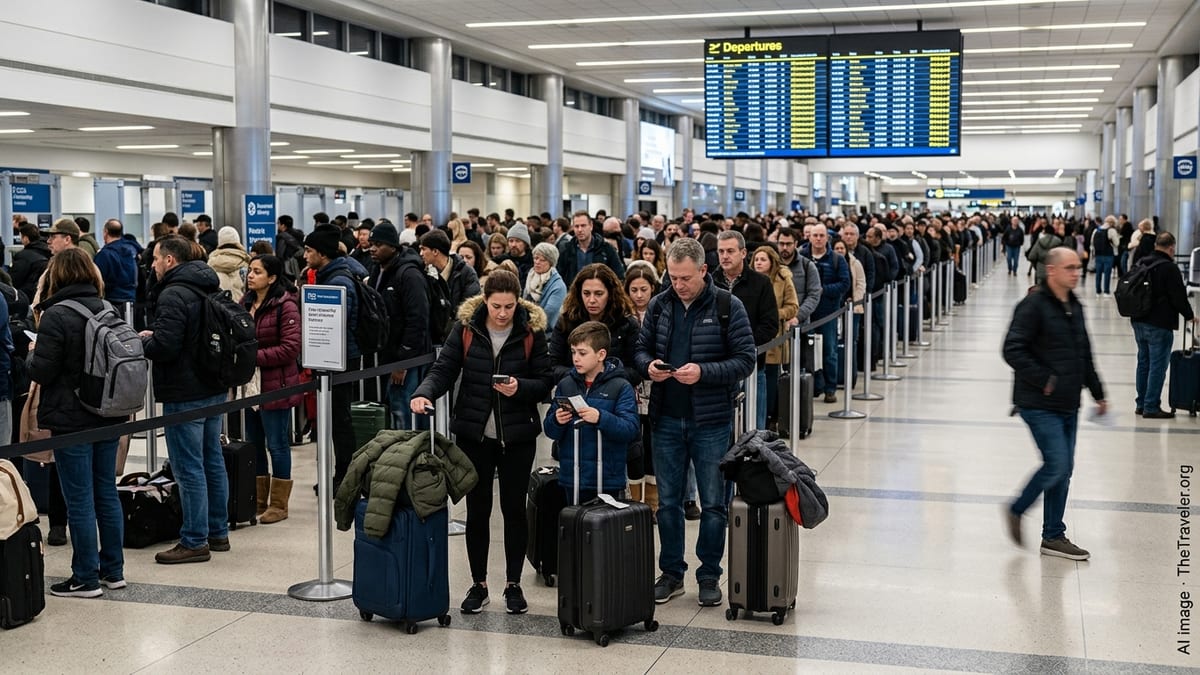
At the same time that weather has battered operations, a partial federal government shutdown that began in mid February has added pressure at airport security checkpoints. Transportation Security Administration employees are continuing to work without pay, and published coverage from airports around the country describes increasing strain on staffing as some workers take leave or seek temporary second jobs.
In several busy markets, local reports indicate that standard guidance about arriving two hours before a domestic flight is proving insufficient during peak times. Travel sites and regional news outlets have documented instances of wait times stretching beyond 90 minutes at some checkpoints, with certain airports in Texas and along the Gulf Coast reporting average waits approaching three hours on the busiest days of the shutdown. Social media posts and airport advisories have echoed that travelers should plan to arrive significantly earlier than they might have in previous years, particularly during spring break.
Publicly available information from TSA in recent seasons has consistently advised travelers to arrive early and prepared, and that message has been amplified in 2026 by airport operators and travel experts. At large hubs where passenger volumes frequently exceed 150,000 people per day, even small staffing gaps can quickly translate into long queues when combined with holiday periods, major sports events and spring break traffic.
For travelers, the practical takeaway is that security waits are no longer a background concern but a central planning factor. Passengers who arrive too close to departure risk missing flights not because of airline delays, but because they cannot clear checkpoints in time.
Where Delays Are Hitting Hardest
The most acute disruptions so far in 2026 have clustered around large connecting hubs and weather sensitive regions. Airports in Atlanta, Dallas, Houston and Chicago have repeatedly appeared in delay and cancellation tallies tied to winter storms, tornado outbreaks and low visibility events. A recent ground stop at Miami International due to dense fog, for example, led to more than one hundred delays in a single morning as inbound flights were held and departures stacked up.
In the Northeast, the February blizzard that swept through major population centers from Washington to Boston brought airport closures, runway snow removal operations and restrictions on arrivals and departures. New York area airports and Boston Logan faced extensive schedule thinning as airlines canceled flights in advance to avoid large numbers of stranded aircraft and crews. Even after conditions improved, ripple effects persisted for days as carriers worked to restore normal schedules.
Travelers connecting to or from Mexico have also felt the impact of overlapping issues. Severe US weather, turbulence in cross border security conditions and temporary suspensions of expedited entry programs have combined to create added uncertainty on some routes. Reports from New York and other gateways describe stranded passengers dealing with both weather related schedule changes and additional scrutiny on certain international flights.
Regional airports are not immune. Temporary airspace closures in parts of Texas and New Mexico in February, along with weather related ground delays at airports such as Phoenix Sky Harbor, have demonstrated how quickly disruptions at a single facility can radiate across a broader region. Even passengers flying between relatively close cities have encountered rolling delays when flights are part of tightly coupled national networks.
How Travelers Can Navigate 2026’s Tough Airport Reality
Given the current environment, travel planners and aviation analysts are emphasizing preparation and flexibility. Many consumer focused guides now recommend arriving three hours ahead for domestic flights at major hubs during peak periods, and up to four hours for long haul international departures, particularly while the shutdown continues. Updated advice also highlights the importance of checking real time security wait tools provided by airports or third party apps on the morning of travel.
Travel experts suggest that when possible, travelers should target mid morning or early afternoon departures, which tend to be less vulnerable to knock on delays from earlier disruptions. Early morning flights can still be an advantage on clear weather days, but on mornings following major storms or overnight ground stops, first wave departures may face longer deicing procedures and air traffic restrictions.
Another consistent recommendation is to avoid tight connections. Where itineraries once allowed 45 minutes between flights at large hubs, many advisors now encourage buffers of at least 90 minutes, especially when connections involve a terminal change or a re clearance of security. Passengers booking separate tickets on different airlines should allow even more margin, as they may need to exit and reenter secure areas.
Travelers are also being urged to prepare for contingencies. That includes saving airline apps and customer service numbers, packing essential medications and a change of clothes in carry on bags, and reviewing an airline’s rebooking and compensation policies before departure. While most delays in 2026 have been tied to weather or system constraints rather than airline controllable issues, understanding those distinctions can help travelers manage expectations when flights go off schedule.
What to Watch in the Weeks Ahead
With spring break season ramping up and the Atlantic hurricane season still months away, analysts note that the current challenges may represent only the first major stress test of the year for US aviation. Travel demand remains strong, and government data from late 2025 showed airlines operating near or above pre pandemic passenger levels on many domestic routes.
If the partial government shutdown persists into late March or longer, security screening capacity could remain under pressure just as college and family travel peaks. Airports in Florida, California, Nevada and the mountain West are expected to see sustained high volumes, which could exacerbate any staffing gaps at checkpoints and airline counters.
Weather will remain a wild card. The same systems that have brought snow and ice to the Midwest and Northeast this winter have also produced severe thunderstorms and tornadoes in the South, leading to periodic ground stops and reroutes. As temperatures warm, the threat will likely shift from snow related disruptions to convective storms and potential early season tropical activity, particularly in the Southeast and Gulf Coast.
For now, the clearest message for travelers is to treat 2026 as a year when extra time, flexible plans and careful monitoring of conditions are no longer optional. With long security waits and flight delays increasingly common, those who build margin into their journeys are more likely to reach their destinations with fewer unpleasant surprises.