

More news on this day
Thousands of passengers across the United States faced mounting disruption today as Southwest, American, Delta and United struggled with 162 delayed flights and 10 cancellations, snarling operations at key hubs in New York, Chicago, Dallas and other major cities and leaving travelers stranded in terminals from early morning through the evening peak.
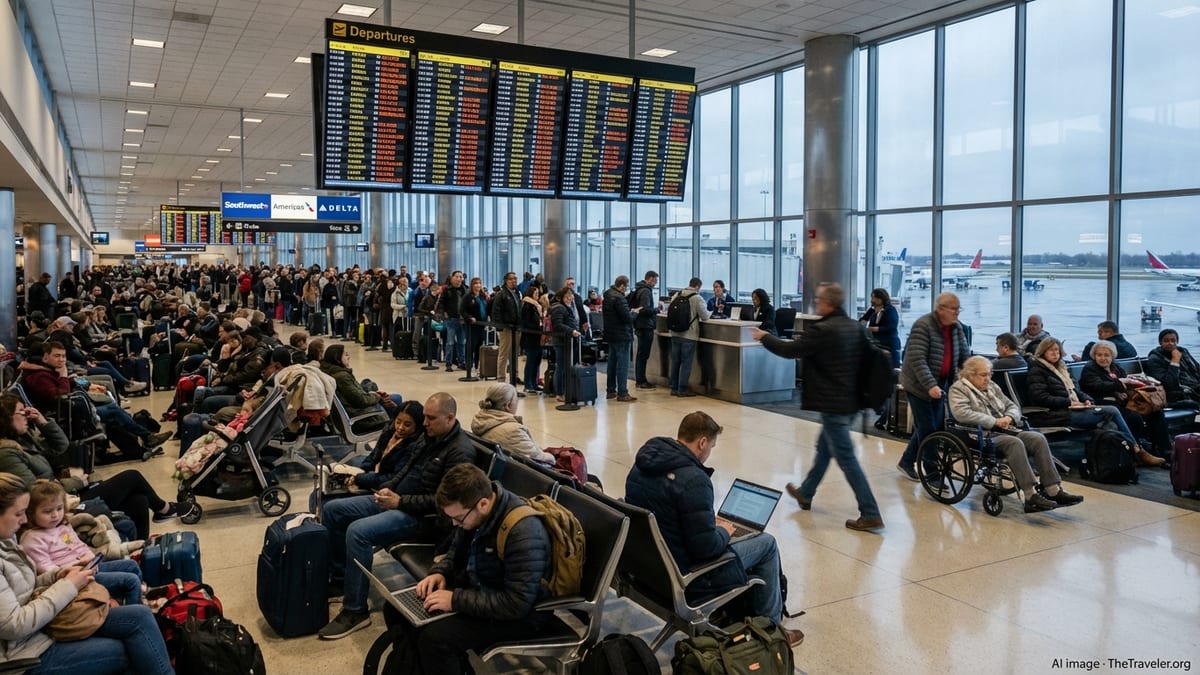
Disruptions Sweep Key US Gateways
Operational turbulence rippled across the US air network as delays clustered around major hubs including New York’s John F. Kennedy and LaGuardia, Chicago O’Hare, and Dallas Fort Worth. Travelers reported long lines, rolling gate changes and departure boards filled with amber "delayed" notices as the backlog grew through the day.
Southwest, American, Delta and United bore the brunt of the disruption, with schedules stretched thin by a combination of weather constraints, air traffic flow programs and crew positioning challenges. While the headline figures of 162 delays and 10 cancellations appeared modest compared with some of this winter’s worst meltdowns, the concentration at already congested airports amplified the impact for passengers.
At New York area airports, delays of 45 minutes to more than two hours were common on busy shuttle and transcontinental routes, frustrating business travelers and families trying to connect to onward international services. In Chicago and Dallas, hub banks were thrown off balance, creating a domino effect of missed connections that left passengers unexpectedly overnighting in terminal hotels.
Airlines stressed that safety remained their primary concern, noting that some departures were held on the ground to avoid weather cells or to accommodate air traffic control spacing restrictions into crowded East Coast corridors. For many passengers, however, the fine difference between a delay for safety and a delay for staffing or logistics mattered less than the simple reality of being stuck at the gate.
New York, Chicago and Dallas at the Center of the Gridlock
New York’s big three airports once again proved to be flashpoints. At JFK and LaGuardia, high traffic volumes and limited runway capacity left little margin when early morning departures slipped behind schedule. As a result, midmorning and afternoon waves were forced into holding patterns, both in the air and on the ground, as controllers worked to meter arrivals and departures.
Chicago O’Hare, already one of the nation’s most delay prone hubs, saw banks of American and United flights bunch tightly together after an early stack of late inbound aircraft. A series of seemingly minor slowdowns during the morning rush translated into extended waits on the tarmac and at gates for passengers connecting to the Midwest, Mountain West and international destinations.
In Texas, Dallas Fort Worth and Dallas Love Field faced a familiar mix of weather and congestion. Even when skies cleared intermittently, residual traffic restrictions kept departures from returning to normal speed. Southwest’s point-to-point network at Love Field and American’s hub operations at DFW both felt the strain, pushing knock-on delays into smaller regional markets that depend heavily on connections through North Texas.
Smaller but strategically important airports such as Phoenix, Denver and Miami reported secondary fallout as disrupted aircraft rotations from the Northeast and Midwest arrived out of position. What began as a New York Chicago Dallas story by mid-afternoon had spread into a broader national pattern of frayed timetables.
Passengers Endure Long Lines, Missed Connections and Uncertain Plans
For travelers caught in the disruption, the numbers on flight boards translated into very human stories of missed events, added costs and mounting stress. Families attempting to start vacations found themselves sitting on terminal floors among carry-ons, while business travelers frantically rebooked meetings and hotel stays from their phones.
Airport concourses at JFK, O’Hare and DFW grew increasingly crowded as the day progressed. Lines for customer service stretched deep into the terminal as passengers queued to be reaccommodated on later flights, often with limited options remaining on peak routes. Food courts and charging stations became de facto waiting rooms as people settled in for uncertain waits.
Many travelers voiced frustration over communication from carriers. While airline apps and text alerts provided basic updates, shifting departure times and gate changes left some feeling that information arrived piecemeal or too late to make alternative arrangements. Others praised counter and gate agents who, despite working under heavy pressure, tried to find creative solutions such as rerouting via secondary hubs or placing passengers on partner airlines when available.
For those whose flights were among the 10 cancellations, the disruption was especially acute. With hotel rooms near airports filling quickly and rebooked departures pushed into the next day, some passengers opted to abandon their trips altogether or switch to overnight buses and trains on shorter-haul routes between East Coast and Midwestern cities.
Weather, Congestion and Crew Logistics Drive the Latest Wave of Delays
Behind the scenes, a familiar trio of factors underpinned the latest wave of disruptions: winter weather, congested airspace and complex crew scheduling. Intermittent low clouds and wind shifts at major hubs triggered spacing programs that slow the rate at which flights can land and depart, echoing across tightly packed schedules.
When a morning departure is held on the ground or forced into a holding pattern, the aircraft and its crew often arrive late for the next scheduled leg. Over the course of a day, this ripple effect can transform a 20 minute delay on a first flight into a series of one hour setbacks for multiple subsequent flights, particularly on hub-and-spoke systems used heavily by American, Delta and United.
Southwest, with its more point-to-point network, is not immune. Once a particular aircraft falls substantially behind schedule, the carrier may have little slack available to swap in a spare jet or fresh crew, particularly on busy days when utilization is already high. Regulations governing pilot duty time also limit how long crews can remain on duty, forcing airlines to cancel or significantly delay flights when crew members time out before replacements can be brought in.
Air traffic control staffing remains a contributing concern, particularly in constrained Northeast corridors and at certain high volume facilities. Even on days without major storms, controllers may be forced to meter flows through bottleneck airspace to maintain safety and workload thresholds, throttling the pace of departures from already crowded airports.
How Southwest, American, Delta and United Are Responding
Airlines moved through a playbook honed by years of operational stresses. American and United focused on protecting their largest hub banks, consolidating lightly booked flights where possible to free aircraft and crews for routes with heavy demand or limited alternatives. Delta prioritized core trunk routes from New York and Atlanta, while trimming select frequencies on shorter segments that could be served by ground transport in a pinch.
Southwest, facing its own slate of delays, leaned on rapid turnarounds at less affected airports in an effort to recover lost time. The carrier distributed updates through its app and social media channels, encouraging travelers to arrive early and consider standby options on earlier flights when available to boost the chance of making tight connections later in the day.
All four major carriers activated customer waivers for some affected routes, allowing passengers to change to different flights or, in some cases, nearby airports without additional change fees. These waivers, sometimes expanded as conditions evolved, provided a modest pressure valve for travelers willing to accept alternate itineraries or off-peak departure times to get moving.
Operational control centers, often likened to mission control rooms, monitored weather radar, traffic flows and crew duty clocks in real time. Dispatchers and planners made continual tradeoffs about which flights to delay, which to attempt to operate on time, and which to cancel outright to prevent systemic gridlock later in the day.
Broader Pattern of Repeated Disruptions This Winter
The latest day of 162 delays and 10 cancellations fits into a broader pattern of repeated national disruptions over the 2025 to early 2026 travel seasons. Data from industry trackers show that major US carriers have faced multiple days recently with hundreds of cancellations and thousands of delays, particularly during winter weather episodes and peak holiday travel periods.
Chicago O’Hare, New York’s airports, Dallas Fort Worth, Atlanta and Los Angeles consistently rank among the most delay prone in the country, a function of both their sheer scale and the tightly timed banked schedules that make them so efficient in normal conditions. When a storm system or traffic management initiative constrains one of these hubs, the effects are quickly felt across airline networks.
While airlines have invested heavily in technology, larger fleets and more resilient schedules since the pandemic, the system remains highly interconnected. Any significant perturbation in one region can cascade into others within hours, especially when aircraft and crews are already operating near maximum daily utilization.
Travel industry analysts note that, despite improvements, the margin for error in US aviation remains narrow. High passenger demand, limited spare capacity and infrastructural constraints mean that even relatively modest disruption events can produce outsized passenger impacts, particularly on days when weather affects multiple regions simultaneously.
Advice for Travelers Caught in or Planning Around Delays
For travelers navigating today’s disruption and preparing for upcoming trips, several practical strategies can help reduce risk and stress. Booking the earliest flight of the day remains one of the simplest safeguards, as morning departures are statistically less likely to be affected by knock-on delays from earlier disruptions.
Flying nonstop when possible, or connecting through less delay prone hubs, can also cut exposure. Travelers with flexible itineraries may find that choosing midweek flights and avoiding peak holiday or long weekend periods reduces the likelihood of encountering severe bottlenecks at major hubs such as New York, Chicago and Dallas.
Real time monitoring is increasingly essential. Airline apps, airport displays and flight tracking services allow passengers to spot emerging problems early, sometimes hours before a formal delay or cancellation is posted. This early warning can provide precious time to request alternative routings, switch to nearby airports or, on short routes, shift to train or car travel.
Experts also recommend packing essentials in a carry on bag, including medications, chargers, a change of clothes and basic toiletries. For those connecting internationally, leaving generous buffers between domestic and long haul flights can help avert the worst consequences of a late inbound segment, especially at congested coastal gateways.
What Today’s Chaos Signals About the State of US Air Travel
While the disruption involving 162 delays and 10 cancellations may not rise to the level of historic national meltdowns, it serves as another reminder of the fragility built into a system that operates near full capacity much of the year. The experience at New York, Chicago, Dallas and other hubs today underscores how thin the line is between a busy but functional day and one in which passengers find themselves stuck on concourses and in customer service queues.
Airlines and regulators continue to debate how best to strengthen resilience, from investing in airport infrastructure and air traffic modernization to adjusting scheduling practices that leave little slack when conditions deteriorate. Labor groups point to staffing levels for both airline crews and controllers as critical constraints that must be addressed to reduce the frequency and severity of such disruption days.
For now, travelers remain on the front line of that fragility. Each new wave of delays and cancellations offers a snapshot of a system still adapting to sustained high demand, shifting weather patterns and evolving operational challenges. Until meaningful capacity and infrastructure gains are realized, scenes like those in New York, Chicago, Dallas and other major US cities today are likely to remain a recurring feature of the American travel landscape.