

More news on this day
The United States has joined a growing list of governments, including the United Kingdom, United Arab Emirates, Saudi Arabia and Poland, in issuing stark new travel warnings as the Iran–Israel war sends shockwaves through global aviation, prompting mass flight cancellations, airspace closures and mounting uncertainty for tourists with trips booked across the Middle East and beyond.
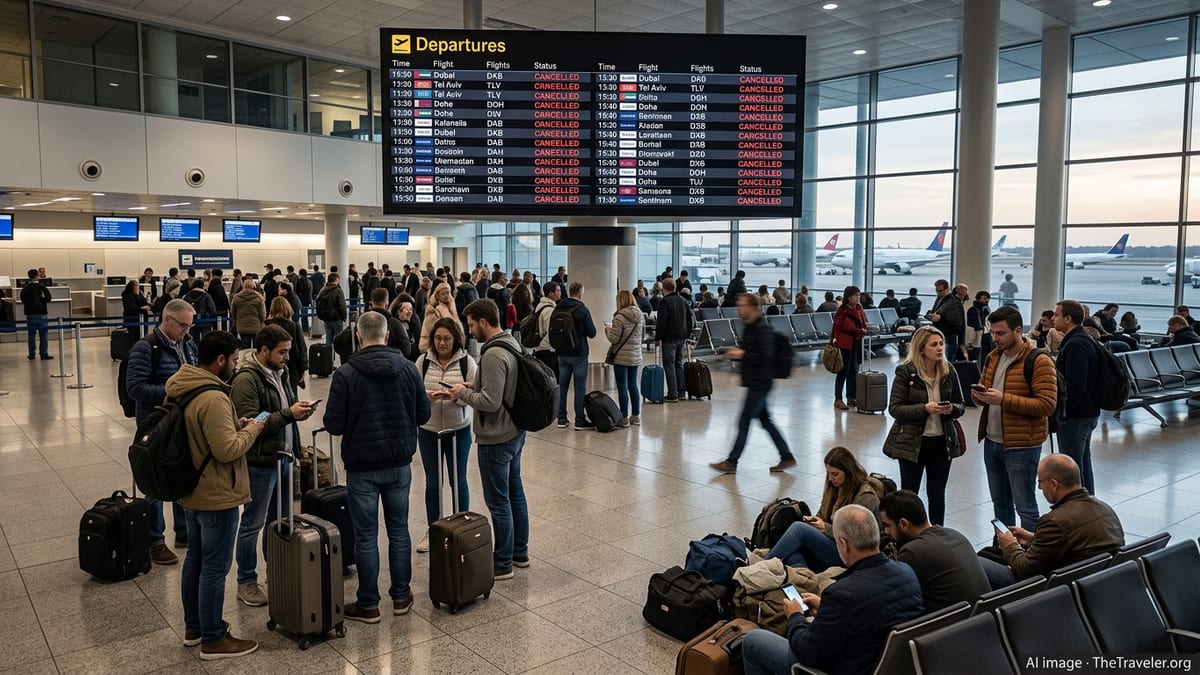
US Escalates Travel Alerts Across the Region
In early March, the US State Department sharply upgraded its travel guidance for citizens across the Middle East, urging Americans to leave multiple countries while commercial options are still available. The advisory covers a wide arc of destinations, including Iran, Iraq, Israel, the Palestinian territories, Jordan, Lebanon, Egypt, Saudi Arabia, the United Arab Emirates and several Gulf neighbors, citing heightened risks from missile and drone attacks, potential terror incidents and civil unrest linked to the widening Iran–Israel conflict.
Officials in Washington warn that rapidly shifting security conditions could force sudden airport closures or further airspace restrictions with little or no notice. Americans already in affected countries are being advised to keep travel documents on hand, maintain a packed “go bag” and register with embassy consular services so they can receive fast-moving updates on evacuation corridors, overland exit routes and limited commercial departures.
The stepped-up US advisories echo the most severe language seen in the region since the early stages of the war in Gaza, marking a clear signal that Washington now sees a substantial risk that routine tourism, business trips and religious pilgrimages may become impossible or unsafe in vast parts of the Middle East at short notice.
UK, EU and Gulf Partners Warn Against Nonessential Travel
The United Kingdom has similarly hardened its stance, with the Foreign, Commonwealth and Development Office advising against all or all but essential travel to a cluster of Middle Eastern states most exposed to Iranian missile and drone strikes. British officials point to the closure or partial closure of airspace over Iran, Israel, parts of the Gulf and key regional corridors as a central driver of the warning, noting that even travelers transiting through hubs such as Dubai, Abu Dhabi or Doha may find themselves stranded if flight patterns are abruptly altered.
Gulf nations directly targeted in the latest Iranian barrages, including the UAE and Saudi Arabia, have also issued their own advisories and aviation notices. Authorities in these countries stress that the closures and restrictions are primarily precautionary, intended to protect civilian aviation from the risk of debris or misdirected strikes. However, the resulting patchwork of national warnings and airline-specific policies has created a confusing landscape for travelers, with rules and risk assessments differing widely depending on citizenship, carrier and final destination.
European Union members are broadly aligned with the British and American approach, warning citizens that conditions on the ground can deteriorate rapidly and that consular assistance may be limited in active conflict zones. Officials emphasize that the presence of large numbers of foreign nationals in exposed cities raises the stakes for governments that might otherwise hesitate to recommend against travel.
Flight Cancellations, Closed Airspace and Patchy Reopenings
For travelers, the most immediate impact of the Iran–Israel war is in the air. Since the first wave of US and Israeli strikes on Iran and Tehran’s retaliatory attacks across the Gulf at the end of February, thousands of flights have been canceled, diverted or severely delayed. Airspace over Iran has been largely closed to civilian traffic, while neighboring countries, including Saudi Arabia, Qatar, Bahrain and the UAE, have implemented partial shutdowns or severe restrictions that force carriers to abandon traditional routes.
Major Gulf hubs that normally function as key links between Europe, Asia, Africa and Australasia have been operating at a fraction of their usual capacity. Dubai International, Doha’s Hamad International and Abu Dhabi’s Zayed International airports have all seen waves of suspensions, with some carriers halting services entirely for days at a time. National airline Saudia has extended suspensions on several routes, while low cost and European carriers have cancelled rotations to Israel, the Gulf and onward destinations as they reassess risk.
In recent days, a limited number of services have begun to resume as air defenses intercept incoming missiles and authorities assess damage to runways and terminal infrastructure. Emirates and other regional airlines have restarted some flights out of Dubai and Abu Dhabi on reduced schedules, while evacuation and special commercial flights have departed the UAE and neighboring states to repatriate stranded tourists. However, governments and airlines alike warn that any reopening remains fragile, and that renewed attacks or further military escalation could force another wave of cancellations without warning.
Poland and Other Countries Urge Citizens to Avoid the Region
Poland has taken one of the toughest lines among European states, advising its citizens to avoid all travel to and through a broad swath of the Middle East, specifically naming Iran, Iraq, Israel, Qatar, Kuwait, Bahrain and the UAE. Warsaw’s foreign ministry has publicly urged tour operators to halt sales to the region and has ruled out deploying military aircraft to evacuate tourists, instead relying on overland convoys and commercial flights when they are available.
Officials in Warsaw have set up 24 hour hotlines and crisis teams to assist nationals stranded in Israel and across the Gulf following abrupt shutdowns of airspace and airport operations. Organized tour groups have been rerouted by land into neighboring Egypt and Jordan, with diplomats coordinating cross border transfers and ground transport on short notice. The message to prospective travelers is unambiguous: new leisure trips should be postponed, and those already in the region should leave while they still can.
Other governments in Europe, Asia and Africa are issuing similar alarms. Some have begun mapping out contingency plans for overland evacuations through relatively stable neighbors, while others are negotiating slots on rescue or commercial flights departing from remaining open hubs. Together, these advisories underscore the extent to which the Iran–Israel war is disrupting not only regional tourism but also global mobility.
What Travelers Need to Know Before They Fly
For tourists and business travelers with existing bookings, the new wave of advisories and flight disruptions means that flexibility and vigilance are essential. Travel experts recommend confirming every segment of a journey directly with airlines in the 24 hours before departure, as schedules are being updated frequently, sometimes multiple times a day. Travelers should expect that tickets routed through Middle Eastern hubs may be rebooked via longer, more northerly or southerly paths, adding considerable time to trips or forcing overnight stays in third countries.
Airlines are generally offering no cost date changes or rerouting for itineraries touching high risk destinations, and in many cases are providing refunds where flights have been outright canceled. However, because many standard travel insurance policies exclude coverage for war, military action and airspace closures, travelers may be unable to claim additional compensation for hotel nights, missed tours or connecting flights booked separately. Policyholders are being urged to read the fine print, contact their insurers directly and keep all receipts in case limited benefits apply.
Hotel bookings in affected cities remain volatile. Properties in conflict exposed markets have reported waves of cancellations and no shows, while simultaneously accommodating stranded guests whose stays are being extended until onward transport becomes available. Travelers are advised to book rooms with flexible cancellation terms, keep a backup plan in mind for alternative destinations and confirm directly with hotels that they remain open and staffed before arrival.
Governments and airlines alike emphasize that safety considerations now outweigh convenience. Prospective visitors are being urged to reconsider nonessential trips to the Middle East, monitor official advisories closely and be prepared for the possibility that, even if airports and airspace appear open today, the situation could change dramatically by the time they are due to travel.