

More news on this day
Amid an escalating military confrontation with Iran, the United States has updated its global travel advisory map, singling out a cluster of countries as the most dangerous destinations for American travelers and pairing the move with a rare worldwide security caution.
Get the latest news straight to your inbox!
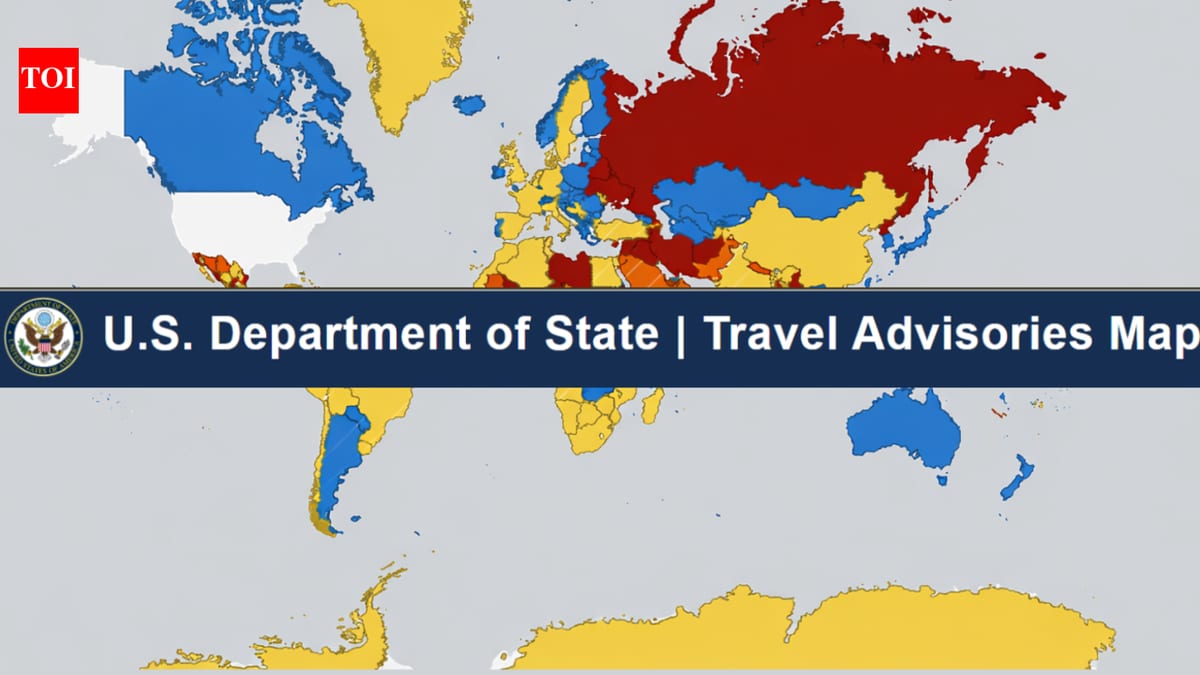
Image by timesofindia.indiatimes.com
Travel advisory system pushed into spotlight
The State Department’s four tier travel advisory framework has come under renewed attention since late February, when the latest phase of conflict with Iran began. Publicly available travel data show that a growing number of destinations are now classified at Level 4, the department’s most severe warning category, which urges US citizens not to travel due to risks such as armed conflict, terrorism, kidnapping or civil unrest.
Under this system, Level 1 urges normal precautions, Level 2 calls for increased caution, Level 3 advises travelers to reconsider plans, and Level 4 recommends avoiding travel altogether. The map published on the department’s website color codes countries accordingly, giving a visual snapshot of where US officials see the gravest threats to citizens abroad.
Analysts note that the advisories are not static and can change rapidly as security conditions evolve. The Iran crisis and associated regional fallout have accelerated those shifts, pushing several destinations higher on the risk scale in a matter of days.
Recent coverage of the updated map has fueled debate among travelers, with some pointing out that perceived everyday risks may not always align with the government’s threat assessments, which focus primarily on political violence and targeted attacks against US interests.
Middle East and North Africa dominate highest risk list
The sharpest concentration of Level 4 advisories remains in the broader Middle East and North Africa, where the Iran conflict has added to already fragile security environments. Countries such as Iran, Iraq, Syria and Yemen have long carried the strictest warnings because of active warfare, militia activity and the risk of detention or wrongful arrest.
Since late February, publicly available notices and media summaries indicate that the State Department has intensified its messaging for a wider arc of states stretching from the eastern Mediterranean to the Gulf. Israel, Lebanon and parts of the Palestinian territories were already under elevated advisories and have seen reinforced warnings as cross border strikes, missile launches and protest movements ripple across the region.
Reports also indicate that US citizens are being strongly urged to leave several countries where the risk of spillover from the Iran confrontation is considered acute, particularly in areas hosting American diplomatic facilities or military assets. In some locations, prior guidance to reconsider travel has effectively shifted into do not travel language, reflecting concerns about potential targeting of US linked sites.
North African countries facing internal instability or extremist activity also feature prominently on the high risk list. While the immediate trigger for the latest update is the Iran conflict, regional security experts point out that long running governance and economic challenges in parts of the Middle East and North Africa continue to underpin the department’s assessments.
Spillover concerns reach beyond the immediate war zone
Although the Iran conflict is centered in the Gulf and its surrounding region, the updated advisory map underscores that perceived risks to Americans now extend well beyond the immediate theaters of military operations. In Europe, a number of countries remain at Level 2 due to terrorism concerns and political demonstrations, with recent guidance highlighting the possibility of protests linked to the war affecting major cities.
Travel advisories for parts of South and Central Asia, including Afghanistan and neighboring states already under high alert for terrorism and insurgency, continue to recommend that US citizens avoid or reconsider travel. Analysts suggest that the confrontation with Iran could further complicate security in these areas if regional proxy groups seek to leverage the crisis.
In the Western Hemisphere, several countries in Latin America remain flagged at Level 3 or Level 4 for crime, kidnapping and political instability rather than direct ties to the Iran conflict. Nonetheless, recent commentary around the updated list notes that anti US sentiment and potential protests tied to the war could add another layer of uncertainty in some capitals.
Security specialists stress that the map is not meant to predict specific incidents, but rather to highlight environments where the convergence of conflict, weak institutions and hostility toward US interests raises the probability of Americans being caught in dangerous situations, including targeted attacks or collateral harm.
Worldwide Caution amplifies message to American travelers
Alongside the country specific updates, the State Department has issued a Worldwide Caution security alert, a tool reserved for moments when officials judge that the threat landscape for Americans abroad has shifted on a global scale. The latest notice, published in late March, cites the war involving the United States, Israel and Iran and warns that groups supportive of Tehran may look to strike US interests or locations linked to Americans in multiple regions.
The Worldwide Caution highlights the possibility of attacks on diplomatic missions, tourist sites, transportation hubs, public gatherings and commercial venues associated with the United States. It also flags the potential for sudden airspace closures, flight cancellations and broader disruption across key transit corridors, particularly around the Middle East and adjacent waters.
For travelers, the worldwide alert is designed to complement country level advisories by encouraging extra vigilance, contingency planning and enrollment in the government’s Smart Traveler Enrollment Program, which allows embassies and consulates to push security updates directly to US citizens overseas.
Industry observers say the timing of the alert, arriving less than a month after the latest escalation with Iran, reflects concern that the conflict could inspire opportunistic attacks or demonstrations in places far removed from the front lines, including in traditionally popular tourist destinations.
What the changes mean for future travel planning
For Americans planning international trips in the coming months, the updated list of high risk countries and the Worldwide Caution together signal a more uncertain landscape. Travel advisors and risk consultancies are encouraging clients to track advisory changes more closely, purchase flexible tickets and insurance where available, and build in backup routes in case of sudden disruptions.
Experts note that a Level 4 designation generally has immediate implications for corporate and institutional travel, with many companies, universities and nongovernmental organizations automatically suspending or restricting staff trips to those destinations. That, in turn, can affect local tourism sectors that rely heavily on business and educational visitors from the United States.
Adventure and independent travelers, who sometimes view government warnings as overly conservative, are also weighing the new information. Discussions in travel forums suggest that even seasoned visitors to regions like the Middle East are reconsidering itineraries that pass near active conflict zones or major US facilities, given the heightened risk of becoming inadvertently entangled in security incidents.
Despite the sobering tone of the latest advisories, travel analysts emphasize that many parts of the world remain at Level 1 or Level 2, where the guidance focuses on common sense precautions similar to those recommended for large US cities. The key message, they say, is not to halt international exploration altogether, but to recalibrate plans around a fast moving geopolitical crisis that has reshaped the State Department’s map of the most dangerous countries for Americans.