

More news on this day
The United States has issued its starkest warning yet to travellers across the Middle East, urging citizens to “depart now” from Jordan, the United Arab Emirates, Iran, Bahrain, Qatar, Kuwait and Oman as the escalating US-Israel war with Iran triggers sweeping airspace shutdowns and strands tens of thousands of passengers worldwide.
State Department Tells Americans to ‘Depart Now’
The new alert from the US State Department, issued late on March 2 and reinforced on March 3, applies to a broad swathe of the region but singles out key Gulf and Levant hubs where commercial aviation is now severely restricted. Officials are warning that the window to exit on commercial flights is narrowing by the hour as more countries curtail or close their skies.
In a social media post, the Assistant Secretary of State for Consular Affairs told Americans to leave Bahrain, Iran, Iraq, Israel, the Palestinian territories, Jordan, Kuwait, Lebanon, Oman, Qatar, Saudi Arabia, Syria, the United Arab Emirates and Yemen using whatever commercial transport remains available. The message echoed language usually reserved for full-scale evacuations, underscoring the level of concern in Washington over rapidly deteriorating security and aviation conditions.
Embassies across the region are amplifying the guidance, urging US citizens not to wait for government-organised repatriation flights and to have contingency plans that do not depend on military airlifts. Travellers are being told to monitor embassy channels closely, enrol in the Smart Traveler Enrollment Program and prepare to shelter in place if local airports close without warning.
Gulf Airspace Closures Trigger Global Flight Chaos
The advisory comes as much of the Gulf’s critical airspace corridor has either fully shut or been placed under stringent restrictions following joint US-Israeli strikes on Iran and Tehran’s retaliatory missile and drone barrages. Key flight information regions over Bahrain, Iran, Iraq, Kuwait, Qatar and parts of Jordan and Israel have been closed outright, according to operational notices to pilots issued since the weekend.
These closures have effectively severed one of the world’s busiest east-west aviation arteries, forcing long-haul flights between Europe, Asia and Africa into lengthy detours or last-minute cancellations. Data from aviation trackers and airport announcements indicate that thousands of flights have been scrapped since Saturday, with Middle Eastern, European and Asian carriers all heavily affected.
In practice, even countries whose airspace is only technically restricted are seeing commercial timetables collapse. Airlines are cancelling or consolidating services rather than attempting complex reroutings through a patchwork of open corridors. The result is mounting congestion at secondary hubs such as Istanbul and Cairo and a cascade of knock-on delays across global networks.
Major Hubs in UAE, Qatar, Bahrain and Kuwait Under Strain
Dubai and Abu Dhabi in the United Arab Emirates, along with Doha in Qatar, Bahrain International Airport and Kuwait International Airport, have become epicentres of the disruption. These hubs normally function as the primary connecting points for traffic between Europe, Asia, Africa and Australasia, but are now operating at sharply reduced capacity or, at times, not at all.
Emirates, Etihad, Qatar Airways, Gulf Air, Kuwait Airways and regional low-cost carriers have all announced waves of cancellations as national aviation authorities impose rolling airspace closures and new security restrictions. Some operators have begun mounting limited repatriation or relief flights using narrow corridors approved by air traffic control, but timetables are volatile and subject to abrupt change.
Airlines outside the region are reacting cautiously. European and Asian carriers including Air France, KLM, Turkish Airlines and various Indian operators have suspended many services to Dubai, Doha, Kuwait City and Manama or rerouted them around Gulf airspace entirely. Industry regulators in Europe are advising airlines to avoid the skies over Iran and neighbouring states hosting US military assets, citing a heightened risk to civil aviation.
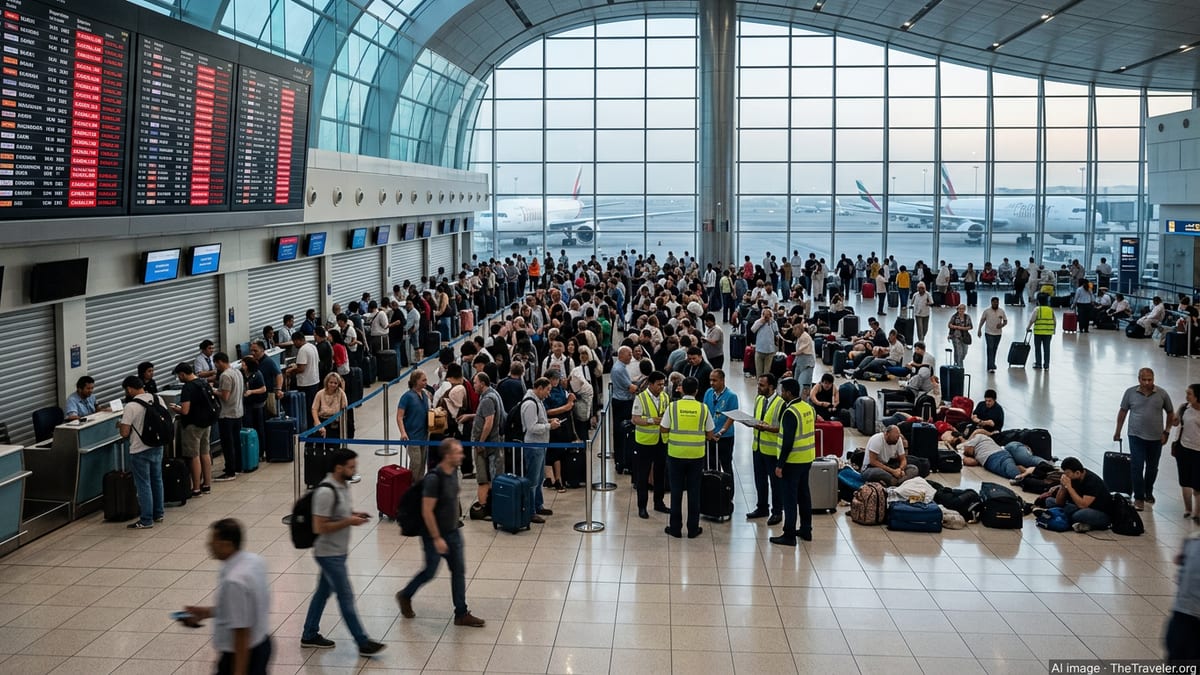
For travellers on the ground, the situation is chaotic. Airport departure boards in Dubai, Doha and Bahrain are dominated by cancellations, while check-in halls periodically flood with passengers when brief operational windows open. Authorities in Jordan and Oman are working to support stranded transit passengers as night-time airspace closures and intermittent restrictions create further bottlenecks.
Tens of Thousands of Travellers Stranded and Re-Routed
Travel industry analysts estimate that tens of thousands of passengers have already been stranded across the Gulf and wider Middle East, with many more facing missed connections, unplanned stopovers and lengthy diversions. The full number is difficult to quantify, but figures from flight-tracking companies show that well over a thousand flights into and out of the region were cancelled during the first major wave of closures alone.
Some long-haul services that were already airborne when the first missiles struck were forced to turn back mid-route or divert to alternative airports in Turkey, Egypt and southern Europe. Others have been operating significantly longer routings over the Red Sea or Central Asia to avoid conflict airspace, stretching crew duty limits and aircraft utilisation.
Travel insurers and tour operators are fielding a surge of calls from anxious customers trying to assess whether their trips are still viable. Many standard policies exclude cover for war-related disruptions, leaving some travellers facing unexpected accommodation and rebooking costs. Cruise lines and package tour companies with itineraries touching Gulf ports are also scrambling to redraw routes or repatriate guests.
What Travellers Need to Do Now
With conditions changing by the hour, consular officials and aviation experts are urging travellers in Jordan, the UAE, Iran, Bahrain, Qatar, Kuwait, Oman and neighbouring states to act quickly. The overarching message is clear: if commercial options exist to leave safely and you do not have a compelling reason to stay, take them now.
Passengers are being advised to stay in close contact with their airline or travel agent, use official apps and airport channels to track last-minute schedule changes, and avoid going to the airport without a confirmed booking. Travellers who are unable to secure an immediate departure should identify safe accommodation away from likely military targets, keep essential documents and medications accessible, and ensure phones and power banks remain charged.
The US warning is also expected to reshape near-term demand for travel to the Gulf. Airlines are preparing for a sharp drop in inbound leisure traffic to Dubai, coastal Oman and other popular winter sun destinations, as well as a potential slowdown in corporate travel linked to the energy and finance sectors. Meanwhile, governments are working with carriers to plan additional repatriation flights if the conflict widens or airspace closures tighten further in the days ahead.