

More news on this day
A United States Air Force C-32 VIP transport has emerged from a Texas paint hangar in a striking new red, white, gold and dark blue livery, signaling a high-profile visual shift for America’s executive air fleet and previewing how future Air Force One aircraft will look.
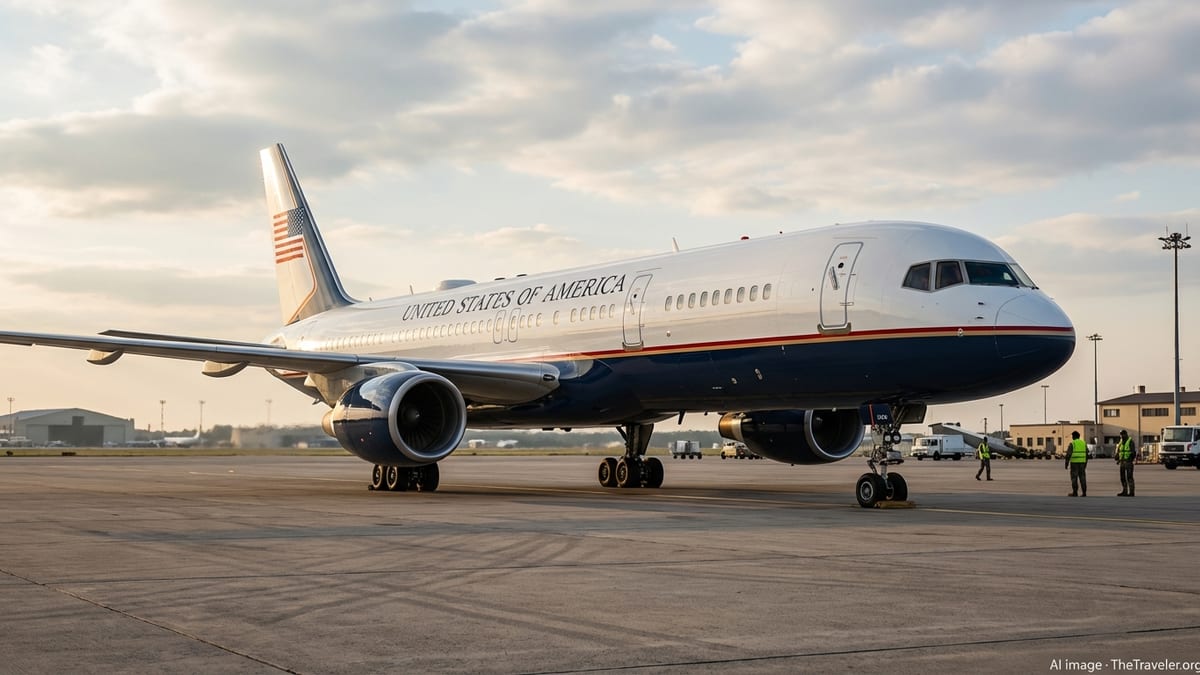
A First Look at the Reimagined C-32
The Boeing C-32A, tail number 99-0003, was recently spotted departing Majors Airport in Greenville, Texas, wearing the bold new colors after an extended maintenance and refurbishment period. Aviation enthusiasts tracking the jet, which was operating under the callsign “Vader 20,” captured images that quickly circulated across aviation forums and social media, confirming that the long-discussed redesign has finally moved from renderings to reality.
The aircraft’s new appearance features a dark blue underside, a crisp white upper fuselage and twin red and gold cheat lines running along the length of the cabin, visually separating the two primary colors. A stylized, “waving” American flag dominates the tail in place of the flat flag motif that has long been standard on the presidential and VIP fleet. Large “United States of America” titles remain prominent along the forward fuselage, reinforcing the aircraft’s status as a national symbol.
While C-32s are best known by the Air Force Two callsign when carrying the vice president, they are frequently tasked with transporting presidents, first ladies, Cabinet members and high-level delegations to destinations around the world. That dual role has made their design and public image an enduring part of how U.S. power and diplomacy are projected abroad.
From Kennedy-Era Blue to Trump-Favored Palette
The rollout of the C-32’s new livery represents the most significant visual departure for America’s executive aircraft since the early 1960s, when President John F. Kennedy’s administration adopted the now-iconic robin’s-egg-blue and white scheme. That mid-century design, developed with the input of industrial designer Raymond Loewy, became synonymous with the Air Force One brand and was later adapted to other VIP types, including the C-32.
The new scheme is closely aligned with a palette long favored by Donald Trump: a deeper, navy-like blue, bright white, vivid red accenting and touches of metallic gold. The layout strongly echoes designs previously revealed for the next-generation VC-25B presidential jets and bears a clear resemblance to Trump’s own Boeing 757, often dubbed “Trump Force One,” which also carries a sweeping U.S. flag on the tail.
This color concept was first publicly floated during Trump’s earlier term in office as the preferred direction for the VC-25B program, only to be shelved under the subsequent administration. With Trump back in the White House, the Air Force has now confirmed the new livery as the official paint scheme for its Executive Airlift fleet, and the C-32A seen in Texas is the first tangible expression of that policy.
Official Recognition of a New Executive Airlift Standard
Air Force officials have described the fresh look not as a one-off experiment, but as the new standard for the service’s top-tier VIP transports. An artist’s rendering released by the service in recent days shows a future VC-25B in the same red, white, gold and dark blue configuration, formally identifying it as the official paint scheme for Executive Airlift.
The decision effectively retires the Kennedy-era visual identity for the presidential fleet after more than six decades in service. It also brings a degree of uniformity to a diverse group of aircraft that includes widebody intercontinental jets, narrowbody C-32s and smaller business-jet derivatives used by senior defense and government leaders. Several other U.S. government executive aircraft outside the Air Force have already been seen in closely related designs, suggesting a broader cross-agency branding effort.
In communications with reporters and industry observers, Air Force representatives have indicated that repainting will be phased in during scheduled heavy maintenance checks to limit disruption. That approach allows the fleet to remain available for global missions while gradually introducing the updated aesthetic across multiple airframes.
How Many C-32s Will Change and When
The U.S. Air Force currently operates a small fleet of C-32A aircraft, all based on the Boeing 757 airframe and assigned to the 89th Airlift Wing at Joint Base Andrews outside Washington. They provide long-range, high-comfort transport with secure communications and office-style interiors tailored to senior leaders who often work throughout flights.
Officials and media reports indicate that four of these C-32s are expected to receive the new livery as part of a wider executive fleet refresh. The jet now emerging from Greenville is the first to complete the process, with additional aircraft set to cycle through the paint and upgrade line in the coming months and years as they reach their scheduled depot visits.
Repainting a large transport aircraft is a complex, labor-intensive effort that typically coincides with major structural inspections, avionics updates and cabin refurbishments. Old coatings are stripped back to bare metal, corrosion protection is reapplied and multiple layers of primer, color and clear protective finishes are added. By pairing the cosmetic shift with technical work, the Air Force aims to manage cost and downtime while delivering an upgraded product to the operational fleet.
Linking the C-32 to the Next Air Force One
The visual debut of the C-32’s new livery also offers the clearest real-world preview yet of how the future Air Force One jets will look when they enter service later this decade. The VC-25B program, based on the Boeing 747-8 platform, has faced cost pressures and schedule delays, and public glimpses of the redesign have so far been limited to digital artwork and scale models.
With the Greenville C-32 now wearing the same core scheme that the Air Force has selected for the VC-25B, observers can see how the colors and lines play on an actual airframe under natural light and in operational settings. That real-world validation is significant for a fleet whose primary mission includes high-visibility arrivals, televised ceremonies and international summits where image and symbolism are carefully curated.
The C-32’s role as a flexible stand-in for the president on shorter runways or less accessible airports further strengthens the connection. When the president or vice president disembarks from a C-32 in the years ahead, its appearance will closely mirror that of the larger VC-25B, reinforcing a unified presidential brand regardless of which aircraft happens to be carrying the Air Force One callsign.
Symbolism, Politics and Public Perception
The redesign of the C-32 and the broader executive fleet is not just an aesthetic choice; it is also a political and cultural statement. The Kennedy-era look, with its softer blue tones and minimalist typography, came to embody a sense of mid-century modernity and American optimism. It appeared in countless photographs, film sequences and news broadcasts, embedding itself deeply in the global imagination.
By contrast, the new livery’s sharper contrasts and darker hues project a more assertive personality. Supporters of the change argue that the fresh colors better reflect contemporary tastes and the current commander in chief’s brand, and that a new generation of aircraft merits a new visual identity. Critics see the palette as overly personalized, too closely tied to a single political figure and out of step with the idea of the presidency as a long-term institution above any one administration.
The emergence of the repainted C-32 is likely to intensify debate about how national symbols should evolve and who gets to define them. For travelers and onlookers who encounter the aircraft on overseas trips, however, the immediate impression will be more visceral: a new, unmistakably American silhouette on the ramp, framed by the red, white and blue of the national flag.
Operational and Practical Considerations
Beyond politics and symbolism, the new livery carries practical implications that Air Force planners have had to weigh. Darker colors, particularly on the underside of large aircraft, can absorb more solar heat, driving up skin temperatures and stressing components beneath the surface. Earlier evaluations of proposed designs raised concerns that such effects could push certain systems beyond their qualified temperature limits, prompting revisions to how and where darker paint is applied.
Engineers and program officials now say the chosen balance of white, dark blue and accent colors has been vetted to avoid unacceptable thermal impacts while still achieving the desired visual impact. The predominance of white on the upper fuselage helps reflect sunlight, while careful placement of darker sections and advanced protective coatings mitigate the potential for hotspots on critical structures and equipment.
From an operational standpoint, the repainting work is being closely integrated with existing logistics and readiness planning. Executive airlift aircraft operate on demanding global schedules, often with limited notice. Ensuring that at least a portion of the C-32 fleet remains available at all times has been a key factor in sequencing which jets enter the paint shop and when.
What the New Look Means for Travelers and Destinations
For the destinations visited by the C-32 and eventually the VC-25B, the updated livery will add a new visual chapter to the long-running story of U.S. diplomatic and presidential travel. Airports accustomed to seeing the familiar light blue and white silhouette taxi onto their ramps will instead welcome a more contrasting, tricolor presence whose dark lower fuselage stands out against concrete and tarmac.
Local spotters and aviation photographers are already adjusting their expectations, planning vantage points and camera settings to capture the revised details when the aircraft touches down. The interplay of deep blue paint, reflective white surfaces and metallic gold striping under varying light and weather conditions is likely to generate a new wave of images shared across news outlets and social platforms every time the jet appears abroad.
For passengers stepping aboard, the change on the outside will not fundamentally alter the secure communications suites, conference spaces and staff work areas that define the C-32’s role as a flying White House annex. Yet as the aircraft pulls up to foreign terminals or rolls past lines of honor guards and motorcades, the refreshed livery will serve as a highly visible reminder that the U.S. executive fleet is entering a new era, carrying familiar missions in a markedly different skin.