

More news on this day
A United States Air Force E-3 Sentry airborne warning and control system aircraft has been heavily damaged in an Iranian missile and drone strike on Prince Sultan Air Base in Saudi Arabia, according to multiple open-source reports and imagery analyses, raising new questions about the vulnerability of critical command and control assets in the ongoing 2026 Iran war.
Get the latest news straight to your inbox!
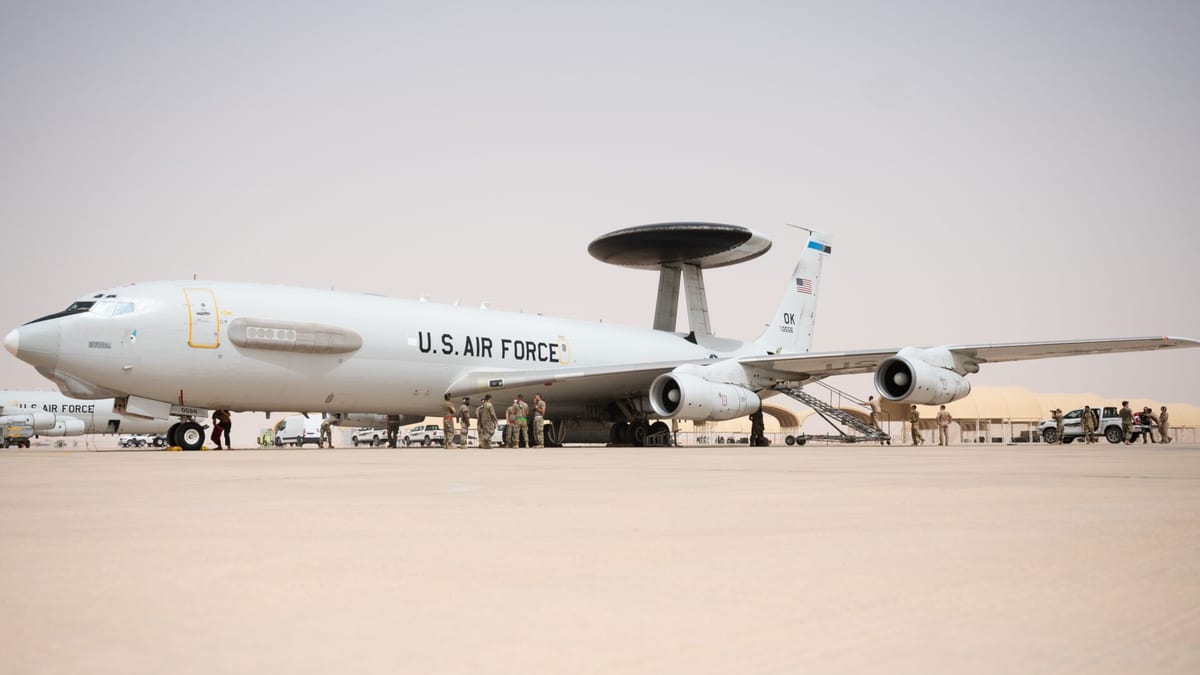
Image by AeroTime
Prince Sultan Air Base Strike Underscores Expanding Conflict
The March 27 attack on Prince Sultan Air Base, south of Riyadh, formed part of a broader Iranian campaign of missile and drone strikes across the region, targeting sites in Israel and Gulf Arab states. Publicly available information indicates that a combination of ballistic missiles and one-way attack drones penetrated air defenses around the Saudi installation, where U.S. aircraft have long operated alongside Royal Saudi Air Force units.
Initial coverage focused on damage to U.S. refueling aircraft and injuries to American personnel at the base, with reports indicating that at least ten U.S. service members were wounded in the strike. Subsequent analysis of commercial satellite imagery and ground photos shared on social media platforms began to highlight the involvement of an E-3 Sentry, one of the most scarce and consequential aircraft in the U.S. inventory.
Imagery circulating online appears to show a U.S. E-3 with extensive fire and blast damage on the Prince Sultan ramp, positioned among other Boeing 707-derived airframes, including KC-135 tankers. Specialists who have examined those images describe catastrophic structural harm concentrated around the aircraft’s distinctive rotating radar dome and upper fuselage, suggesting that the aircraft is likely a total loss.
The strike on Prince Sultan is one of several Iranian attacks recorded against the base in March, following earlier incidents in which tankers were damaged. Open sources tracking incidents in the 2026 Iran war now list the March 27 event as the most serious to date involving high-value U.S. aircraft at the Saudi facility.
Rare E-3 Sentry Loss Hits Critical Command and Control Fleet
The Boeing E-3 Sentry serves as an airborne warning and control system platform, providing wide-area radar surveillance, battle management, and airspace coordination for U.S. and allied forces. Based on the Boeing 707 airframe and fielded in the late Cold War, the Sentry’s large rotating radome houses systems that can track hundreds of targets across hundreds of miles, acting as what analysts frequently describe as an airborne command post and radar station.
Open-source reference data indicates that the U.S. Air Force operates only a few dozen E-3s, with a smaller number in fully modernized E-3G configuration. In recent years, a combination of airframe age, rising maintenance demands, and budget constraints has already reduced the size of the fleet, leaving limited margins for additional attrition. Aviation tracking resources and defense commentary suggest that the aircraft involved in the Prince Sultan strike was among those upgraded for extended service, further magnifying the impact of its loss.
The destruction or effective write-off of a single E-3 matters because of the unique role these aircraft play in orchestrating complex air campaigns. Unlike fighters or tankers, which exist in larger numbers and have clearer replacement paths, airborne early warning and control platforms are few in number and cannot be easily substituted. Analysts following the 2026 Iran war have emphasized that each Sentry sortie can influence the performance of dozens of other aircraft over a wide region, from fighters and bombers to drones and support assets.
Given the small fleet and high cost, the E-3s are typically regarded as strategic assets. Their presence at forward bases such as Prince Sultan had already prompted discussion in defense circles about dispersal, hardened shelters, and additional point-defense measures. The latest incident is likely to intensify that debate, particularly as Iran demonstrates improving accuracy with ballistic missiles and loitering munitions against high-value, fixed targets.
Implications for U.S. Air Operations Over the Gulf and Beyond
The damage to the E-3 Sentry in Saudi Arabia comes at a time when U.S. and allied air operations over the Persian Gulf, Iraq, and the eastern Mediterranean are already stretched by the tempo of the 2026 Iran war. Regional reporting shows that U.S. aircraft have been conducting frequent patrols, missile-defense support, and strike missions, relying heavily on airborne early warning and control to coordinate activity over congested and contested airspace.
A diminished E-3 fleet could constrain how long and how far such missions can be sustained. Without continuous AWACS coverage from aircraft like the Sentry, planners may need to narrow the geographic scope of operations, stagger sorties to match available airborne command capacity, or rely more on ground-based radars and partner capabilities. Each of those options carries trade-offs in detection range, reaction time, and survivability against further long-range strikes.
The incident also highlights the particular vulnerability of large, slow, high-signature aircraft when based within reach of modern missile and drone arsenals. While these platforms typically operate at significant distances from hostile territory once airborne, they are most at risk on the ground, where they depend on base defenses, hardened infrastructure, and dispersal to survive. The Prince Sultan attack illustrates how a single successful strike can significantly alter the balance of specialized assets available to a theater commander.
For Gulf airspace in particular, where commercial routes, military corridors, and unmanned systems often overlap, the reduction of AWACS capacity raises renewed concern about situational awareness. Travel and aviation analysts note that regional air navigation already relies on a dense network of civil and military sensors, and any degradation of high-end airborne surveillance during a conflict can complicate the management of air traffic and deconfliction measures across busy corridors.
Pressure Mounts on Modernization Plans and Base Protection
The loss of an E-3 at Prince Sultan arrives against the backdrop of long-running U.S. debates over how and when to replace the ageing Sentry fleet. Prior to the current conflict, the Air Force and U.S. policymakers had been weighing a transition to newer platforms such as the E-7, while also considering budget pressures and competing priorities. Public budget documents and industry reporting describe a replacement timeline that extended into the 2030s, leaving the E-3 to soldier on despite rising sustainment costs and operational risks.
In the wake of the Iranian strike, those timelines may come under fresh scrutiny. Commentaries in defense-focused publications argue that the war has exposed the vulnerability of high-value enablers like AWACS, tankers, and intelligence aircraft, suggesting that modernization programs can no longer be treated as discretionary or easily deferred. The damage at Prince Sultan provides a tangible example of how quickly attrition can erode capabilities that took decades to build.
At the same time, the attack is likely to feed a broader reassessment of base protection in the Gulf region. Over the past decade, militaries have invested heavily in ballistic missile defenses and layered air-defense systems, yet the proliferation of smaller, cheaper drones and precision weapons has complicated the picture. The ability of Iran to deliver effective strikes against parked aircraft at a well-known base, despite those defenses, will be parsed closely by planners considering how to shield other regional hubs that host U.S. and coalition forces.
For host nations like Saudi Arabia, which depend on the presence of U.S. air assets for both deterrence and operational support, the incident may also influence future basing arrangements. Discussions about dispersal of aircraft to additional facilities, enhanced hardening of shelters and fuel farms, and closer coordination on air and missile defense are expected to intensify as all sides absorb the lessons of the March 27 attack.
Regional Travel and Aviation Outlook Amid Rising Tensions
While the strike on Prince Sultan Air Base directly affects military operations, it also reverberates through the wider aviation ecosystem of the Gulf. The visibility of the incident, amplified by images of the damaged E-3 circulating on social media and in specialist outlets, underscores to travelers how close major commercial routes run to active conflict zones and strategically significant infrastructure.
Airlines operating through Saudi and neighboring airspace have already been adjusting routings and altitude profiles in response to missile and drone activity linked to the 2026 Iran war. Flight-tracking data and airline statements over recent weeks show reroutings around known launch areas and heightened caution along certain corridors, particularly during periods of announced military action or after high-profile strikes.
Travel-news analysts describe a pattern in which carriers, regulators, and air-navigation service providers reassess risk dynamically, often on a day-by-day basis, as the security situation evolves. The confirmed damage to a high-value U.S. command and control aircraft at Prince Sultan is likely to factor into those assessments, reinforcing perceptions that long-range strikes on critical infrastructure remain a credible threat.
For now, commercial service to and from Saudi Arabia continues, but the incident adds another layer of tension to an already volatile regional picture. Passengers transiting through Gulf hubs may see continued adjustments in schedules and routings as operators balance efficiency against evolving security considerations, while observers watch closely to see how the United States and its partners respond to the loss of one of their most sophisticated airborne assets.