

More news on this day
An Iranian missile and drone strike on Prince Sultan Air Base in Saudi Arabia has destroyed a United States Air Force E-3G Sentry airborne early warning aircraft, a high-value loss that is intensifying scrutiny of American basing practices and air defenses across the Gulf amid the ongoing 2026 Iran war.
Get the latest news straight to your inbox!
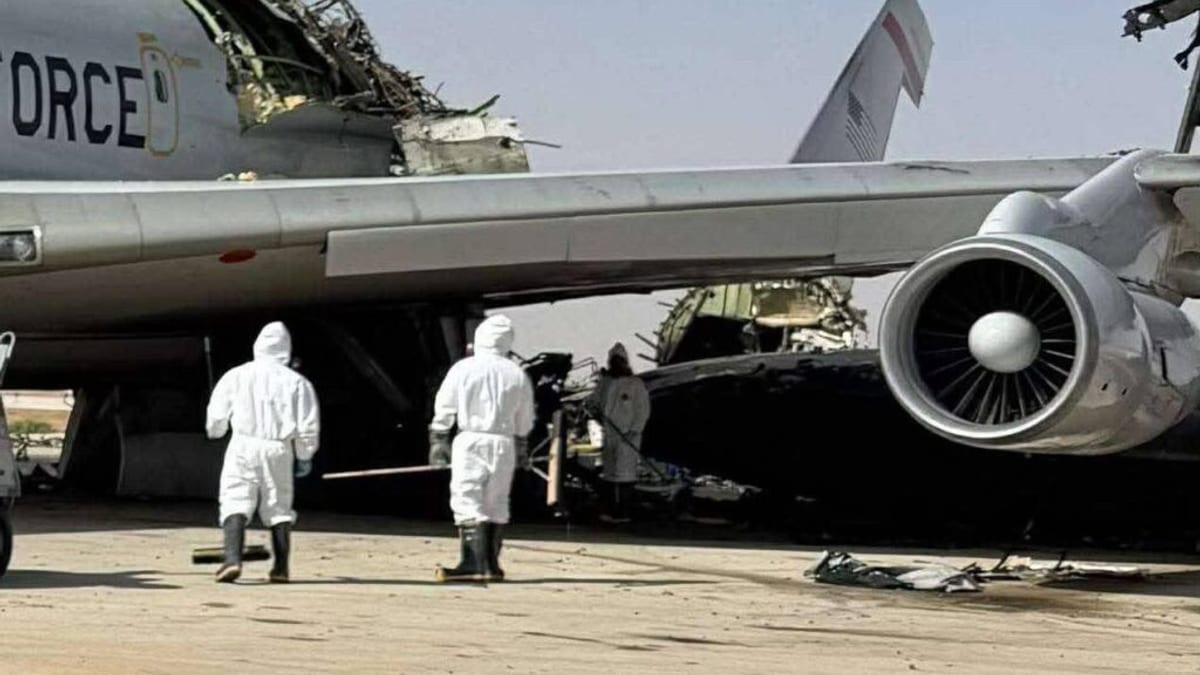
Image by AIRLIVE
A Precision Strike on a Critical Node
Reports emerging over the weekend indicate that the attack on Prince Sultan Air Base occurred on March 27, when Iranian forces launched a combined missile and drone salvo at the installation south of Riyadh. Publicly available information and open-source imagery suggest that while several refueling aircraft were damaged, a single E-3G Sentry parked on the airfield suffered catastrophic destruction.
Imagery and analysis shared by defense watchers and open-source intelligence communities appear to show the aircraft struck near the distinctive rotating radar dome that defines the E-3’s profile. The airframe, identified in multiple open sources as serial number 81-0005, is shown burned out on or near a taxiway, separated from clusters of damaged KC-135 tankers elsewhere on the base. The pattern has fueled assessments that the strike was deliberately aimed at the Sentry’s radar section.
Additional reporting on the broader attack describes at least 10 U.S. service members wounded at the base and multiple refueling aircraft damaged or destroyed, underscoring that the strike targeted high-impact enablers rather than fighter aircraft alone. For regional planners, the combination of tanker and airborne warning losses at a single location is being viewed as a serious operational shock rather than an isolated incident.
Prince Sultan Air Base has long served as a hub for U.S. and coalition air operations over the Gulf, the Red Sea, and into the Levant. The ability of Iranian forces to land accurate strikes on parked aircraft at such a heavily used facility is sharpening questions about dispersal, hardening, and sheltering of critical assets during a protracted conflict with Tehran.
Why the E-3G Sentry Matters
The Boeing E-3 Sentry, derived from the 707 airframe, functions as an airborne early warning and control platform, providing long-range radar surveillance, battle management, and air traffic control for combat operations. The E-3G is the most modern U.S. Air Force configuration, equipped with upgraded radar, mission systems, and communications, and represents a substantial share of the service’s remaining high-end airborne warning capacity.
Public inventories indicate that only a small number of E-3s remain in active U.S. service after years of retirements and budget-driven fleet reductions. Analysts and aviation historians note that the loss of a single E-3G is not easily absorbed, particularly during an intensive air campaign over multiple theaters requiring constant coverage, including the skies around the Strait of Hormuz and over partner nations such as Israel and Saudi Arabia.
There is currently no one-for-one replacement fully fielded for the Sentry fleet. Future airborne warning capabilities are expected to rest on a mix of new E-7 Wedgetail aircraft, ground-based sensors, and space-based and networked systems. However, those transitions are still underway, leaving the legacy E-3s as a key backbone for real-time air picture management.
In that context, the destruction of an E-3G on the ground represents more than the loss of a single airframe. It reduces the number of available orbits that the United States and its partners can sustain at any given time, potentially creating coverage gaps that adversaries may seek to exploit in contested airspace stretching from the eastern Mediterranean to the Gulf of Oman.
Implications for Gulf Basing and Air Defense
The strike on Prince Sultan Air Base follows earlier Iranian attacks that reportedly damaged multiple U.S. KC-135 Stratotanker refueling aircraft at the same location. Taken together, these incidents point to a persistent focus by Tehran on enablers that underpin long-range U.S. and allied air operations, rather than solely on frontline fighters or symbolic infrastructure.
Observers of the conflict note that Iranian missile and drone accuracy appears to have improved over the course of the war, with more recent strikes demonstrating tighter clustering of impacts on high-value targets. The apparent ability to hit a specific taxiway area and destroy the E-3G has intensified debate about how much warning and intercept capacity regional defenses can reliably provide when facing large salvos of precision weapons.
For host nations such as Saudi Arabia, the damage at Prince Sultan Air Base adds to pressure to reassess joint base layouts and the concentration of strategic assets. Satellite imagery referenced in open reporting shows key aircraft parked in relatively exposed positions, with limited hardened shelters suitable for large platforms like the E-3 and KC-135. In the current threat environment, that posture is increasingly seen as a vulnerability.
Travelers and expatriate communities in the Gulf are watching these developments closely, as major transport hubs and expatriate residential areas sit within the broader defensive envelope of these bases. While commercial air operations have continued, periodic airspace restrictions and rerouted civilian flights reflect the heightened sensitivity around any potential spillover from military targets to the surrounding region.
Regional Air Picture and Travel Corridor Security
The loss of an airborne early warning aircraft at a key hub has implications beyond military strike planning. The same networks that support combat air patrols over Saudi Arabia and neighboring states also underpin deconfliction between military and civilian traffic, particularly in crowded corridors linking Europe, the Gulf, and South and East Asia.
Airlines have already adjusted routes in response to missile and drone activity over the Gulf and parts of the eastern Mediterranean, favoring tracks that keep civilian traffic away from known launch corridors and air defense engagement zones. Aviation safety bodies and national regulators rely heavily on accurate, shared air pictures to manage that process, heightening the importance of resilient surveillance coverage even as military assets come under attack.
With the Prince Sultan strike coming alongside Iranian launches toward Israel and other Gulf states, regional airspace managers are contending with fluctuating risk levels from week to week. Travel industry planners describe a balancing act between maintaining connectivity for business and pilgrimage travel and responding swiftly to temporary closures or altitude restrictions near conflict zones.
So far, there are no indications in public reporting of direct threats to civilian airports in Saudi Arabia tied to the March 27 attack. However, the demonstrated reach of Iranian missiles and drones to tightly focused military targets nearby is adding urgency to calls for layered protection of both military and civilian aviation infrastructure across the region.
A Rare Combat Loss for a Strategic Fleet
Historically, the E-3 Sentry fleet has suffered only a handful of major accidents since entering service in the 1970s, and almost none as a result of direct enemy action. Open-source chronologies of notable E-3 incidents primarily list peacetime mishaps, including landing accidents and a crash in Alaska in the 1990s, underscoring how unusual it is for an E-3 to be written off in combat.
Commentary from defense analysts and aviation communities characterizes the March 27 loss at Prince Sultan Air Base as one of the most significant U.S. aircraft losses of the current conflict in terms of strategic impact. Compared with fighter or attack aircraft, airborne early warning and refueling platforms are far less numerous and far more challenging to replace quickly.
For the United States, the incident is likely to accelerate both near-term changes in how high-value aircraft are based and longer-term efforts to transition to more survivable and distributed sensor architectures. For Iran and other regional actors, it may be seen as proof that precision strikes can reach deeply into what were once considered secure rear-area hubs.
As the 2026 Iran war continues to reshape security calculations around the Gulf, the burned-out hulk of the E-3G Sentry at Prince Sultan has quickly become a symbol of how modern conflicts can expose even the rarest and most technologically advanced assets to sudden loss on the ground.