

More news on this day
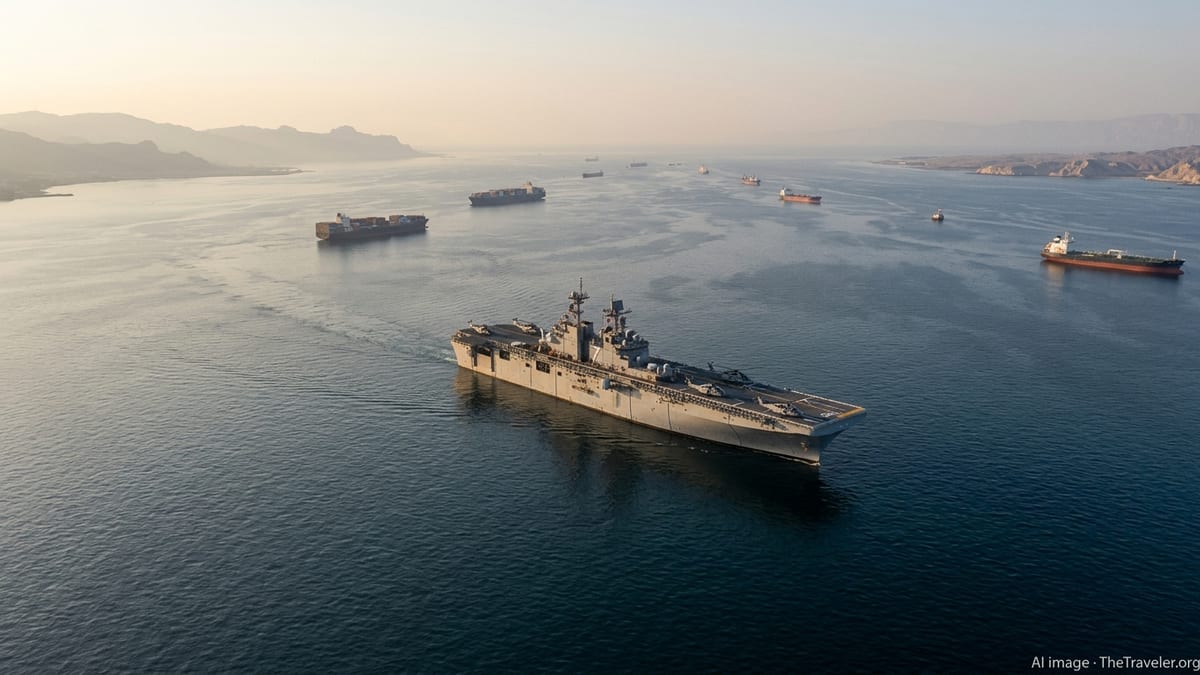
The deployment of the U.S. amphibious assault ship USS Tripoli toward the Gulf, amid an expanding war with Iran and the partial closure of the Strait of Hormuz, is accelerating a cascade of travel and tourism disruptions across the Middle East and beyond.
Get the latest news straight to your inbox!
Warships, Chokepoints and a Shifting Security Map
The USS Tripoli, carrying Marines from the 31st Marine Expeditionary Unit, is moving toward the region as part of a wider U.S. build-up intended to secure threatened sea lanes near Iran. Publicly available tracking data and broadcast reports indicate the ship is expected to join other U.S. naval assets already concentrated around the Arabian Sea and Gulf approaches, reinforcing a show of force close to the Strait of Hormuz.
The deployment comes as Iran’s confrontation with the United States and Israel has turned the Strait of Hormuz into the focus of a high-risk standoff. According to open-source coverage, Iran’s closure or effective restriction of the waterway since late February has halted much commercial traffic and pushed global oil prices sharply higher, turning a longstanding vulnerability for energy markets into a live crisis.
Security analysts note that the arrival of a large amphibious platform such as USS Tripoli raises both deterrence and escalation questions. Its presence signals the potential for maritime escorts and even amphibious operations in contested waters, but it also places more high-value military targets inside a crowded and heavily surveilled theater.
For the travel and tourism sector, the implications are immediate: a militarized seascape at one of the world’s most important choke points heightens risk perceptions, disrupts shipping-driven cruise and ferry traffic, and reinforces government warnings to avoid non-essential travel anywhere near the Gulf.
Airspace Closures Force Airlines to Reroute and Cancel
The air travel network across the Middle East is under acute strain as the Iran conflict widens. Since early March, multiple Gulf and international carriers have reduced or suspended services to key hubs including Dubai, Doha and Abu Dhabi as states close or restrict their airspace. Travel industry bulletins describe thousands of flight cancellations and diversions, with some airlines issuing broad waivers for passengers booked to or through cities from Bahrain and Kuwait to Larnaca and Amman.
European and Asian airlines are being forced into longer, more northerly or southerly routings to avoid Iranian and Iraqi skies. Industry advisories report that some carriers have temporarily suspended certain India–Europe and Gulf–Europe routes altogether, while others are adding hours to flight times and introducing technical fuel stops to maintain safety margins.
Indian, Australian and European travelers have been particularly affected. National aviation authorities and travel firms in these markets describe stranded passengers at transit hubs, compressed seat availability on remaining corridors, and sharply higher operating costs as jets detour around conflict zones. For many routes, the Middle East’s role as an indispensable bridge between Asia, Africa and Europe has turned from an asset into a vulnerability.
With no clear timeline for a reopening of airspace, airlines are prioritizing network resilience over schedule restoration. Travel advisories recommend that passengers build in additional buffer time, expect sudden changes to routings, and maintain up-to-date contact details with their carriers for rapid rebooking.
Cruise, Ferry and Cargo Routes Under Pressure
While global attention is focused on air corridors, maritime tourism and cargo operations are also being reshaped by the Iran conflict and the USS Tripoli’s approach to the region. Shipping data cited in recent coverage show that most commercial vessels are avoiding the Strait of Hormuz, despite some tankers and bulk carriers continuing to transit under special arrangements. The combination of Iranian threats, rising war-risk insurance premiums and an expanding U.S. naval footprint has created a volatile environment for civilian shipping.
Cruise calls to Gulf ports, which had been steadily growing in recent seasons, are being postponed or quietly removed from itineraries. Operators are adjusting winter and spring programs away from Dubai, Abu Dhabi and Muscat toward safer Eastern Mediterranean or Indian Ocean ports. Industry notices point to uncertainty over port access, shore excursion safety, and the availability of bunkering fuel in a region where key energy and logistics facilities have come under attack.
Regional ferry connections that depend on relatively short transits across the Gulf are also affected. While many of these services are primarily used by workers and local residents, they form a niche but important part of the wider tourism ecosystem, linking coastal cities, islands and pilgrimage sites. Interruptions to these routes are compounding the sense of isolation in some Gulf communities already struggling with supply-chain delays.
Cargo diversions around the Arabian Peninsula, via the Red Sea or even longer Cape routes, add time and cost to the movement of goods that underpin the tourism economy, from hotel food supplies to aviation fuel. Travel companies warn that these pressures could filter into higher prices for consumers and reduced capacity on popular seasonal routes.
Tourism Demand Collapses Across the Region
As the security situation has darkened, leisure demand for travel to the broader Middle East has slumped. Reports from airlines, tour operators and national tourism agencies indicate that inbound bookings to Gulf destinations, Iran’s immediate neighbors and popular regional stopover cities have fallen sharply since the first missile and drone strikes.
Large carriers based in the Gulf have trimmed frequencies on long-haul services that traditionally feed tourists into the region’s resorts and city breaks. Travel data providers describe package cancellations for spring and early summer to destinations such as Oman, Jordan and certain Red Sea resorts, driven both by safety concerns and by uncertainty over how travelers would reach these locations if key hubs remain constrained.
Travel advisories from several governments now urge citizens to reconsider non-essential trips to countries adjacent to the conflict zone and to exercise heightened caution in others that serve as transit points. This has a chilling effect even on areas physically distant from active hostilities, as travelers often perceive the Middle East as a single, interconnected risk area.
Local tourism operators, from desert camp providers to city tour guides, are reporting a steep decline in forward bookings. Many are pivoting to domestic or regional customers where possible, but face headwinds from rising fuel costs and broader economic uncertainty tied to the energy price shock.
Travel Risk Management and What Passengers Should Expect
For travelers and corporate mobility planners, the rapid escalation around Iran and the deployment of USS Tripoli underscore the importance of dynamic risk management. Specialist travel advisories recommend continuous monitoring of itineraries that overfly or transit the Middle East, even if the final destination lies elsewhere, as route changes can occur with little notice.
Passengers are being advised to pay close attention to airline alerts, maintain flexible tickets where possible, and anticipate indirect routings that may add several hours to long-haul journeys. Travel managers are increasingly steering staff away from routings that depend on Gulf hubs, seeking alternatives via Europe, Central Asia or North Africa, even at higher cost.
Insurance considerations are also shifting. Some policies treat declared conflict zones and war-related disruptions differently from standard operational delays, prompting travelers to review coverage for cancellations, missed connections and emergency evacuations. Industry commentary suggests that comprehensive policies with explicit provisions for political and security events are gaining new relevance.
Ultimately, the trajectory of travel disruption will hinge on how the confrontation around Iran and the Strait of Hormuz evolves in the coming weeks. The arrival of USS Tripoli and other naval assets may eventually facilitate safer corridors for commercial traffic, but for now it is reinforcing the perception of a region on a war footing, with significant implications for global mobility, tourism and the broader travel economy.