

Utilities in Mexico are relatively affordable by international standards, but the structure of tariffs, strong climate differences and heavy subsidies create outcomes that can surprise new foreign residents. For relocation planning, it is important to understand not only headline per kilowatt hour prices, but also how electricity, gas, water and internet are billed and how consumption patterns can move a household from low subsidized rates to significantly higher charges.
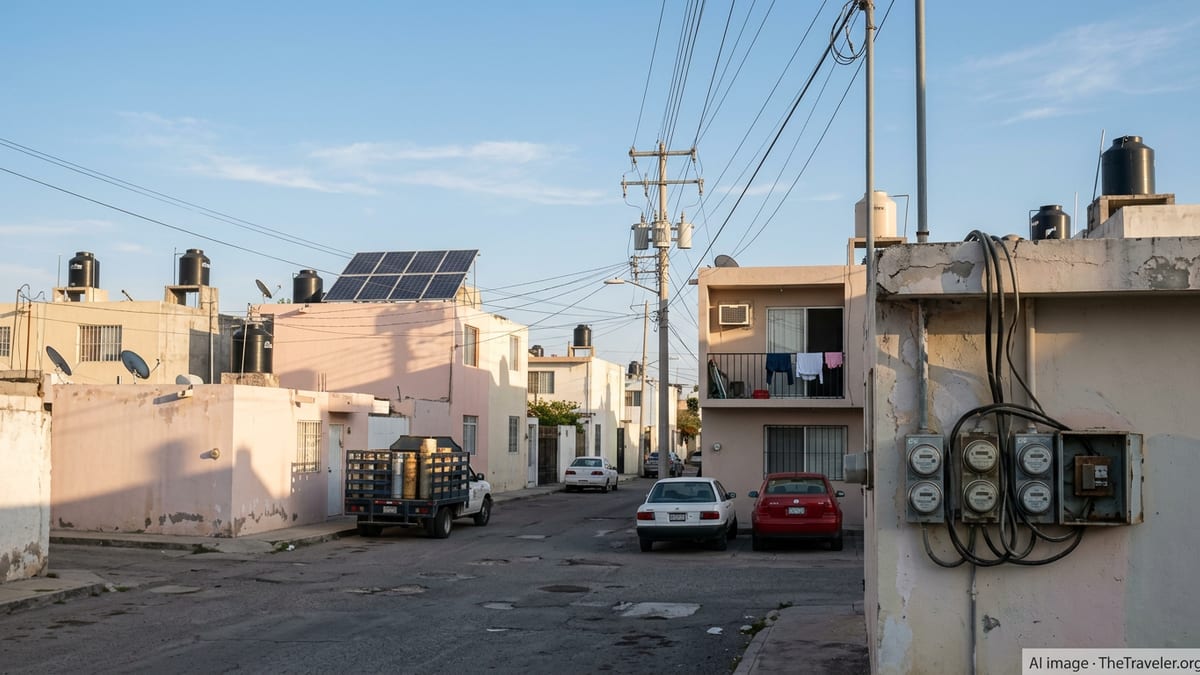
Structure of the Mexican Electricity System
Residential electricity in Mexico is supplied almost exclusively by the state-owned Comisión Federal de Electricidad (CFE). For most households there is no choice of retailer, and tariffs are set at federal level with regional and seasonal differentiation. This centralization simplifies account setup for expats but also means there is limited room to shop around for better prices. Residential tariffs are heavily subsidized relative to commercial and industrial users, particularly in hotter regions where air conditioning is considered a basic need.
Mexico uses a block tariff system: low "basic" consumption is charged at a subsidized rate per kilowatt hour, an additional block at a slightly higher rate, and any use beyond that block at a noticeably higher "surplus" rate. For standard temperate-climate tariffs, public data for 2025 indicates that the first 75 kWh per month may be priced a little above 1 Mexican peso per kWh, the next 65 kWh slightly higher, and any additional consumption several times that level. Over the billing cycle this blended structure keeps bills modest for low and moderate use, but costs accelerate as air conditioning, electric heating, or multiple large appliances are added.
There is also a national "high-consumption" residential tariff known as DAC (Doméstica de Alto Consumo). Households that exceed an annual average threshold, which in many zones is around 3,000 kWh per year, are reclassified into DAC and lose most subsidies. In DAC, per kWh charges can roughly triple or quadruple compared with subsidized bands, and a fixed monthly charge is added. Once classified as DAC, a household typically remains there for a rolling 12-month period even if consumption subsequently falls, so the financial impact is prolonged.
For expats accustomed to deregulated electricity markets, the main practical implication is that Mexico rewards stable low-to-moderate consumption but penalizes sustained heavy use. Large, fully air-conditioned homes, especially in hot coastal areas, can see bills similar to or higher than many parts of North America or Western Europe if usage is not carefully managed.
Typical Residential Electricity Costs for Expats
Residential electricity prices in Mexico are lower than the United States average on a per kWh basis, with nationwide estimates for 2024 and 2025 suggesting typical subsidized residential tariffs around 0.10 to 0.12 US dollars per kWh when converted from pesos. However, because of the block tariff structure and DAC, headline averages can be misleading for relocation budgeting. Actual monthly bills vary widely by climate zone, dwelling type and whether air conditioning is used regularly.
In temperate highland cities where air conditioning is rarely needed and homes are smaller, many two-person households report bi-monthly bills (CFE typically bills every two months) in the range of approximately 200 to 600 Mexican pesos. That implies monthly averages of about 100 to 300 pesos, or roughly 6 to 18 US dollars, for modest usage based on lighting, refrigeration, electronics and occasional hot water needs. These levels are achievable where construction favors natural ventilation and there is minimal electric heating or cooling.
In hotter regions along the coasts and lowlands, consumption profiles are very different. Running one or more air conditioners for many hours per day, in combination with electric water heaters or pool pumps, can raise bi-monthly bills into the 1,500 to 4,000 peso range or more. Once a property crosses the DAC threshold, per kWh rates can increase to the equivalent of 0.18 to 0.25 US dollars or higher in some zones, and it is common to see bi-monthly bills above 5,000 pesos for large, fully air-conditioned homes. For expats comparing with their home country, subsidized Mexican tariffs are clearly lower, but DAC rates are similar to mid-range or high residential tariffs in many developed markets.
Because of this variability, relocation planning should avoid relying on national "average bill" figures. Instead, expats are advised to obtain recent CFE bills for specific candidate properties, noting the tariff type, total kWh for the billing period and any DAC classification. For budgeting purposes, a conservative planning range for a typical expat household is often between 300 and 2,000 pesos per month, with the lower end reflecting modest use in a mild climate and the upper end reflecting intensive cooling in hot regions while still avoiding DAC.
Regional and Seasonal Variations in Electricity Costs
Mexico’s tariff system incorporates geographic zones and, in some regions, summer tariffs that recognize the additional demand created by high temperatures. Warmer coastal states and lowland areas often benefit from more generous subsidized blocks or higher kWh thresholds before DAC applies, reflecting policy priorities to protect vulnerable households from extreme cooling costs. In contrast, many highland cities with milder climates have tighter thresholds on what counts as subsidized "basic" consumption.
Seasonal variation is particularly relevant in areas where summer temperatures remain high for several months. During these periods, even conservative use of air conditioning can push a household’s bimonthly consumption above the standard subsidized block but still below DAC. The result is a pronounced seasonal spike in bills, even if the underlying per kWh rates have not changed significantly during the year. Conversely, winter bills in these same locations may be relatively modest.
For expats evaluating coastal resort areas or low-elevation cities, it is important to analyze electricity costs based on annualized consumption rather than a single mild-season bill. Reviewing a full year of historical bills for a property can provide a clear view of peak summer expenses and whether the household has ever crossed into DAC. A property that appears inexpensive in winter can prove far costlier once summer cooling demand is taken into account.
In rural and semi-rural locations, infrastructure constraints and reliability also need consideration. While tariff levels themselves are standardized by zone, voltage fluctuations and brief outages are more common in some areas. Households with sensitive electronics or remote work requirements may need to budget for voltage regulators, surge protection or backup power solutions, which represent an indirect but real component of electricity-related costs.
Managing Household Electricity Consumption
Because Mexico’s tariff structure strongly penalizes sustained high use, technical and behavioral strategies to manage consumption can significantly influence total utility spending for expats. The most impactful area is typically air conditioning. Choosing properties that are well insulated, with reflective roofs, cross-ventilation and ceiling fans, allows indoor comfort with reduced reliance on compressors. Programmable thermostats, zoning and limiting AC use to occupied rooms and peak heat hours all contribute to keeping bimonthly kWh totals below DAC thresholds.
Appliance choice also matters. Electric resistance water heaters, clothes dryers and ovens can materially increase consumption. Whenever possible, gas water heaters and stoves, efficient inverter air conditioners and modern refrigerators should be prioritized. For expats bringing appliances from abroad, checking voltage compatibility and energy efficiency ratings is important, as older or non-inverter air conditioners and large entertainment systems can raise base load substantially.
Solar generation has become a popular mitigation strategy in sunny regions. Residential rooftop photovoltaic systems interconnected with CFE under net-metering-type schemes can offset daytime usage and, if appropriately sized, keep annual net consumption beneath DAC thresholds. Upfront capital costs vary but are often recouped more quickly in regions where heavy AC use would otherwise trigger high tariffs. For high-usage expat households planning a long stay, a solar feasibility assessment is often worthwhile.
From an administrative perspective, monitoring bills and consumption history is also key. CFE bills show kWh consumption for the current and previous periods, the applicable tariff and whether the account is in DAC. New residents should review these details regularly during the first year in a property to confirm that combined lifestyle, appliance mix and local climate are producing the expected cost profile and to adjust behavior before crossing critical thresholds.
Other Core Utilities: Gas, Water and Internet
While electricity is usually the most complex utility from a tariff-structure perspective, expats also need to account for gas, water and internet costs. In much of Mexico, residential heating, water heating and cooking use liquefied petroleum gas (Gas LP) delivered in cylinders or to fixed rooftop tanks. Regulatory changes in recent years have attempted to balance price caps for household consumers with market liberalization for commercial users, but typical household prices per kilogram remain closely regulated in many regions. Depending on local market conditions, this can make gas a cost-effective alternative to electric water heating and cooking.
Monthly gas costs for a typical household using LP for hot water and cooking can range from a few hundred to around one thousand pesos, depending on family size, climate and appliance efficiency. Tank refills are often ordered on demand rather than billed as a subscription, which can make budgeting less intuitive for newcomers. In some urban areas, natural gas networks exist, generally billed monthly according to metered cubic meters consumed at regulated tariffs, but coverage is still limited compared to LP delivery.
Water and sewage services are generally provided by municipal or state utilities and billed monthly or bimonthly. National studies indicate that residential water tariffs in Mexico are low by regional standards, with average charges per cubic meter significantly below the Latin American average. Many municipalities apply increasing block tariffs where low essential consumption is priced very cheaply and higher consumption more steeply, but even at higher blocks, total bills for typical households are usually modest in absolute terms. However, in water-stressed cities, tariffs and penalties for very high consumption are gradually tightening.
Internet and telecommunications costs are broadly comparable to or slightly lower than many developed markets for basic fixed-line broadband. Several large operators provide residential plans in the 50 to 200 Mbps range with flat monthly fees. For relocation budgeting, combining a mid-range broadband package with moderate electricity, water and gas consumption often results in a total utilities envelope that remains competitive with many North American and European cities, even when electricity spending is on the higher side due to climate.
Billing, Metering and Payment Practices
Understanding how utilities are billed and paid in practice is important for expats to avoid service interruptions or unexpected arrears. CFE generally bills residential electricity every two months, with physical bills delivered to the property and digital copies available via the company’s app and online portal. Payment options include bank transfer, direct debit, online payment, convenience stores and banks. Some landlords retain the account in their name and recharge tenants, while others transfer the account to the tenant, which provides clearer visibility of consumption history.
Electricity meters are typically individual to each dwelling, though multifamily buildings may have separate common-area meters billed to the homeowners’ association. Newer meters are digital and read remotely, while older models may still be read manually. It is prudent for newcomers to photograph meter readings at move-in and compare them with the values on the first bill to ensure continuity and avoid being charged for previous occupants’ usage.
Water and gas billing practices vary more by locality. Municipal water utilities may bill monthly or bimonthly, using either metered consumption or a fixed fee based on property characteristics where meters are absent or not functioning. LP gas deliveries are often paid cash or card at the time of refill, with no regular billing cycle. Natural gas, where available, is typically billed monthly on a metered basis. Internet and telecoms usually follow a standard monthly subscription model with recurring bank or card payments.
Because billing cycles for electricity, water and internet may not be aligned, expats should map out due dates during the first months in a new property. Automatic payments are widely used and reduce the risk of accidental disconnection, though it is advisable to monitor statements closely during the first few cycles to validate charges and ensure consumption aligns with expectations and relocation budgets.
The Takeaway
Utilities in Mexico are not uniformly cheap or expensive; rather, they are structured to support basic, low-to-moderate consumption with significant subsidies while charging much more for sustained high use, particularly of electricity for cooling in hot climates. For expats, this means that the same official tariff schedule can translate into very different monthly bills depending on property characteristics, appliance choices and personal comfort preferences.
From a relocation-planning perspective, Mexico can offer very competitive utility costs for households that choose climate-appropriate housing, prioritize energy-efficient appliances and manage air conditioning thoughtfully. Conversely, large, fully air-conditioned homes in hot regions that cross into DAC can face electricity expenditures comparable to or exceeding those in many high-cost countries, even though national averages remain low.
Decision-grade analysis therefore depends less on national statistics and more on property-specific data. Prospective residents should obtain a full year of recent utility bills, understand the applicable CFE tariff and DAC thresholds, and consider whether lifestyle expectations align with a low, moderate or high consumption profile. When this due diligence is performed, utilities and electricity costs in Mexico are generally predictable and manageable as part of a broader relocation budget.
FAQ
Q1. Are electricity costs in Mexico generally cheaper than in the United States?
In per kWh terms, subsidized residential electricity in Mexico is usually cheaper than the US average, but high-consumption DAC tariffs can be similar to or higher than many US state rates.
Q2. What is the DAC electricity tariff and why does it matter for expats?
DAC is a high-consumption residential tariff applied when a household exceeds specified annual kWh thresholds. It removes most subsidies, substantially increasing per kWh charges and fixed monthly fees.
Q3. How often will I receive my electricity bill from CFE?
Most residential customers receive their CFE electricity bill every two months. The bill shows total kWh used in the period, applicable tariffs and any DAC classification.
Q4. How much should a typical expat budget monthly for household electricity?
Budgeting between 300 and 2,000 pesos per month covers many scenarios, from modest use in mild climates to intensive cooling in hotter regions while still avoiding DAC. Large, heavily air-conditioned homes may exceed this range.
Q5. Is it worth installing solar panels on a home in Mexico?
In sunny regions with high cooling needs, rooftop solar can materially reduce net consumption and help avoid DAC, often making financial sense for expats planning multi-year stays.
Q6. Are water bills in Mexico a significant part of household utility costs?
For most households, water and sewage charges are modest compared with electricity. Mexico’s average residential water tariffs are relatively low, though high consumption in water-stressed cities can attract higher charges.
Q7. What is the main type of residential gas used and how is it billed?
Most households use liquefied petroleum gas in cylinders or rooftop tanks, paid per refill rather than through a fixed monthly bill. Some urban areas have piped natural gas billed monthly by meter.
Q8. How reliable is the electricity supply in Mexico for remote work?
Supply is generally reliable in major cities, though short outages and voltage fluctuations can occur, especially in some rural or coastal areas. Many expats use surge protection and, in higher-risk locations, backup power solutions.
Q9. Can I put the electricity account in my own name as a foreigner?
In most cases, yes. With identification and proof of residence, expats can have a CFE account in their name, although some landlords prefer to keep the account and recharge tenants.
Q10. What should I check on previous utility bills before renting or buying?
Review at least 12 months of CFE bills to see total kWh per period, tariff type, any DAC status and seasonal peaks. For water and gas, check past spending and whether consumption is metered or based on fixed fees.