

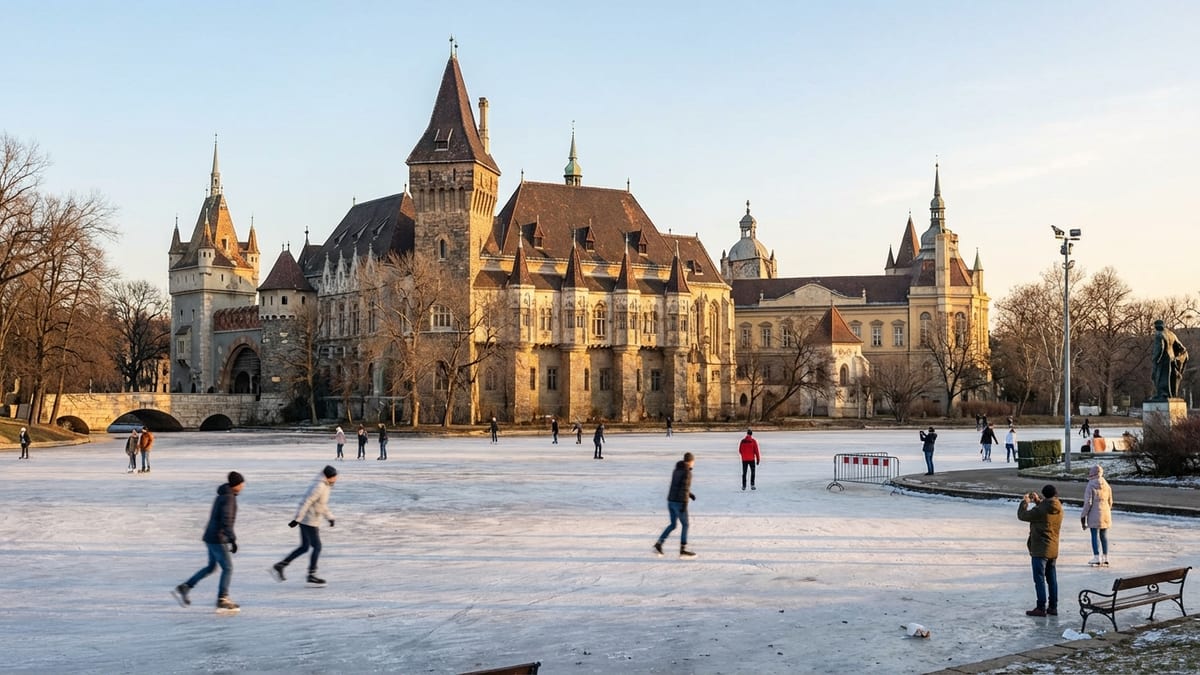
I arrived at Vajdahunyad Castle with my expectations shaped by Instagram shots and a few breathless blog posts describing it as a “fairytale castle in the middle of Budapest.” After a couple of visits in different seasons and at different times of day, I feel I understand the place well enough to be honest about it.
Parts of it did feel dreamy, especially at golden hour by the lake, and wandering the courtyard at night was unexpectedly atmospheric. Other aspects, though, felt overhyped, slightly confusing, and more like a pleasant park detour than a destination you build your whole day around. If you are trying to decide whether it is worth your time, my honest answer is: it depends what you expect from a “castle” and how you plan your visit.
First Impressions: A “Fake” Castle That Still Charms
My first glimpse of Vajdahunyad Castle came as I walked through City Park from Heroes’ Square, and it really did look like something lifted from a storybook. The towers and turrets appear suddenly behind the trees, reflected in the lake, with the ice rink or boats depending on season. Knowing it was built only in the late 19th and early 20th century for Hungary’s millennial celebrations, and then rebuilt permanently because people loved it, changed the way I saw it. This is not a medieval fortress with battle scars. It is an architectural collage: Romanesque, Gothic, Renaissance and Baroque styles stitched together on purpose, like a three-dimensional postcard of Hungarian architecture.
At first I was a little disappointed by that “fake castle” label. I had come in with a vague expectation of some dramatic historical stronghold. Instead I got a beautifully designed showpiece, essentially a themed exhibit that got out of hand and stayed. Once I accepted that, I started to appreciate the details: carved stone portals, tiny balconies, whimsical rooflines, and the way each wing references a different historic building from inside Hungary and neighboring regions.
The surroundings help a lot. In winter, the huge City Park Ice Rink spreads out in front of the castle, and gliding or at least shuffling across the ice with the illuminated facade behind you is genuinely magical. In warmer months, the same space is filled with water and rowboats, which makes the whole setting gentler and more romantic. My first impression, therefore, was mixed but generally positive: my history-nerd side felt a bit shortchanged, but my photographer’s eye was happy.
Practicalities: Opening Hours, Access and What Is Actually Free
On a practical level, Vajdahunyad Castle is straightforward to reach and surprisingly flexible to visit. The castle sits right in City Park, a short walk from Heroes’ Square. I used the M1 metro (the old yellow line) and got off at Hősök tere or Széchenyi fürdő, both of which are about a five to ten minute walk through the park. Several buses and trolleybuses also stop nearby, so access is not an issue even if you are staying on the Pest side further south.
The main thing that confused me initially was what people mean by “visiting the castle.” The courtyards and exterior are free, and they are open essentially all day. The faux gate is not locked, so you can wander through the grounds early in the morning or late at night, which I did more than once. That part really is no-cost sightseeing, and you can get most of the classic views without paying a forint. Only when you want to go inside the museum spaces or up the towers do you need a ticket.
The castle houses the Museum of Hungarian Agriculture, which currently keeps typical Hungarian city-museum hours. When I checked, the pattern was consistent: closed on Mondays, open Tuesday to Sunday from about 10:00 to 17:00 in the main season, with slightly shorter hours in winter. Last entry is usually thirty minutes before closing, which caught me out once when I showed up too close to the end of the day and had to rush. Ticket prices for the museum itself are still on the affordable side by European capital standards, roughly the equivalent of a few euros for adults, with discounts for students and seniors and free entry for small children.
There are separate or combined tickets if you want to climb the Gatehouse Tower or the Apostles’ Tower, and these have slightly different hours again, generally starting at 9:00 or 10:00 and stopping by late afternoon. I found the information fragmented across different sources, and it did not always match signage on-site, so if climbing towers is a priority, I would double check the latest details the week you travel and aim to come in the middle of the day rather than close to opening or closing.
The Courtyards and Architecture: Great Photos, Limited Depth
The free-access courtyards are where I spent most of my time, and where I think many visitors get their strongest impressions. Walking through the gate into the main courtyard, you are immediately surrounded by buildings that look like they have been assembled from four different eras. One side recalls a fortified Gothic stronghold, another mimics a Renaissance palace, and tucked into one corner is a Romanesque-style church based on the Jak Chapel. It feels theatrical, deliberately picturesque rather than organically evolved.
This is both a strength and a weakness. On one hand, it is a photographer’s playground. Every corner has a new angle, a new archway framing the lake, or a sculpted relief artfully weathered enough to look older than it is. I happily spent an hour just wandering, taking photos and sitting on benches watching tour groups flow through. On the other hand, if you are looking for a historically coherent story, you will not find it easily in the courtyard alone. There are plaques and a bit of context, but not a strong narrative that ties everything together for a casual visitor.
I also noticed how quickly the illusion breaks once you start looking at materials and details up close. Some facades feel less refined, some repairs are quite obvious, and it becomes clear this is a late 19th century fantasy of medieval and Renaissance Europe, not an original structure. That bothered me a little when I compared it to truly old castles elsewhere in Hungary and Central Europe. At the same time, I reminded myself that this was built as a celebratory project, not a defensive one. Viewed that way, the architectural mash-up becomes more like a cultural exhibition in stone, and I found it easier to appreciate.
The statues scattered around the grounds deserve a mention, particularly the hooded “Anonymous” statue of the chronicler. It has become one of those obligatory photo stops, with tourists rubbing the pen for luck. I found the sculpture genuinely striking, and standing in front of it in a quiet moment early one morning gave me more of a sense of Hungary’s literary and historical traditions than much of the castle facade did.
Inside the Museum: Interesting, But Not Essential for Everyone
On my second visit, I bought a ticket to the Museum of Hungarian Agriculture inside the castle to see whether the interior was worth the time. The museum is extensive. It covers everything from traditional farming tools and rural life to hunting, forestry and fishing, with many rooms laid out in a fairly classic, object-heavy museum style. If you are deeply interested in agricultural history or Central European rural culture, this will be a satisfying and surprisingly comprehensive stop.
For me, as someone mildly interested but not an expert, the experience was mixed. Some rooms had engaging displays and decent English explanations. I enjoyed the sections on traditional Hungarian breeds and folk customs, and a small hunting exhibit had impressive taxidermy and historical weapons. Other parts, though, felt old-fashioned and dense, with long panels of text and glass cases filled with similar items. I found my attention fading after about an hour, which is longer than many casual visitors are likely to spend.
From a purely visual standpoint, the interiors offered a few nice surprises. Certain staircases and halls are architecturally impressive, and occasional views out of the windows into the courtyard remind you that you are inside this unusual composite castle. However, there are also plenty of corridors and rooms that feel more like a generic museum than a unique palace. If you are short on time in Budapest, I would not say the museum is a must-do unless the topic strongly appeals to you or the weather drives you indoors.
One frustration I had was the lack of a clear, concise route or highlight map for visitors who just want the essential rooms. It is easy to get lost in the maze of halls and end up backtracking. If I went again, I would set aside a defined block of time, say ninety minutes, and be comfortable skipping sections that do not immediately catch my interest instead of dutifully walking past every case.
Towers, Views and Seasonal Atmosphere
Climbing at least one of the towers was the highlight of my paid visit. The Apostles’ Tower, in particular, rewards you with wide views over City Park, the lake, and even as far as Gellért Hill and Buda Castle on a clear day. The climb itself is reasonably demanding, with a narrow spiral staircase and about 150 steps, so it is not suitable for everyone. Once upstairs, though, the panorama really helps you place Vajdahunyad Castle in the broader landscape of Budapest. I could see Heroes’ Square, the Széchenyi Baths, and the green canopy of the park stretching out in every direction.
The Gatehouse Tower is less demanding and more accessible, and for many visitors it will be enough. I did find, however, that the information about tower opening times and combined tickets was inconsistent between brochures, websites and on-site signs. On one day the Apostles’ Tower was closed without much explanation. On another, an advertised tour time did not seem to materialize. It felt a bit ad hoc, which is worth bearing in mind if you are squeezing this visit into a tight schedule.
Seasonally, Vajdahunyad Castle shifts its personality. In winter, the City Park Ice Rink in front of the castle is one of the largest outdoor rinks in Europe, and skating there in the late afternoon as the lights come on is one of those experiences that actually lives up to the photos. The castle becomes a backdrop rather than the main event, and in some ways that is when it works best. I noticed that contactless payments and online booking have become more standard at the rink, but deposits for skate rental may still require cash, so I made sure to carry some Hungarian forints.
In summer, the ice rink turns back into a lake and you can rent small boats or paddle craft and circle past the castle walls. This is less dramatic than skating but more peaceful, and on a warm evening it is a pleasant way to unwind. Around the castle grounds, pop-up festivals, food stalls or small concerts sometimes take over parts of the courtyard, especially on weekends. That can add to the atmosphere, but it can also mean noise, crowds and limited access to certain viewpoints. On one visit an event setup blocked what I knew would have been one of the best photo angles across the bridge, which was frustrating.
Crowds, Expectations and Where Reality Falls Short
Vajdahunyad Castle is not as overwhelmed by tourism as the Parliament building or Fisherman’s Bastion, but it is hardly a secret. Midday in peak season, the central courtyard is busy with tour groups, school trips and visitors taking the same three or four popular photos. If your mental image is of strolling quietly through empty cobbled passages, you will probably be disappointed. I had the best experiences early in the morning on a weekday and later in the evening, when I could walk around almost alone, especially in shoulder seasons.
One point where reality fell short of my expectations was in the level of storytelling and context for individual visitors. Given how deliberately the castle combines multiple architectural periods and references different historic buildings, I had hoped for more accessible information that pulled everything together. Instead, I found bits and pieces scattered here and there: a sign about this facade, a short panel about that chapel. It is all correct, but it is more fragmented than inspiring unless you already know the references.
Another mild disappointment concerned maintenance and small details. While the overall effect from a distance is still impressive, closer up I noticed peeling paint, slightly worn surfaces, and the occasional feeling that certain corners had not seen much attention in a while. It did not ruin my visit, but given how visually driven the attraction is, those small signs of neglect stood out. I also had to dodge a few informal photo shoots and wedding sessions which sometimes treated the most scenic spots as if they were their private studio.
All of that said, I still think many online descriptions oversell the “fairytale” element while glossing over the fact that this is effectively a replica castle designed as a national showcase. If you arrive expecting something like a smaller version of Buda Castle or a true medieval fortress, you might leave underwhelmed. If you frame it as a creative park-side monument with strong visual appeal and a niche museum tucked inside, it feels more honest and satisfying.
Fitting Vajdahunyad Castle Into a Budapest Itinerary
In practical terms, the question for most travelers is not just “is Vajdahunyad Castle worth visiting?” but “is it worth my limited time in Budapest?” For me, the answer became clearer when I looked at the surrounding area as one connected experience rather than isolating the castle on its own. City Park is home to several major sights: Széchenyi Thermal Bath, the Budapest Zoo, Heroes’ Square, and the ice rink or boating lake. It is easy to combine a walk around the castle with one or two of these in a single half day.
On my most satisfying visit, I took the M1 out in the late afternoon, walked through Heroes’ Square into the park, did a slow lap around Vajdahunyad Castle’s courtyards and lakeside paths, climbed a tower, then headed to Széchenyi Baths for an evening soak. In winter, I swapped the baths for an evening skating session in front of the castle. In both cases, the castle was a scenic highlight and a pleasant place to linger, but not the sole focus of the outing.
If I were short on time in Budapest, I would not feel guilty about experiencing the castle only from the outside as I cut through the park. The fact that the courtyards are open all day and free makes it a very low-risk addition to your route. You can decide on the spot whether to buy a museum ticket or climb a tower based on your energy level and the weather. That flexibility is one of its biggest strengths.
Looking back, I would not repeat my first visit exactly as I did it, when I devoted a large part of my day specifically to the castle and museum alone. It was simply too much time for what is, at heart, a secondary attraction in a city full of world-class landmarks. The experience improved dramatically once I treated it as part of a broader City Park wander rather than a must-see in isolation.
The Takeaway
After spending real time there in different seasons, my overall verdict is that Vajdahunyad Castle is worth visiting for most travelers, but more as a scenic backdrop and an atmospheric park landmark than as a stand-alone headline attraction. Its strengths lie in its visuals, its flexibility and its setting beside the lake, ice rink and City Park greenery. The fact that the grounds are free and accessible nearly all day makes it an easy add-on, and at certain moments, especially at dusk or with the winter lights reflecting on the ice, it can feel genuinely magical.
At the same time, you need to adjust your expectations. This is a relatively modern, purpose-built “greatest hits” of Hungarian architecture rather than an authentic medieval fortress. The museum inside is large and earnest but somewhat old-fashioned, and it will not appeal equally to everyone. Information can be scattered, tower access occasionally inconsistent, and at busy times the courtyard feels more like a stage set for photos than a place to quietly absorb history.
Who is it best for? If you are a photographer, a casual architecture enthusiast, or someone who enjoys atmospheric city walks, Vajdahunyad Castle is a very rewarding stop, especially combined with Széchenyi Baths or ice skating or boating on the lake. Families will appreciate the open courtyards, space for kids to wander, and the proximity to the zoo and playgrounds in the park. Budget-conscious travelers will like that the most iconic views cost nothing at all.
If you are primarily a history purist, or if your time in Budapest is extremely limited, you might want to prioritize the Parliament, Buda Castle district, and other core sites first. In that scenario, I would still recommend a quick detour through City Park if you happen to be nearby, but I would not stretch your schedule just to see Vajdahunyad Castle. Approached with realistic expectations and slotted sensibly into a wider day in City Park, though, it can absolutely justify its place on your Budapest list.
FAQ
Q1. Is Vajdahunyad Castle free to visit?
The exterior courtyards and grounds are free to visit, and you can walk through them at almost any time of day. You only need to pay if you want to enter the Museum of Hungarian Agriculture or climb the towers.
Q2. What are the current opening hours for the museum inside Vajdahunyad Castle?
When I checked most recently, the Museum of Hungarian Agriculture was open from around 10:00 to 17:00 from Tuesday to Sunday, with shorter winter hours and closure on Mondays. Last entry is generally about 30 minutes before closing, so it is best not to arrive right at the end of the day.
Q3. How do I get to Vajdahunyad Castle from central Budapest?
The easiest way is to take the M1 metro line to Hősök tere or Széchenyi fürdő, then walk through City Park for five to ten minutes. Several buses and trolleybuses also stop at Heroes’ Square, and from there the castle is a short stroll.
Q4. Is it worth going inside the Museum of Hungarian Agriculture?
It depends on your interests. If you enjoy museums and have an interest in rural life, farming history or hunting, you may find it worthwhile. If you are short on time or only mildly curious, the free exterior and a tower climb will likely give you enough of an experience.
Q5. Are the towers at Vajdahunyad Castle worth climbing?
Yes, especially the Apostles’ Tower if it is open during your visit. The climb is quite steep but the views over City Park and across Budapest are impressive. Just be aware that hours and tour times can vary, so I would check on-site early in your visit.
Q6. When is the best time of day to visit Vajdahunyad Castle?
Early morning and late afternoon or early evening are the most enjoyable. The light is softer for photos, the courtyard is less crowded, and at dusk the castle reflected in the lake or ice can look genuinely dreamy.
Q7. How long should I plan to spend at Vajdahunyad Castle?
If you are only exploring the outside and taking photos, 45 to 90 minutes is usually enough. If you also plan to visit the museum and climb a tower, you could easily spend two to three hours, especially if you combine it with a walk through City Park.
Q8. Is Vajdahunyad Castle suitable for children and strollers?
The courtyards and park paths are largely stroller-friendly and children often enjoy the open space and the lakeside setting. The towers, with their narrow staircases, are not suitable for strollers and can be challenging for very young kids.
Q9. How does Vajdahunyad Castle compare to Buda Castle?
Buda Castle is a historic royal complex with major museums and panoramic views of the Danube, and it feels much more central to Budapest’s story. Vajdahunyad Castle is smaller, newer and more like a romantic architectural showcase in a park. I found it charming but less essential than Buda Castle.
Q10. Should I visit Vajdahunyad Castle in winter or summer?
Both seasons have strong points. In winter, the ice rink in front of the castle creates a truly memorable scene and skating there is a standout experience. In summer, the boating lake and green park surroundings make it perfect for a relaxed walk. If you love winter atmospheres and do not mind the cold, I would give a slight edge to a winter visit.