

When I first started comparing Budapest’s thermal baths, I kept hearing two very different narratives. Lukács Baths came up again and again as a “local classic” with serious medical credentials and a bit of old-school grit. Veli Bej Bath, on the other hand, was whispered about as a “secret Turkish bath” hidden inside a hospital complex, smaller, more atmospheric, and far less touristy.
I decided to test both on the same trip, paying close attention to the details that actually matter when you have limited time, a mid-range budget, and a low tolerance for chaotic crowds. What I found is that Veli Bej really is a hidden gem in some ways, but the story is more nuanced than the simple classic-versus-secret cliché.
First Impressions: Classic Institution vs Hidden Courtyard
Walking up to Lukács Baths, I felt like I was arriving at a serious, almost institutional spa complex. The frontage is mid-century rather than fairy-tale, the signage clear, and there is no sense of mystery about where to go. The lobby is functional and a little worn, with the kind of tiled floors and fluorescent lighting you expect from a place that is part medical facility, part public bath. It immediately communicated one thing: this is for people who come here regularly, not for people chasing perfect Instagram photos.
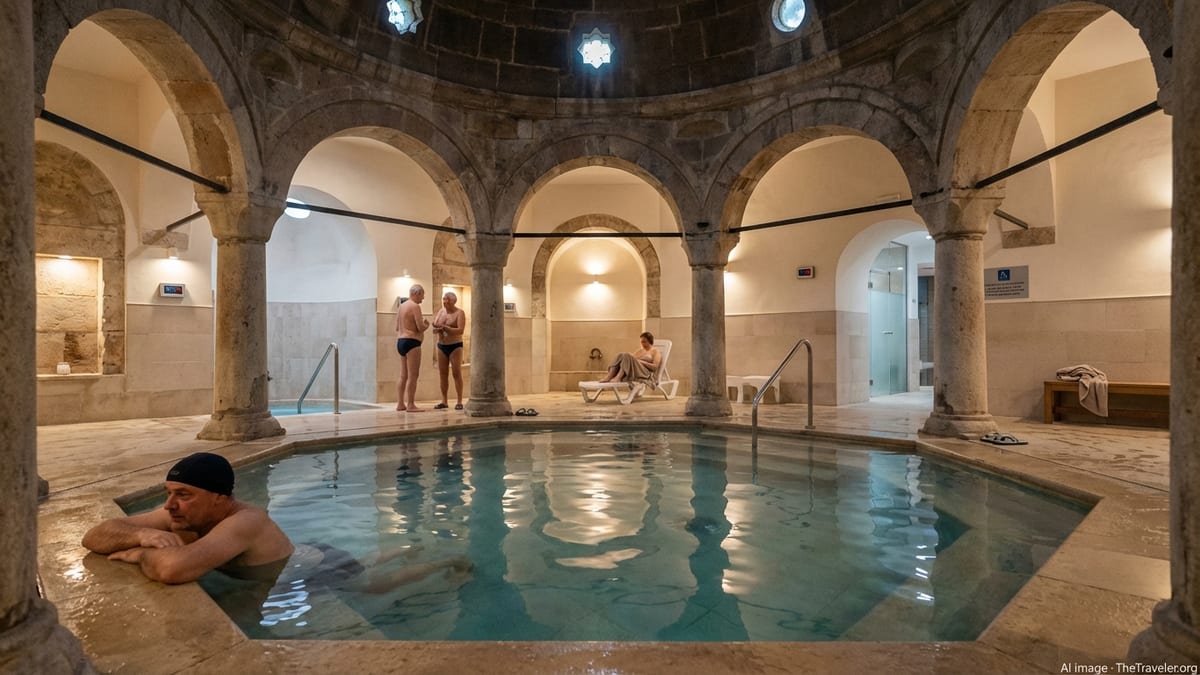
Veli Bej, by contrast, is tucked into a larger white building that doubles as a hospital and a hotel, a little removed from the main street. I actually walked past the entrance once, because there is no grand façade shouting “historic thermal bath, tourists this way.” Stepping into the reception area felt like pushing through a side door into a secret. It was quieter, smaller, and far more understated. Only when I reached the inner dome hall, with the octagonal central pool under stone arches and a starry ceiling, did it hit me that this was a 16th century Ottoman bath restored with a modern spa layout wrapped around it.
Subjectively, Veli Bej made the stronger visual impression. The central Turkish dome, the stone, and the softened artificial light create an immediate sense of calm. Lukács took longer to charm me. The outer pools and plaques of healing testimonials are what gradually give it personality. If you want that immediate “wow, this is special” moment, Veli Bej delivers it the second you step under the dome. Lukács needs a bit of context and patience.
Practicalities: Opening Hours, Booking, and “Will I Even Get In?”
Before I went, I assumed the bigger, more famous Lukács would be harder to navigate. In reality, Lukács is the more straightforward option for most travelers. It operates like a standard Budapest bath: daily opening hours broadly around 7 am to 7 pm, with some evenings extended to 8 pm on certain weekdays, and ticketing that allows you to stay all day. I could buy a locker or cabin ticket at the counter or online, and if I had a Budapest Card I could have walked in for free, which is a rare and generous perk in the city’s bath scene.
Veli Bej, on the other hand, runs on a much more restrictive schedule and structure. It is open in two distinct blocks most days: a 6 am to 12 pm morning session and a 3 pm to 9 pm evening session, with a fixed closure from 12 pm to 3 pm for water exchange and cleaning. On some weekdays it only opens in the afternoon. Each ticket is strictly for a three-hour stay, no full-day options, and capacity is capped at around 80 people. There is no online booking: you buy your ticket at the cashier, and if the bath is full you are handed a number and asked to wait. I saw people turned away or told to come back later.
From a decision-making standpoint, this matters more than it seems on paper. With Lukács, I could slot a bath visit into almost any day, arrive mid-morning or mid-afternoon, and know I would be able to get in. With Veli Bej, I had to plan a specific time window, respect the midday shutdown, and accept that if I arrived right at a busy time there might be a wait. The payoff is intimacy and quiet, but it does demand more scheduling discipline. If your time in Budapest is short, or you hate rigid time slots, Lukács is less risky.
Price, Value, and What You Actually Get for Your Forints
Both baths sit below the top-tier prices of Széchenyi or Gellért, but the way they structure value is very different. At Lukács, I paid for a standard day ticket with a locker, roughly in the 7,000 to 8,000 HUF range depending on weekday or weekend, which matches recent pricing trends across Budapest’s municipal spas. There are cheaper student and afternoon tickets during the last two hours on weekdays, and the Budapest Card can get you in for free. In practical terms, that meant I could turn up late morning, leave for lunch nearby, and return if I wanted, or simply lounge around the pools for as long as I liked within opening hours.
At Veli Bej, prices sit between roughly 5,700 and 7,200 HUF depending on day and time slot, which on paper looks cheaper. The catch is that those three hours tick away quickly once you factor in showering, changing, and just settling in. There are no discounted student or senior tickets, and if you overstay, an extra per-minute fee applies. When I did the math afterward, my per-hour cost at Veli Bej was actually higher than what I ended up paying per hour at Lukács, simply because I could stretch Lukács out over nearly a full day if I chose to.
In terms of add-ons, I found Lukács’ pricing to be more flexible. The sauna world is a modest extra fee, massages are competitively priced by Budapest standards, and there is a range of services from basic aroma massage to more medically oriented treatments. Veli Bej also offers massages, and the prices are relatively reasonable for a small, atmospheric spa. But here again, the three-hour limit shaped my behavior. I hesitated to book a longer massage at Veli Bej because I did not want half my thermal time eaten by a treatment in a separate room. At Lukács, a 20-minute massage felt like a small detour in a long day, not a major chunk of my visit.
Crowds, Atmosphere, and How Peaceful It Really Feels
If your main question is “Which one is quieter and more atmospheric right now?”, then my experience was very clear. Veli Bej is the more tranquil of the two. The capacity cap, the smaller footprint, and the fact that it operates within a hospital complex all work in its favor. When I visited during a weekday afternoon session, there was a soft murmur of conversation, but no chaotic shouts, no tour groups, and no stag parties. The demographic leaned toward locals, a few foreign visitors who had clearly done their research, and people who looked like regulars on doctor-prescribed regimes.
Lukács was never what I would call unmanageably crowded, but it was certainly busier and more varied. In the outdoor pools, I shared space with serious lane swimmers, older Hungarians doing slow therapeutic exercises, backpackers soaking and chatting, and people sunning themselves on the loungers and terraces. The indoor thermal section was calmer, but at peak times the pools could feel a little packed. I needed to hunt for a quiet corner or aim for earlier or later hours to find the same level of stillness that Veli Bej offered almost by default.
One downside of Veli Bej’s intimacy is that any inconsiderate behavior is more noticeable. In a small domed hall, one loud conversation or a group treating it like a social club can cut through the quiet. I did not personally experience anything too disruptive, but I could see how a couple of noisy guests would instantly change the mood. Lukács, spread over multiple indoor and outdoor zones, gave me options. If one pool felt too lively, I could migrate to another or retreat to the sauna world.
Facilities, Comfort, and the Small Details That Make or Break a Visit
In terms of pure thermal experience, both baths are strong, but they excel in different ways. Veli Bej’s central dome with five thermal pools at slightly different temperatures, plus a small swimming and hydrotherapy pool, sauna, and steam room, feels compact and thoughtfully organized. I appreciated that I could see almost everything from the central space, and it was easy to move between hot and cooler pools without getting lost. The restoration work means surfaces are clean, with modern tiles and lighting that still honor the historic arches and stonework.
Lukács offers more variety and more of a campus feel. There are multiple indoor thermal pools, two outdoor swimming pools, and an outdoor adventure pool. The medical heritage is very present: I saw weight-bath setups, physiotherapy sections, and signs for curative treatments that made it clear this is not designed primarily as a tourist playground. That said, the wellness area with saunas and the outdoor pools offer a more conventional spa-day feel. The tradeoff is that the complex layout can be confusing if you arrive without a mental map: I wandered in circles more than once trying to relocate a specific pool I had liked earlier.
Comfort-wise, neither bath is luxury in the high-end hotel spa sense, but I found Veli Bej slightly more polished in the immediate changing and shower areas. The compact size means less walking around wet and lost. At Lukács, the changing rooms and showers do show their age in spots, with some locker rooms feeling more utilitarian than cozy. Nothing was dirty or unacceptable, but if you are expecting the polished, scented-candle aesthetic, neither bath will fully deliver. These are working thermal institutions first.
Location, Transport, and How Each Fits into a Day in Budapest
Both Veli Bej and Lukács sit on the Buda side of the Danube, in the same general area, which makes them relatively easy to combine with visits to Margaret Island or the riverside promenades. Lukács has the edge in straightforward access and neighborhood feel. It sits just off a main avenue, with trams and buses stopping nearby, and you can be at the Danube embankment in a short stroll. After my soak, I walked down toward the bridge and found plenty of cafés and casual restaurants for a late lunch or coffee.
Veli Bej is only a short walk from Lukács in practical terms, but because it is embedded in the hospital and hotel complex, it feels more hidden. The signage is improving, but it is still possible to second-guess yourself on the way in. The upside is that the surrounding area is surprisingly rich in side trips: Margaret Island is close, and there are historic Ottoman sites and even underwater cave entrances in the broader neighborhood. If you want to make a day around quieter, more local-feeling parts of Buda, basing yourself around Veli Bej does make sense.
For me, the bigger location factor was how each visit slotted into my broader schedule. Lukács worked well as a “half lazy day” activity: I went mid-morning, soaked, lounged in the sun, had a snack, and only left when I genuinely felt done. Veli Bej, because of the strict three-hour window, pushed me to design my day around that slot. I found myself checking the time more than I wanted. If you thrive on structure and like clear, bounded experiences, that might even be a plus. If you want slow, unscheduled days, Lukács is more forgiving.
Rules, Age Limits, and Who Each Bath Really Suits
Both Veli Bej and Lukács are mixed-gender and require proper swimwear, plus flip-flops and a towel or robe. Rentals are available at both, but I would bring my own towel to avoid extra costs and sometimes disappointing rental quality. Where they differ significantly is in who they actually welcome and how family-friendly they are.
Veli Bej enforces a strict age limit: children under 14 are not allowed at all. The bath exists partly as a therapeutic facility for adults, and the atmosphere reflects that. If you are traveling with younger children, this is simply not an option. Even for older teens, the tone is clearly adult and quiet. Lukács, while not primarily a family aqua-park, is far more accommodating. You will see a mix of ages, and the outdoor pools in particular can have more energy. For multi-generational trips or families with older kids who can behave considerately, Lukács is the better fit.
Another subtle but important difference is cultural attitude. At Veli Bej, the combination of locals on medical routines and the small capacity creates a more serious, almost meditative environment. People talk, but they tend to do so softly. At Lukács, I felt more comfortable chatting with friends at normal volume, and it seemed widely accepted that not everyone was there strictly for curative reasons. Neither place has the party vibe you sometimes see at Széchenyi’s summer nights, but Lukács is more socially flexible.
Real Decision Moments: How I Actually Chose Between Them
The first big decision I had to make was where to go on my limited first full day in Budapest. I was dealing with mild travel fatigue, a tight budget, and only one guaranteed free afternoon. I chose Veli Bej for that slot because I wanted quiet more than variety, and the reputation as a “secret Turkish bath” appealed to me. In hindsight, I am glad I did it that way. Those three hours under the dome, moving between warm and hot pools, were exactly the reset I needed. The time limit forced me to fully disconnect from my phone and the outside world. The downside was that when my three hours were up, I could not justify paying for another session, so that was it.
The second decision came a few days later when a rainy forecast ruined my plan for an outdoor walking day. I weighed returning to Veli Bej against trying Lukács. This time, the deciding factor was flexibility. I wanted somewhere I could linger without a clock ticking in my head, maybe grab a light bite, maybe read a book on a lounger if the weather cleared. Lukács won that round. I spent most of an entire day coming and going between pools and terraces, and while the setting was less magical than Veli Bej’s dome, the freedom of not counting down three-hour blocks felt liberating.
The third decision was about whether to pay extra for add-ons. At Veli Bej, I skipped the massage even though the prices were appealing. I simply did not want to surrender a full hour of my limited thermal time to a treatment room. At Lukács, with the time pressure lifted, I booked a short 20-minute massage on the spot. It was not the most luxurious massage I have ever had, but the price-to-relaxation ratio felt fair. That small choice highlighted the core tradeoff: Veli Bej concentrates quality into a defined window, while Lukács lets you stretch your experience into a full slow day.
The Takeaway
After testing both Veli Bej and Lukács Baths back to back, I do think Veli Bej earns the “hidden gem” label, but only if you understand what kind of gem it is. It is not hidden because it is unknown anymore; it is hidden because of its physical location inside a hospital complex, its limited capacity, and its refusal to play the mass-tourism game with online booking and open-ended day tickets. When you manage to line up the schedule and slip inside, you get a compact, beautifully restored Ottoman dome, a quiet, mostly local crowd, and a feeling of stepping out of time for a few hours.
Lukács, for all its slightly scruffy corridors and functional aesthetics, remains a classic Budapest spa with real depth. It is more practical, easier to access, and kinder to loose itineraries. The outdoor pools and medical heritage give it a unique character that does not translate well into glossy photos but feels authentic in person. If you want a thermal day that can expand or contract around the weather, your energy, and spontaneous decisions, Lukács simply works better.
So which would I choose if I could only visit one? If I were visiting Budapest for the first time, on a tight schedule, and wanted a single, iconic but still relatively affordable bath, I would pick Lukács. The all-day structure, the free entry with Budapest Card, and the variety of pools make it easier to recommend to most travelers, including couples, solo visitors, and families with older kids. I would save Veli Bej for a second or third visit, or for travelers who know they want a quieter, more contemplative experience and are willing to work around the three-hour sessions and possible waiting list.
If I return, I will do it differently. I would book a morning or early afternoon at Veli Bej on a weekday, when the prices are slightly lower and the mood is at its calmest, then plan an unhurried day at Lukács on a separate date. Used this way, the two baths complement each other beautifully: Veli Bej for focused, atmospheric restoration, and Lukács for a slower, more expansive day of soaking into the rhythm of Budapest itself.
FAQ
Q1: Which bath is better if I only have time for one, Veli Bej or Lukács?
If you want maximum flexibility, an all-day experience, and a good balance of locals and visitors, I would choose Lukács. If you value a quieter, more intimate atmosphere and do not mind planning around a strict three-hour session, Veli Bej can be more special.
Q2: Do I need to book in advance for either Veli Bej or Lukács?
For Lukács, you can usually just walk in, and online tickets are also available, which helps on busy days. Veli Bej does not offer online booking at all; you must buy in person, and because of the small capacity, you may have to wait if it is already full.
Q3: How much do the baths cost, roughly?
At Lukács, expect to pay around the mid-thousands of forints for a weekday day ticket, with weekends a bit higher and discounts for students, afternoons, and Budapest Card holders. Veli Bej’s three-hour tickets sit in a similar band but vary by time slot and day, and there are no student or senior discounts.
Q4: Which bath is less crowded?
In my experience, Veli Bej was consistently calmer, thanks to its strict capacity limit and smaller footprint. Lukács can get busy, especially in the outdoor pools and during prime hours, but it is still less chaotic than the biggest tourist baths in Budapest.
Q5: Are either of the baths suitable for children?
Lukács is more suitable if you are traveling with older children or teens who can respect the quiet areas. Veli Bej is adults-only in practice, as children under 14 are not allowed, and the atmosphere is very much oriented toward adult relaxation and therapy.
Q6: What should I bring with me?
I recommend bringing a swimsuit, flip-flops, and a towel for both baths. You can rent towels on site, but rentals can be basic and add to the cost. A light robe or cover-up makes moving between pools more comfortable, especially in cooler months.
Q7: How easy is it to get to each bath by public transport?
Both baths are on the Buda side and are reachable by tram and bus. Lukács is slightly easier to spot and reach from the main avenue, while Veli Bej is tucked inside a hospital and hotel complex, so you may need to pay closer attention to signs or directions the first time.
Q8: Can I spend a full day at Veli Bej?
Not in the way you can at Lukács. Veli Bej sells only three-hour tickets and closes every day from midday to mid-afternoon for water exchange. You can book multiple sessions, but you will have to leave and re-enter, and the cost and logistics make it less practical for an all-day stay.
Q9: Which bath feels more “authentically local”?
Both are strongly local in different ways. Lukács feels like a long-standing city institution where people come for swimming, therapy, and routine wellness. Veli Bej feels like a quieter, more secret spot used by locals on medical prescriptions and in-the-know visitors. If you want fewer tourists and a more hushed tone, Veli Bej wins.
Q10: If I am on a tight budget, which bath offers better value?
On a strict per-hour basis, Lukács usually works out better value because you can stay all day, especially with student or afternoon discounts or a Budapest Card. Veli Bej’s ticket price is reasonable, but the mandatory three-hour limit and lack of discounts narrow the value gap, so it is best if you know you will fully use and appreciate that focused time.